Researchers at China Mobile Research Institute and Peking University have demonstrated a new approach to multi-qubit entanglement, generating a 5-qubit Greenberger-Horne-Zeilinger state at a rate of 688 Hz with a fidelity of 0.956 ± 0.053. The team achieved this level of entanglement using only two ququarts, reducing the physical-mode overhead from exponential to linear under certain circumstances, potentially accelerating large-scale quantum systems. This programmable integrated-photonic entanglement generator, fabricated on a silicon chip, encodes and processes quantum circuits within these ququarts, and successfully verifies quantum teleportation and phase estimation. The published findings indicate this scheme reduces the physical-mode overhead from exponential to linear under certain circumstances, potentially accelerating large-scale quantum systems.
Ququart Encoding Scheme for Multi-Qubit Entanglement
A novel approach to multi-qubit entanglement utilizing a new encoding scheme challenges conventional wisdom regarding scalability in quantum computing. Researchers report encoding up to five qubits within just two ququarts, a significant reduction in the physical resources typically required. This achievement, detailed in Communications Physics, centers on sequentially generating quantum correlations on a single particle, offering a potentially more streamlined path toward larger, more complex quantum systems. The fidelity of this 5-qubit entangled state reached 0.956 ± 0.053, a measurement indicating the robustness and reliability of the entanglement itself, critical factors for practical applications in quantum computing and communication protocols. Within a single ququart, the researchers successfully generated high-fidelity 3-qubit W and Greenberger-Horne-Zeilinger states, and verified the functionality of quantum teleportation and phase estimation, showcasing the versatility of the scheme.
The authors note they are providing an unedited version of this manuscript to give early access to its findings, indicating their commitment to open dissemination of this research. Funding for the project was provided by multiple sources including the Innovation Program for Quantum Science and Technology [2021ZD0301500] and the National Key Research and Development Program of China [2019YFA0308702], underscoring the growing investment in quantum technologies within the region.
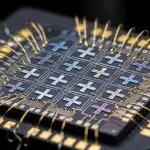
The pursuit of scalable quantum computing has long been hampered by the difficulty of creating and maintaining entanglement between multiple qubits; current methods often demand an exponential increase in physical components as qubit numbers rise. However, a team at China Mobile Research Institute and Peking University has demonstrated a novel approach using integrated photonics to generate and process multi-qubit entanglement within what they term “ququarts,” reducing the physical-mode overhead from exponential to linear under certain circumstances. Their work, detailed in Communications Physics, focuses on encoding quantum information using fewer physical modes than previously thought necessary. Central to their innovation is a programmable silicon chip capable of generating a 5-qubit entangled state at a rate of 688 Hz. This pulse frequency suggests the potential for applications extending beyond laboratory demonstrations, hinting at real-time quantum processing capabilities. The researchers achieved a fidelity of 0.956 ± 0.053, which is crucial for maintaining the integrity of quantum computations and communications. Notably, the team utilized only two ququarts to encode the 5-qubit entanglement, a significant reduction in physical complexity.

See today’s quantum computing news on Quantum Zeitgeist for the latest breakthroughs in qubits, hardware, algorithms, and industry deals.