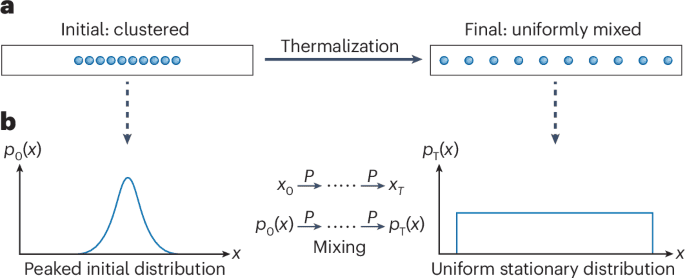
A subscription to Nature+ offering access to Nature and 54 other Nature Portfolio journals is currently available for £17.99 for a 30-day trial, with cancellation at any time, as researchers address a key weakness hindering the full potential of quantum simulation. While quantum algorithms excel at modeling how systems evolve over time through Hamiltonian dynamics, they have historically struggled to reliably prepare the crucial thermal equilibrium states needed to begin those simulations. Now, Anirban Chowdhury of IBM Research reports demonstrating an algorithm capable of efficiently preparing an important class of these thermal states, a step toward more complete quantum modeling. Chowdhury explains the significance of this advancement. A print and online subscription to this journal costs £169.00 per year, or £14.08 per issue.
Quantum algorithms, while proficient at simulating how systems evolve over time via Hamiltonian dynamics, have historically faced challenges in establishing the initial conditions for these simulations; specifically, preparing the thermal equilibrium states necessary to accurately model real-world phenomena. This advancement is significant because preparing these states has been a persistent bottleneck, despite the established strengths of quantum approaches in simulating the dynamics themselves. Access to the research detailing this algorithm, and the wider body of work published in Nature Physics, is available through a Nature+ subscription, currently priced at £17. A full year’s print and online subscription to the journal costs £169.00, equating to £14.08 per issue, offering researchers a comprehensive resource for staying abreast of developments in the field. This efficient preparation of thermal states promises to broaden the scope of quantum simulations, enabling more accurate modeling of complex physical systems.
This advancement is particularly significant because achieving thermal equilibrium is fundamental to modeling complex physical systems, and previous methods often proved computationally expensive or impractical for larger simulations. Chowdhury’s work builds upon established theoretical foundations in statistical physics and Markov chains, referencing studies by Rouzé and Stilck França, as well as earlier work by Barahona dating back to 1982. The ability to rapidly and accurately prepare thermal states unlocks new possibilities for quantum simulation, potentially accelerating discoveries in materials science, drug design, and fundamental physics, and represents a key step toward realizing the full potential of quantum computing.




See today’s quantum computing news on Quantum Zeitgeist for the latest breakthroughs in qubits, hardware, algorithms, and industry deals.