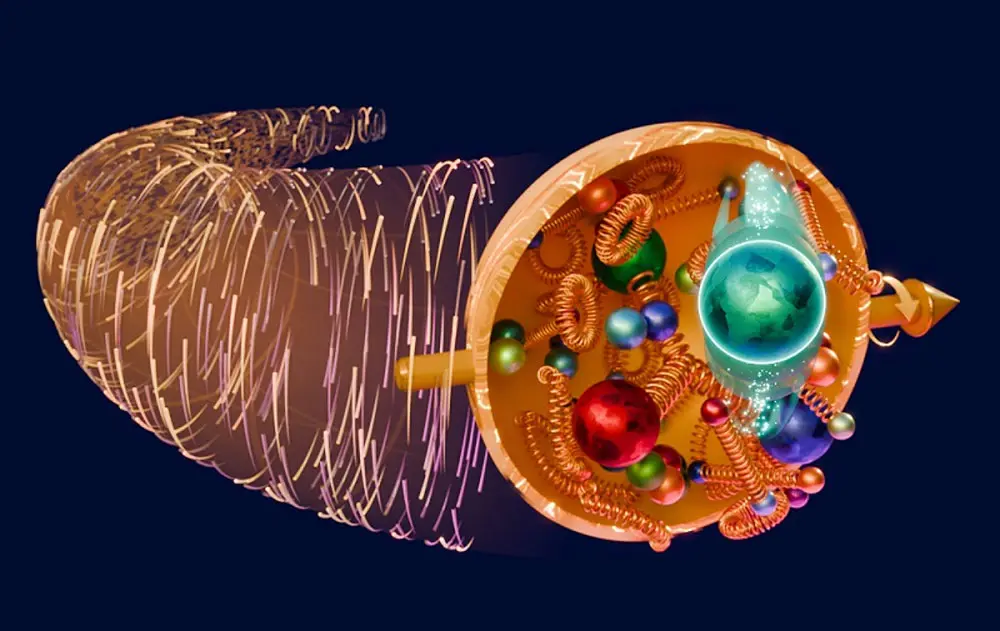
A team from Argonne and Brookhaven National Laboratories has used the Polaris supercomputer to reveal the internal structure of the pion, a subatomic particle central to the strong nuclear force that binds protons and neutrons. Pions are closely connected to the fundamental force holding the nucleus of every atom together, and understanding their behavior is key to explaining how matter forms at its most basic level. The researchers employed Monte-Carlo simulations of lattice quantum chromodynamics, a technique originally proposed by Michael Creutz at Brookhaven Lab, to generate high-resolution 3D images of the pion’s internal quark arrangement. “Pions mediate the strong force that binds nucleons—that is, the protons and neutrons that account for an atom’s mass,” said Yong Zhao, an Argonne physicist and principal investigator on the project. By probing the pion’s internal structure, scientists aim to gain a deeper understanding of how quarks and gluons combine to create visible matter.
Polaris Supercomputer Reveals Pion’s 3D Structure
This work addresses a fundamental question in nuclear physics: how visible matter emerges from elementary particles like quarks and gluons. Scientists have long sought to understand quark distribution within composite particles, but experimental data for the lightest of these, the pion, is scarce, necessitating reliance on large-scale simulations. The simulations captured hundreds of snapshots of spacetime, represented on a lattice with millions of grid points, a feat only achievable with the parallel computing power of a machine like Polaris. These images reveal how the transverse size of the pion decreases as momentum increases, a pattern mirroring observations in protons, and demonstrate that the pion’s effective size is smaller than that of the proton at moderate momentum values. “Polaris allowed us to simulate how quarks move and correlate inside the pion, both along its direction of motion and across it,” Zhao said. The resulting data, detailing the pion generalized parton distribution (GPD), will provide valuable guidance for upcoming experiments at facilities like the Thomas Jefferson National Accelerator Facility and the future Electron-Ion Collider at Brookhaven.
The pursuit of understanding matter’s fundamental structure has led researchers to increasingly sophisticated computational methods, with recent work utilizing the Advanced Leadership Computing Facility (ALCF) at Argonne National Laboratory to map the internal architecture of the pion. These simulations offer a pathway to first-principles calculations, bypassing the limitations of direct experimental observation.
This computational approach allows scientists to probe the distribution of quarks within the pion, a challenge due to the limited availability of experimental data for this lightest of composite particles. The team’s work centers on determining the pion generalized parton distribution (GPD), a key to generating detailed 3D images of the particle’s internal architecture.
Pions mediate the strong force that binds nucleons – that is, the protons and neutrons that account for an atom’s mass,” said Yong Zhao, an Argonne physicist and principal investigator on the project.
Yong Zhao, an Argonne physicist and principal investigator on the project
Pion structure can be addressed at a profound level by quantifying its multidimensional structure,” Zhao said.
Our results reveal that the transverse size of the pion decreases as the momentum in the direction of the pion increases – a pattern also seen in the proton – and that the effective size of the pion is smaller than that of the proton at moderate parallel pion momentum values,” Zhao said.


See today’s quantum computing news on Quantum Zeitgeist for the latest breakthroughs in qubits, hardware, algorithms, and industry deals.