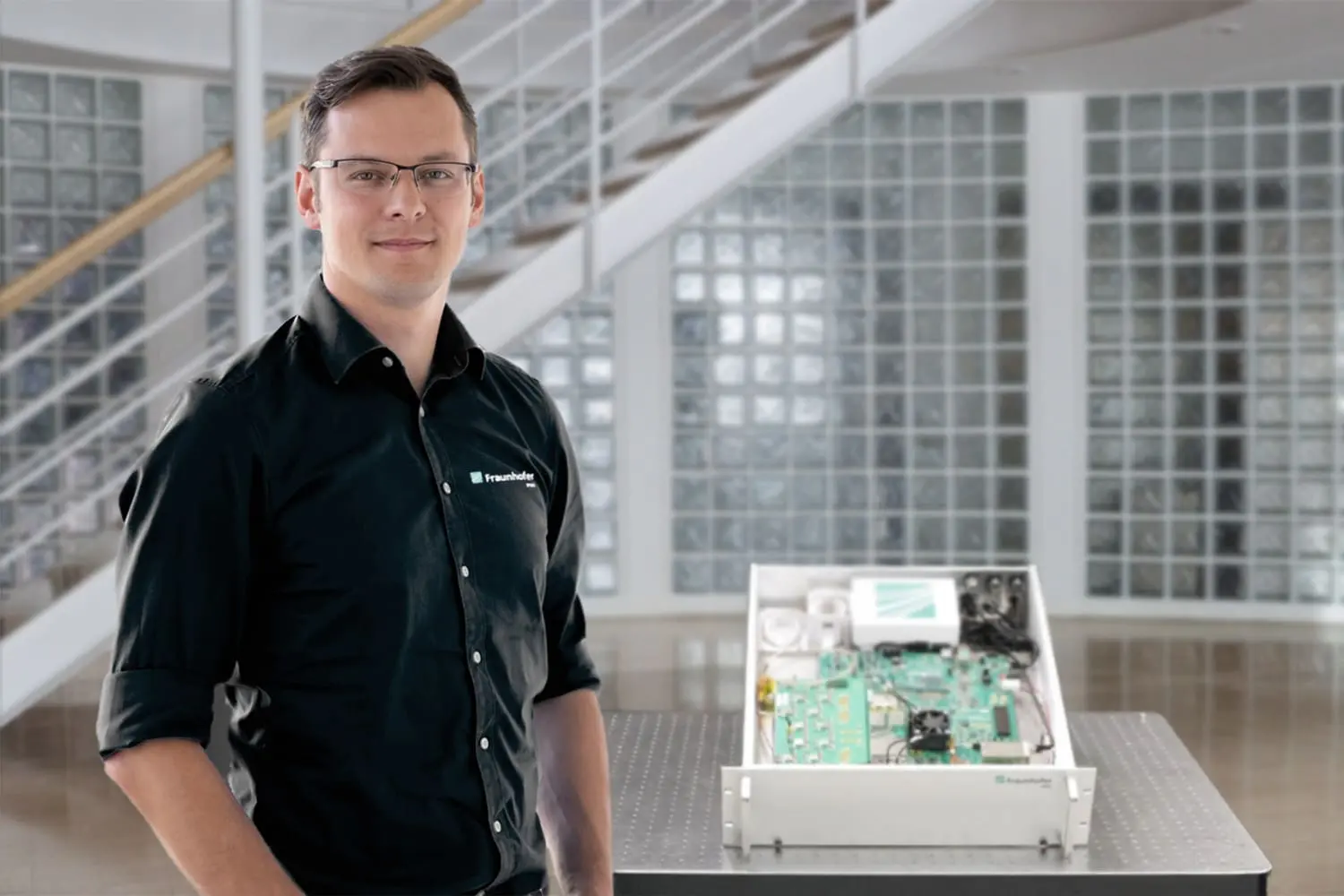
Fraunhofer IPMS has launched Q‑Dice, a quantum random number generator capable of delivering true randomness at a rate exceeding 4 Gbit/s. The system generates these numbers by measuring quantum vacuum fluctuations, offering a secure alternative to algorithm-based approaches vulnerable to attack. Rigorous testing, including validation against BSI AIS 20/31 and the NIST SP test suite, confirms the quality of the randomness produced by Q‑Dice. “With Q-Dice, we make high-quality quantum randomness practically usable and accessible,” says Dr. Alexander Noack, Division Director Data Communication & Computing at Fraunhofer IPMS. Available as both a 19-inch rack system and an online platform, Q‑Dice aims to remove adoption barriers for applications demanding robust encryption, secure communication, and high-scale simulation.
Q-Dice: 4.1 Gbit/s Quantum Randomness from Vacuum Fluctuations
Quantum random number generators (QRNGs) are rapidly changing data security, and Fraunhofer IPMS’s Q-Dice system achieves data rates of 4.1 Gbit/s, significantly outpacing conventional algorithmic methods. This performance is crucial because existing random number generation techniques often rely on deterministic algorithms susceptible to prediction and exploitation; Q-Dice, however, derives its randomness from the unpredictable behavior of quantum vacuum fluctuations, the fleeting appearance and disappearance of particles in seemingly empty space. This reliance on quantum mechanics provides an intrinsically random and uncontrollable source of entropy, vital for applications requiring the highest levels of security. Unlike many QRNGs confined to laboratory settings, Q-Dice is available in two deployment models: a self-contained 19-inch rack system for on-site integration and an online platform, broadening accessibility for developers and organizations without dedicated hardware infrastructure.
Fraunhofer IPMS maintains complete in-house control over the entire development process, from laser design and analog front-end electronics to FPGA-based data processing and high-speed 10 Gbit/s Ethernet connectivity, ensuring precise control over signal quality and entropy extraction. The system’s security credentials are robust, complying with the stringent standards of the German Federal Office for Information Security (BSI) according to AIS 20/31 and achieving an EAL 3 and PTG 3 classification. The company is now actively seeking partners to pilot the technology and collaboratively develop real-world applications, demonstrating a commitment to expanding the reach of quantum-enhanced security solutions.
Random bit rate: 4.1 Gbit/s All‑in‑one solution 19-inch rack-mounted system (other form factors available on request) 10G Ethernet interface (additional interfaces on request) Designed for high-throughput integration environments and evaluated according to BSI AIS 20/31 and NIST SP test suites.
Fraunhofer IPMS
Fraunhofer IPMS QRNG Deployment, Hardware & Entropy-as-a-Service
Practical deployment of quantum random number generation requires robust hardware and flexible access models; Fraunhofer IPMS addresses both with its Q‑Dice system. Achieving a sustained random bit rate of 4.1 Gbit/s, Q‑Dice surpasses the capabilities of algorithmic random number generators, a crucial advantage for applications demanding high throughput and uncompromising security. This performance is rooted in the system’s core principle: harnessing quantum vacuum fluctuations as the source of entropy, ensuring a fundamentally unpredictable output. The commitment to security is underscored by rigorous validation against internationally recognized standards. The system is available in two configurations to suit diverse operational needs; organizations can opt for a dedicated 19-inch rack system for on-premises integration, complete with a 10 Gbit/s Ethernet interface, or leverage the platform for secure, cloud-based access to quantum entropy. This accessibility supports a collaborative vision for the future.
The system delivers true random numbers at bit rates exceeding 4 Gbit/s based on intrinsically random and uncontrollable quantum effects.
Fraunhofer Institute for Photonic Microsystems IPMS




See today’s quantum computing news on Quantum Zeitgeist for the latest breakthroughs in qubits, hardware, algorithms, and industry deals.