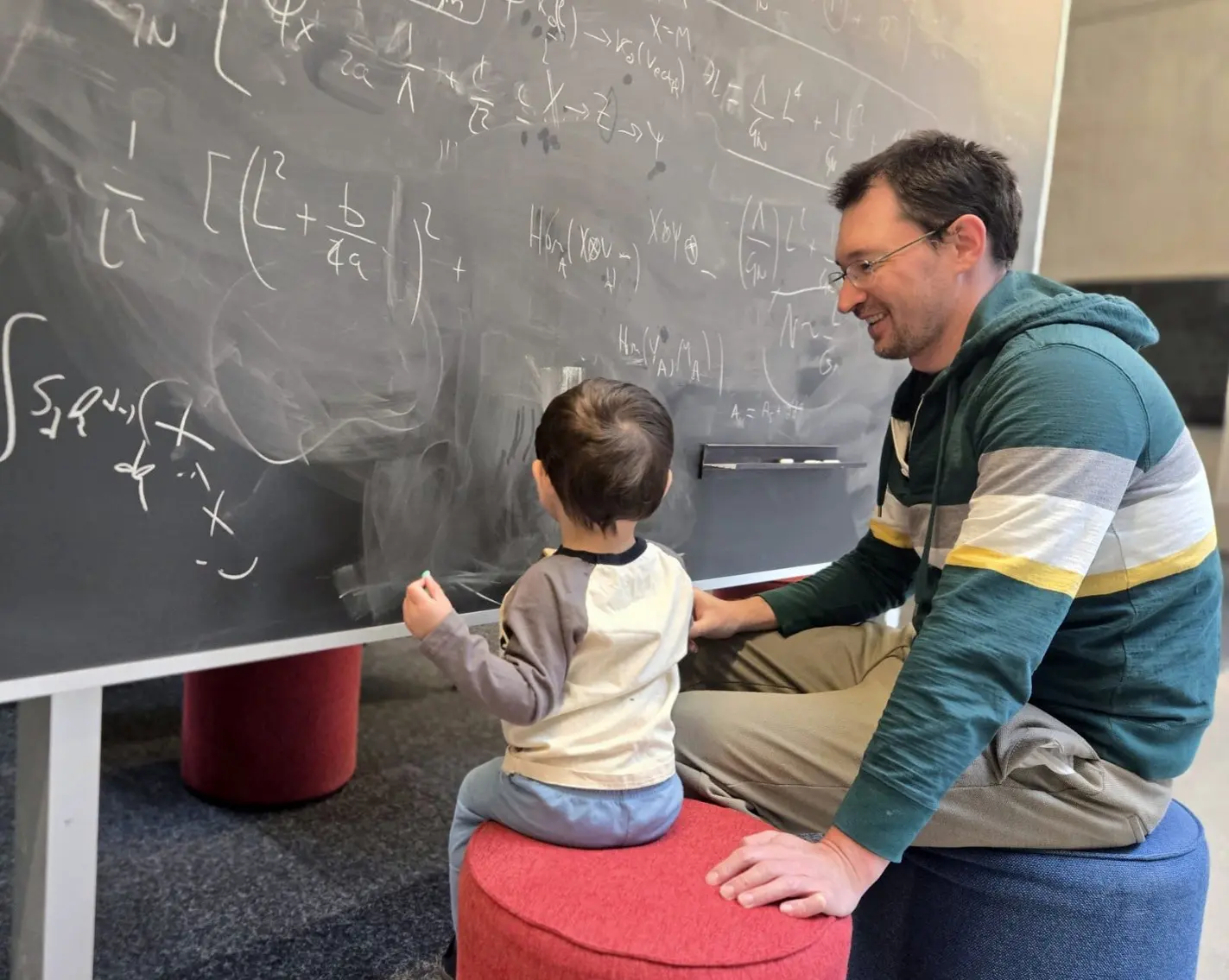
Drawing inspiration from the algorithms behind image generation tools like DALL-E and SORA, a Perimeter Institute researcher has outlined a potential path to reversing quantum information loss. Einar Gabbassov, a PhD student at Perimeter Institute and University of Waterloo, derived the stochastic Schrödinger equations that describe the quantum reverse process, a feat previously thought impossible using standard quantum mechanics. The key, Gabbassov explains, lies in meticulously monitoring the environment interacting with a quantum system, specifically, weakly entangled qubits, allowing for the reconstruction of a system’s trajectory even as it experiences disruption. “The classical forward and reverse processes used by image generation models are described by a stochastic differential equation, and this equation was derived in the 1970s,” says Gabbassov, noting the surprising connection to decades-old mathematics. This new formalism, unlike traditional methods, accounts for individual system trajectories, potentially offering a way to navigate the inherent noisiness of quantum systems and recover lost information.
Diffusion Models Inspire Quantum Information Reversal
The ability to rewind quantum information loss, once considered a fundamental limit, is now theoretically possible thanks to an unexpected connection with artificial intelligence. Einar Gabbassov, a PhD student at the University of Waterloo’s Faculty of Mathematics with affiliations with the Institute for Quantum Computing and Perimeter Institute for Theoretical Physics, drew inspiration from diffusion models, the algorithms powering image generation tools, to develop a mathematical framework for reversing this process. These models, initially designed to create images from noise, provided a surprising analogy for tackling quantum decoherence. Gabbassov’s work builds upon stochastic differential equations first formulated in the 1970s, demonstrating how established mathematical principles can find new applications in contemporary physics. He explains that having an explicit equation for generative machine learning is useful because previous approaches were often ad hoc or variational.
By measuring the state of an “environment” qubit, researchers can infer how a corresponding “system” qubit has been perturbed, effectively tracking its trajectory through the noise. This detailed monitoring is crucial; repeating the measurement allows researchers to understand the stochastic trajectory of the system, potentially reversing information loss. Gabbassov derived the stochastic Schrödinger equations that describe the quantum reverse process, differing from traditional methods that focus on average dynamics and discard environmental information. These equations not only prove the theoretical possibility of reversing quantum information loss but also offer a precise mathematical tool for quantum generative machine learning, moving beyond ad-hoc circuit designs.
The classical forward and reverse processes used by image generation models are described by a stochastic differential equation, and this equation was derived in the 1970s. It’s pretty old mathematics, later adapted to machine learning.
Stochastic Schrödinger Equations and Environmental Monitoring
He proposes a scenario involving two qubits, one representing the system whose information is at risk and the other acting as a proxy for the environment. As these qubits become weakly entangled, measuring the environment qubit’s state, forcing it to collapse into a definite 0 or 1, reveals how the system qubit has been perturbed. The resulting path back to the original state isn’t a perfect rewind, but a stochastic journey guided by a “drift” that nudges the system back towards its initial quantum state despite ongoing noise. These stochastic Schrödinger equations distinguish themselves from conventional methods of analyzing open quantum systems by focusing on individual trajectories rather than average dynamics. “Deriving a reverse process is not possible with this formalism unless you make other assumptions,” Gabbassov explains, “but that’s what a stochastic Schrödinger equation can give you. If you work at the level of stochastic trajectories, then you can build a reverse process.”
The well-established formalism of quantum channels and master equations that describes systems evolving under noise only describes average dynamics, and discards information about the environment. Deriving a reverse process is not possible with this formalism, unless you make some other assumptions.
Reverse Processes Beyond Quantum Channels & Master Equations
Gabbassov’s recent work details a method for potentially reversing the scrambling of quantum information, a feat previously considered impossible within established quantum frameworks. He found inspiration in diffusion models, algorithms powering tools like DALL-E and SORA, which excel at reconstructing images from noise. Traditional approaches to modeling open quantum systems, utilizing quantum channels and master equations, focus on average dynamics and discard crucial information about the environment. This limitation prevents the derivation of a true reverse process. Gabbassov circumvented this issue by developing stochastic Schrödinger equations, which meticulously track the interaction between a quantum system and its surroundings. The key lies in monitoring a weakly entangled “environment” qubit; by measuring its state, researchers can infer the precise perturbation experienced by the system qubit. Gabbassov adds that having an explicit equation for generative machine learning is useful because previous approaches were often ad hoc or variational, and these equations could refine and accelerate quantum machine learning algorithms.
Source: https://perimeterinstitute.ca/news/reversing-quantum-information-loss-using-lessons-machine-learning

See today’s quantum computing news on Quantum Zeitgeist for the latest breakthroughs in qubits, hardware, algorithms, and industry deals.