Quantinuum’s 98-qubit Helios system is establishing a new standard for reliability in quantum computing, demonstrated through a collaboration with Sandia National Laboratories. Published in Nature, results show the system achieved 98 percent and 99 percent, respectively, in single- and two-qubit operations, indicating a high degree of accuracy in fundamental quantum processes. Sandia National Laboratories, which hosts the Department of Energy’s longest-running quantum computing program, has partnered with Quantinuum for four years under a Cooperative Research and Development Agreement, recently renewed in May. “As a national resource, we are committed to accelerating quantum computing technology in support of economic and national security,” said Sandia senior manager Mike Descour, highlighting the significance of this public-private effort toward building fault-tolerant quantum computers capable of tackling complex challenges.
Helios System Achieves High Fidelity with 98 Qubits
Featuring 98 qubits and a sustained collaboration with Sandia National Laboratories, Quantinuum’s Helios system is demonstrably improving quantum computer reliability, yielding results that validate its performance against rigorous benchmarks. Published in Nature, the findings detail how the Helios system achieved 98 percent and 99 percent, respectively, in operations involving one and two qubits, a critical metric indicating the accuracy of these fundamental quantum calculations. This level of precision is particularly noteworthy as it surpasses previous generations of quantum processors and establishes Helios as Quantinuum’s most dependable quantum computer to date.
Sandia’s role extends beyond testing; the laboratory pioneered new methods for debugging quantum computers and contributed a novel benchmarking methodology to assess the performance of mid-circuit measurements, essential for error correction. “The most important aspect of today’s quantum computers is not speed, but reliability,” explained Sandia’s Robin Blume-Kohout, a co-author on the paper, highlighting the focus on stability over computational power. For over two decades, Sandia has cultivated a robust quantum computing program, combining its engineering expertise with advanced microelectronics and nanotechnology facilities to develop and evaluate quantum devices across various platforms. Quantinuum operates a research and development site in New Mexico, strategically located near Sandia’s main campus, facilitating close interaction and knowledge exchange. The Helios system’s performance, operating “beyond the capabilities of classical simulation alone,” as stated by Quantinuum’s Tony Ransford, establishes a new benchmark of fidelity and complexity for quantum computers, signaling significant progress toward realizing the potential of quantum supercomputing.
In operations that involved only one or two qubits, or quantum bits, the system demonstrated very high fidelity – % and %, respectively.
Sandia National Laboratories
Sandia & Quantinuum Advance Integrated Photonics for Scalability
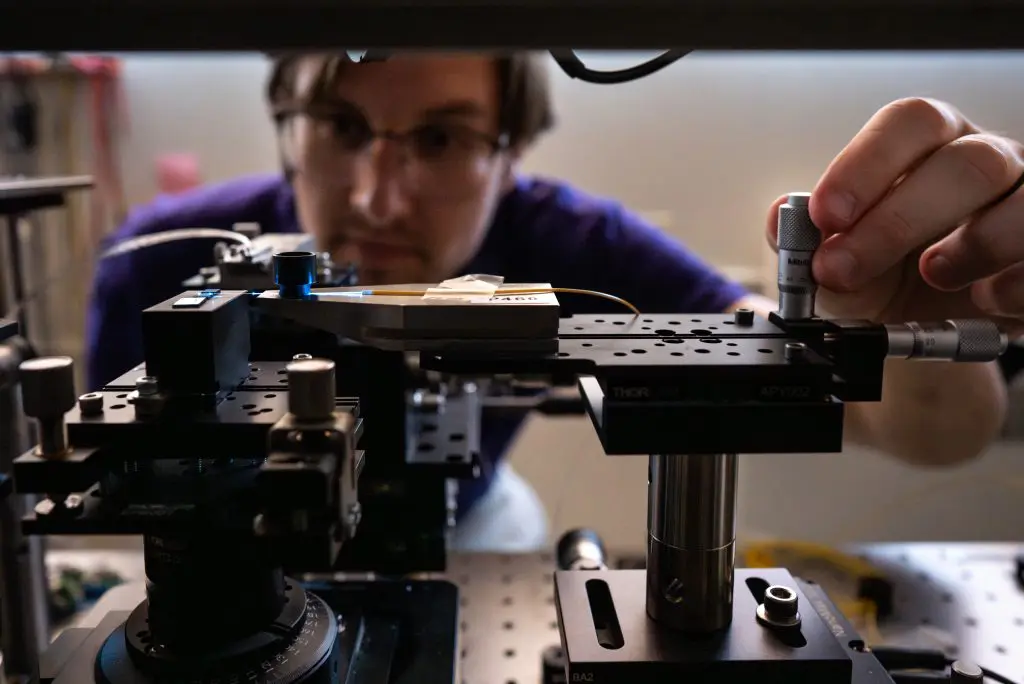
Sandia National Laboratories’ sustained investment in quantum computing, spanning over two decades, has yielded a collaborative effort with Quantinuum focused on advancing scalable hardware for fault-tolerant systems. These components are not merely theoretical; Sandia actively assists Quantinuum in the design and testing of these technologies for potential integration into future quantum platforms, leveraging the lab’s expertise in microelectronics and nanotechnology. Quantinuum’s 98-qubit Helios system has become a focal point for this collaboration, undergoing rigorous assessment by Sandia researchers who pioneered methods for debugging quantum computers. This detailed evaluation, recently published in Nature, confirms Helios as Quantinuum’s most reliable quantum computer to date, demonstrating high fidelity in single- and two-qubit operations. “We evaluate every aspect of quantum computer performance with our commercial partners to accelerate the advent of quantum supercomputing,” explained Robin Blume-Kohout of Sandia, a co-author on the published findings. The emphasis on reliability, rather than speed, underscores a critical shift in the field.
As a national resource, we are committed to accelerating quantum computing technology in support of economic and national security.
National Lab Validates Benchmarking for Quantum Error Correction
Sandia National Laboratories is playing a crucial role in validating the performance of commercial quantum computers, recently completing an assessment of Quantinuum’s 98-qubit Helios system. The findings, recently published in Nature, detail Helios’s performance, demonstrating 98 percent and 99 percent, respectively. Blume-Kohout elaborates that quantum computers are susceptible to numerous subtle failures, from miscalibrated lasers to atomic instability, all of which degrade fidelity and limit computational power. Sandia’s work extends beyond performance testing; the laboratory is actively involved in designing and testing integrated photonic components for future quantum platforms. These energy-efficient chips, utilizing microscopic optical channels, promise to improve scalability and reduce the energy demands of quantum computing.
Helios operates beyond the capabilities of classical simulation alone and established a new benchmark of fidelity and complexity for quantum computers.




See today’s quantum computing news on Quantum Zeitgeist for the latest breakthroughs in qubits, hardware, algorithms, and industry deals.