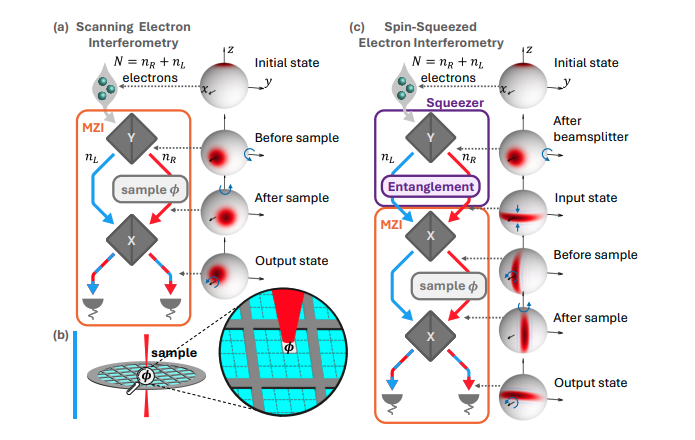
The fundamental limit of image clarity in electron microscopy, a cornerstone of modern materials science and biology, is currently dictated by unavoidable noise arising from the relatively small number of electrons used to create an image. Shiran Even-Haim, Ethan Nussinson, and colleagues from the Technion – Israel Institute of Technology and the Weizmann Institute of Science demonstrate a pathway to overcome this limitation by applying principles of quantum entanglement, specifically a technique called spin squeezing, to electron microscopy. Their theoretical work reveals that generating entangled electron states through interactions and careful measurement strategies can dramatically improve the signal-to-noise ratio, potentially allowing researchers to visualise structures with unprecedented detail and reduce the damaging effects of the electron beam. This research bridges the gap between atomic physics and electron microscopy, offering a promising route towards quantum-enhanced imaging and a new era of high-resolution structural analysis.
Researchers have theoretically demonstrated that quantum entanglement, specifically spin squeezing, can overcome the noise limitations in electron microscopy. This technique promises more explicit images, particularly for delicate biological samples, by reducing quantum noise below the standard limit and potentially enabling visualisation with unprecedented detail. Current limitations stem from shot noise inherent in electron beams, a fundamental consequence of the discrete nature of electrons.
The team’s work proposes harnessing quantum entanglement to enhance image clarity. Spin squeezing generates correlated electron states, enabling more precise measurements of phase, a critical element in image formation. Calculations indicate that, under conditions relevant to cryo-electron microscopy, spin squeezing could substantially improve the signal-to-noise ratio, potentially approaching the Heisenberg limit of precision.
This improvement would not only yield more explicit images but also reduce the electron dose required for imaging, minimising damage to sensitive biological samples. While generating and controlling entangled electron states presents a significant challenge, this research opens a promising new avenue for advancing electron microscopy and unlocking new insights into the fundamental building blocks of life. The technique offers the potential to visualise biological structures with increased resolution and enhanced clarity, addressing long-standing limitations in the field.
👉 More information
🗞 Spin Squeezing in Electron Microscopy
🧠 DOI: https://doi.org/10.48550/arXiv.2507.09243




See today’s quantum computing news on Quantum Zeitgeist for the latest breakthroughs in qubits, hardware, algorithms, and industry deals.