Supersolid dipolar Bose-Einstein condensates sustain Higgs excitations, exhibiting quadratic dispersion and resulting in fractional revivals analogous to the Talbot effect. Numerical modelling within a toroidal geometry demonstrates minimal coupling to sound modes, enabling non-spectroscopic determination of the Higgs particle’s effective mass through revival times.
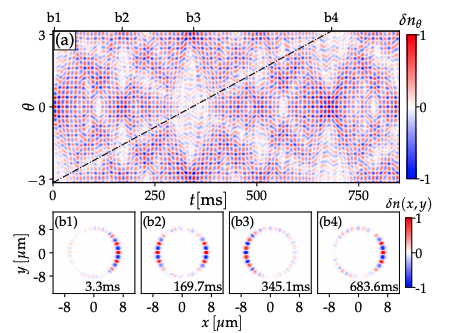
The exotic state of matter known as a supersolid, exhibiting properties of both solids and superfluids, continues to yield surprising behaviour. Recent research demonstrates that Higgs excitations, fundamental particles associated with mass, within these supersolids display unusual dynamics resembling optical ‘carpets’ – patterns that periodically reappear as a wave propagates. This phenomenon, observed through numerical simulations of a toroidal supersolid formed from dipolar Bose-Einstein condensates, offers a novel, non-spectroscopic method for determining the effective mass of these Higgs particles. K. Mukherjee, M. Schubert, and colleagues, from Lund University and the University of Stuttgart, detail these findings in their article, ‘Quantum Carpets of Higgs particles in a Supersolid’. The work explores the time evolution and dispersion of localised Higgs quasiparticles, revealing fractional revivals attributable to the quadratic dispersion relation inherent in these excitations.
Dipolar Bose-Einstein condensates (BECs) demonstrate supersolid behaviour, characterised by simultaneous density modulation and global phase coherence, and researchers utilise numerical simulations to investigate these excitations within a toroidal geometry, mirroring experimental limitations and minimising coupling to sound modes. The Gross-Pitaevskii equation (GPE), a nonlinear partial differential equation describing the quantum mechanical evolution of a Bose-Einstein condensate, models the BEC dynamics, solved numerically on a three-dimensional grid with periodic boundary conditions simulating an infinite system, while a fixed box size of 45 µm prevents spurious interactions between periodic images. Validation of accuracy occurs through testing different grid resolutions, including 128x128x64 and 256x256x64, and a time-stepping algorithm with a time step of 10-4 ensures stable and reliable results.
To determine the excitation spectrum, researchers perform a Bogoliubov-de Gennes (BdG) analysis, a method for calculating the elementary excitations of a many-body system, involving the solution of a set of linear equations, the BdG equations, that describe the collective excitations of the BEC. Simplification of these equations occurs through the use of symmetric and antisymmetric combinations of amplitudes, and a sparse eigenvalue solver calculates the excitation energies, providing a detailed understanding of the system’s energetic landscape. Analysis reveals a quadratic dispersion relation for the Higgs excitation branch when the system resides sufficiently far from the critical point, confirming theoretical predictions and establishing a foundation for further investigation.
This quadratic behaviour leads to the observation of
This quadratic behaviour leads to the observation of fractional revivals in the excitation’s time evolution, analogous to the Talbot effect, or ‘carpet’ patterns observed in optics, offering a unique window into the dynamics of these excitations. Researchers utilise these revival times to determine the effective mass of the Higgs particle through a non-spectroscopic method, circumventing the need for direct spectral analysis and providing an independent verification of the results. The interplay between ground state contrast, dispersion coefficients, and Talbot time offers a comprehensive picture of the Higgs excitation’s behaviour, paving the way for further investigations into coherent Higgs dynamics and interactions within these fascinating supersolid systems.
Researchers explore the influence of the critical point on the excitation behaviour, finding that the quadratic dispersion relation and the Talbot effect become more pronounced as the system moves further away from the critical point. They further investigate the role of interactions between Higgs particles, finding that these interactions can lead to the formation of bound states and the emergence of new collective modes. Future work will focus on extending these simulations to include the effects of disorder and on exploring the possibility of using Higgs excitations to create novel quantum devices. The study provides a valuable contribution to the field of quantum many-body physics and opens up new avenues for research in the area of supersolid materials.
👉 More information🗞Quantum Carpets of Higgs particles in
🗞 Quantum Carpets of Higgs particles in a Supersolid
🧠 DOI: https://doi.org/10.48550/arXiv.2507.00989



See today’s quantum computing news on Quantum Zeitgeist for the latest breakthroughs in qubits, hardware, algorithms, and industry deals.