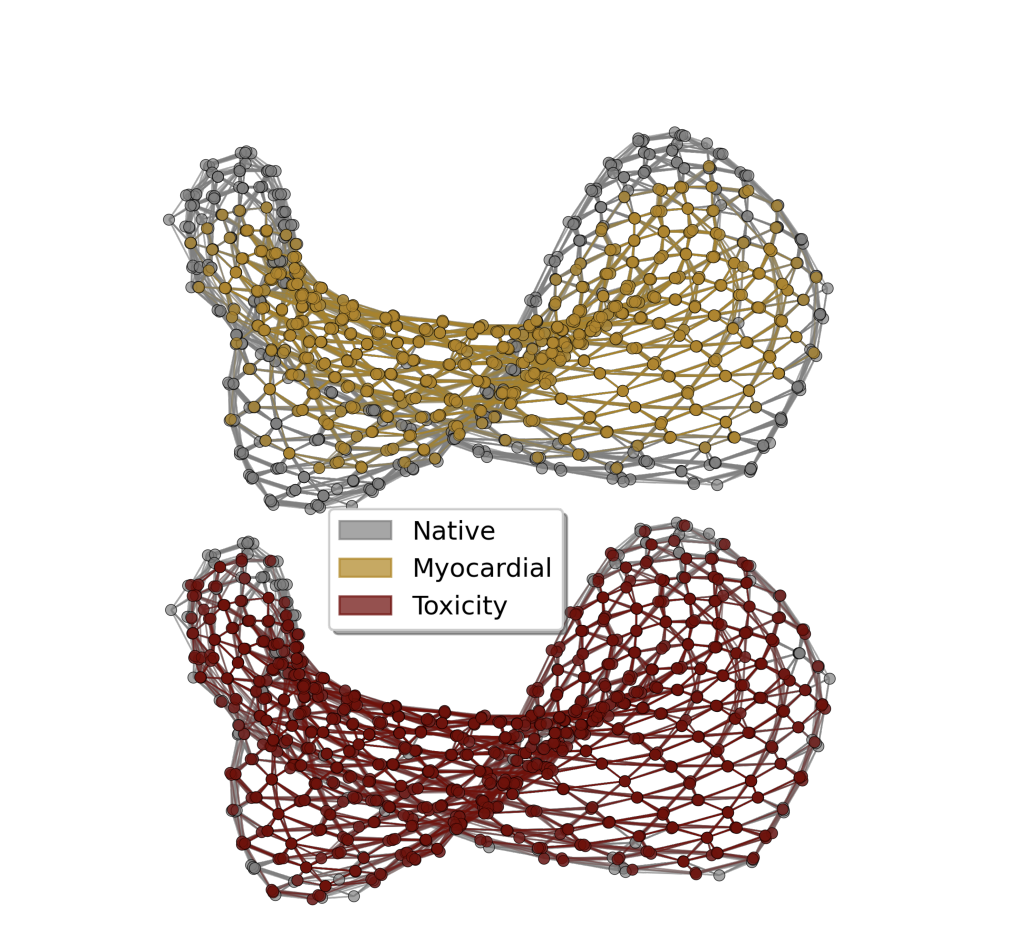
Quantum machine learning seeks to harness the power of quantum mechanics to improve artificial intelligence, and a new technique developed by Anton Simen, Carlos Flores-Garrigos, and Murilo Henrique De Oliveira, all from Kipu Quantum GmbH, alongside Gabriel Dario Alvarado Barrios, Juan F. R. Hernández, and Qi Zhang, represents a significant step towards realising that potential. The researchers propose a novel feature mapping technique that utilises the complex dynamics of a quantum spin glass to identify subtle patterns within data, achieving a performance boost in machine learning models. This method encodes data into a disordered quantum system, then extracts meaningful features by observing its evolution, and importantly, the team demonstrates performance gains of up to 210% on high-dimensional datasets used in areas like drug discovery and medical diagnostics. This work marks one of the first demonstrations of quantum machine learning achieving a clear advantage over classical methods, potentially bridging the gap between theoretical quantum supremacy and practical, real-world applications.
The core idea is to leverage the quantum dynamics of these annealers to create enhanced feature spaces for classical machine learning algorithms, with the goal of achieving a quantum advantage in performance. Key findings include a method to map classical data into a quantum feature space, allowing classical machine learning algorithms to operate on richer data. Researchers found that operating the annealer in the coherent regime, with annealing times of 10-40 nanoseconds, yields the best and most stable performance, as longer times lead to performance degradation.
Applying Quantum Mapping to Diverse Biological Datasets
Applying Quantum Mapping to Diverse Biological Datasets
The method was tested on datasets related to toxicity prediction, myocardial infarction complications, and drug-induced autoimmunity, suggesting potential performance gains compared to purely classical methods. Kipu Quantum has launched an industrial quantum machine learning service based on these findings, claiming to achieve quantum advantage. The methodology involves encoding data into qubits, programming the annealer to evolve according to its quantum dynamics, extracting features from the final qubit state, and feeding this data into classical machine learning algorithms. Key concepts include quantum annealing, analog quantum computing, feature engineering, quantum feature maps, and the coherent regime. The team encoded information from datasets into a disordered quantum system, then used a process called “quantum quench” to generate complex feature representations. Experiments reveal that machine learning models benefit most from features extracted during the fast, coherent stage of this quantum process, particularly when the system is near a critical dynamic point. This analog quantum feature mapping technique was benchmarked on high-dimensional datasets, drawn from areas like drug discovery and medical diagnostics.
Results demonstrate a substantial performance boost, with the
Achieving Significant Performance Boosts with Quantum Features
Quantifying Substantial Performance Gains with Quantum Features
Results demonstrate a substantial performance boost, with the quantum-enhanced models achieving up to a 210% improvement in key metrics compared to state-of-the-art classical machine learning algorithms. Peak classification performance was observed at annealing times of 20-30 nanoseconds, a regime where quantum entanglement is maximized. The technique was successfully applied to datasets related to molecular toxicity, myocardial infarction complications, and drug-induced autoimmunity, using algorithms including support vector machines, random forests, and gradient boosting. By encoding data into a disordered quantum system and extracting features from its evolution, the researchers demonstrate performance improvements in applications including molecular toxicity classification, diagnosis of heart attack complications, and detection of drug-induced autoimmune responses. Comparative evaluations consistently show gains in precision, recall, and area under the curve, achieving improvements of up to 210% in certain metrics. Researchers found that optimal performance is achieved when the quantum system operates in a coherent regime, with longer annealing times leading to performance degradation due to decoherence. Further research is needed to explore more complex quantum feature encodings, adaptive annealing schedules, and broader problem domains. Future work will also investigate implementation on digital quantum computers and explore alternative analog quantum hardware platforms, such as neutral-atom quantum systems, to expand the scope and impact of this method.
Future Directions and Further Research on Quantum ML
Understanding the Underlying Quantum Spin Glass Mechanism
The core physics underpinning this approach relies on the Hamiltonian dynamics of the quantum spin glass, which typically models frustrated magnetic interactions. By encoding classical features into the initial state of the qubits, the system is forced to evolve through an energy landscape dictated by the J-coupling matrix. The resulting feature vector is thus not merely a transformation, but a representation derived from the time-evolution operator, \hat{U}(t) = e^{-i\hat{H}t}, offering a path for feature extraction that respects quantum mechanical principles.
Furthermore, the utilization of quantum annealers provides a physical platform for realizing the necessary complex correlations. Conceptually, this process maps the computationally intractable problem of high-dimensional feature space exploration onto the physically manageable ground state search of the spin glass model. This intrinsic link between optimization and quantum dynamics is what allows for the generation of features exponentially richer than those achievable through standard linear or polynomial classical feature mapping techniques.
Despite the promising results, significant technical hurdles remain, primarily relating to decoherence and scalability. The stability of the performance observed in the coherent regime is highly sensitive to environmental noise and temperature fluctuations, placing constraints on the operational time window. For industrial deployment, developing error correction codes capable of maintaining quantum information fidelity over the required nanosecond timescales, especially for larger qubit counts, represents the next critical frontier for the field.




See today’s quantum computing news on Quantum Zeitgeist for the latest breakthroughs in qubits, hardware, algorithms, and industry deals.