Entangled photons’ spatial degree of freedom holds the key to quantum foundation and applied quantum techniques. However, measuring this feature has been a long-standing challenge. Researchers have turned to quantum state tomography, but it’s costly, while quantum holography requires additional references. In this breakthrough article, scientists introduce a novel approach called quantum Shack-Hartmann wavefront sensing, which enables efficient and reference-free measurement of the biphoton spatial wave function. This game-changing method has far-reaching implications for quantum physics and adaptive optics.
Can Quantum Wavefront Sensing Unlock the Secrets of Biphoton Spatial Dynamics?
The spatial degree of freedom of entangled photons is a crucial tool for quantum foundation and applied quantum techniques. To fully utilize this feature, it is essential to experimentally characterize the multiphoton spatial wave function, including the entangled amplitude and phase information at different evolutionary stages. However, there has been no effective method to measure it.
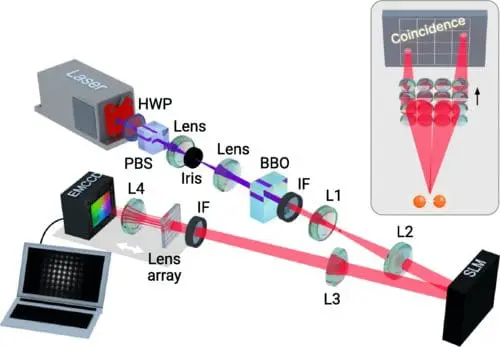
Quantum state tomography is costly, and quantum holography requires additional references. In this article, we introduce a novel approach called quantum Shack-Hartmann wavefront sensing to perform efficient and reference-free measurements of the biphoton spatial wave function. The joint probability distribution of photon pairs at the back focal plane of a microlens array is measured and used for amplitude extraction and phase reconstruction.
In the experiment, we observe that the biphoton amplitude correlation becomes weak while phase correlation shows up during free space propagation. Our work is a crucial step in quantum physics and adaptive optics and paves the way for characterizing quantum optical fields with high-order correlations or topological patterns.
What is Biphoton Spatial Wave Function Dynamics?
Entangled photons’ spatial degree of freedom is an essential tool for quantum foundation and applied quantum techniques. The multiphoton spatial wave function, including the entangled amplitude and phase information at different evolutionary stages, is a key feature that needs to be experimentally characterized.
However, there has been no effective method to measure it. Quantum state tomography is costly, and quantum holography requires additional references. In this article, we introduce a novel approach called quantum Shack-Hartmann wavefront sensing to perform efficient and reference-free measurement of the biphoton spatial wave function.
The joint probability distribution of photon pairs at the back focal plane of a microlens array is measured and used for amplitude extraction and phase reconstruction. This method allows us to experimentally characterize the multiphoton spatial wave function, including the entangled amplitude and phase information at different evolutionary stages.
How Does Quantum Wavefront Sensing Work?
Quantum wavefront sensing is a novel approach that uses the joint probability distribution of photon pairs at the back focal plane of a microlens array to measure the biphoton spatial wave function. The method involves measuring the joint probability distribution of photon pairs and using it for amplitude extraction and phase reconstruction.
The joint probability distribution is measured by detecting the photons at the back focal plane of the microlens array. The detected photons are then used to reconstruct the amplitude and phase information of the biphoton spatial wave function. This method allows us to experimentally characterize the multiphoton spatial wave function, including the entangled amplitude and phase information at different evolutionary stages.
What are the Applications of Biphoton Spatial Wave Function Dynamics?
The applications of biphoton spatial wave function dynamics are vast and varied. The ability to experimentally characterize the multiphoton spatial wave function has many potential applications in quantum physics and adaptive optics.
One application is in the field of quantum imaging, where the ability to measure the biphoton spatial wave function can be used to create high-resolution images of objects or scenes. Another application is in the field of quantum communication, where the ability to measure the biphoton spatial wave function can be used to encode and decode information.
The applications of biphoton spatial wave function dynamics are not limited to these two fields. The ability to experimentally characterize the multiphoton spatial wave function has many potential applications in other areas of physics and engineering as well.
What are the Challenges of Biphoton Spatial Wave Function Dynamics?
Despite its many potential applications, biphoton spatial wave function dynamics is a challenging field to work in. One challenge is the difficulty of measuring the joint probability distribution of photon pairs at the back focal plane of a microlens array.
Another challenge is the need for high-quality optics and detectors to accurately measure the photons. Additionally, the complexity of the multiphoton spatial wave function makes it difficult to experimentally characterize.
In conclusion, biphoton spatial wave function dynamics is a crucial tool for quantum foundation and applied quantum techniques. The ability to experimentally characterize the multiphoton spatial wave function has many potential applications in quantum physics and adaptive optics.
The challenges of biphoton spatial wave function dynamics are significant, but with the development of new technologies and methods, it is possible to overcome these challenges and unlock the secrets of this fascinating field.
Publication Date: 2024-07-16
Authors: Yi Zheng, Zhao-Di Liu, Rui-Heng Miao, Jin‐Ming Cui, et al.
Source: Physical review letters
DOI: https://doi.org/10.1103/physrevlett.133.033602




See today’s quantum computing news on Quantum Zeitgeist for the latest breakthroughs in qubits, hardware, algorithms, and industry deals.