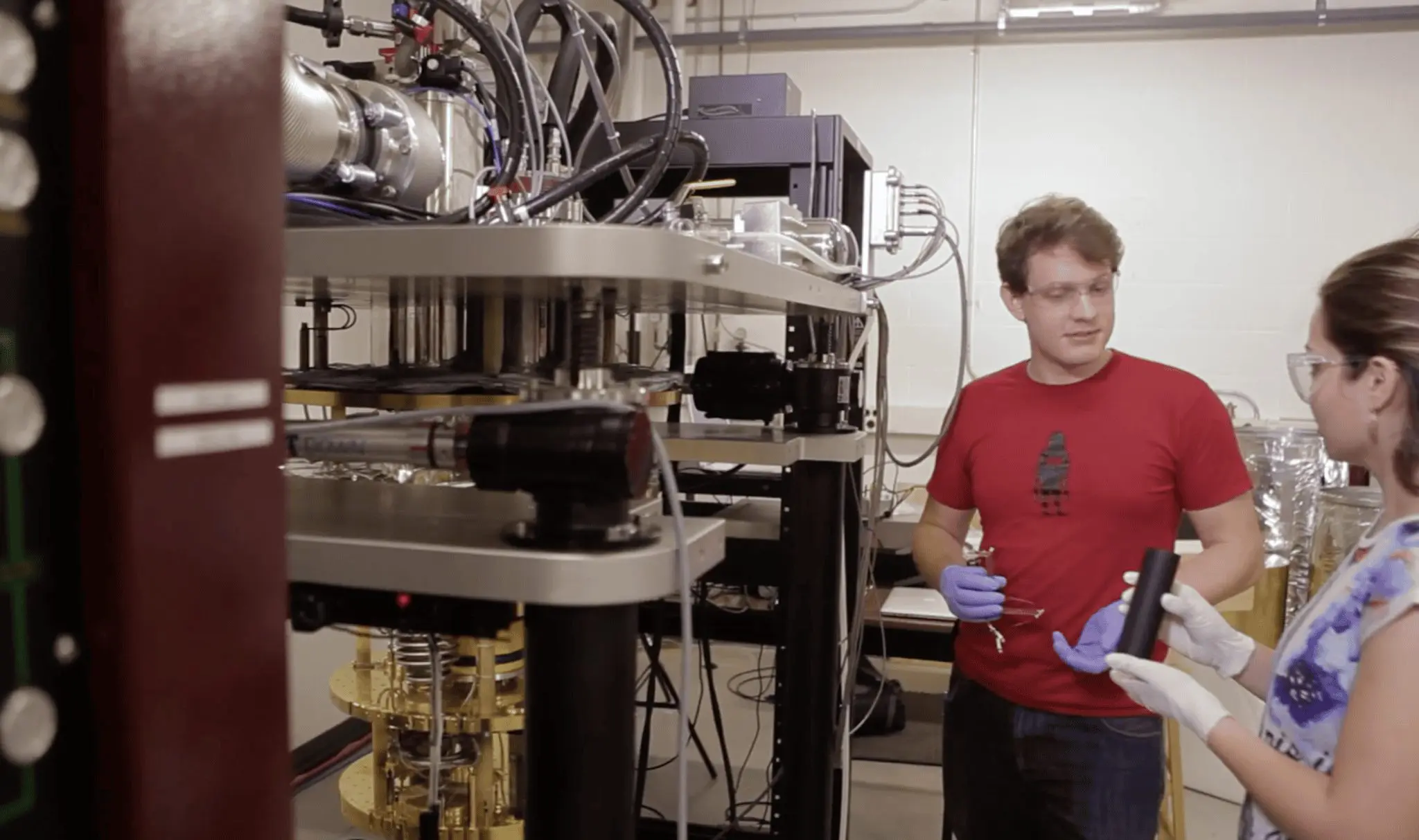
A $149,945 investment will bolster the development of quantum sensors at the University of Waterloo, funding millimeter-wave infrastructure designed by Bradley Hauer, Professor in the Department of Electrical and Computer Engineering. This is among $7.1 million in new funding allocated through the Natural Sciences and Engineering Research Council of Canada’s Discovery Research program to over 100 researchers across multiple disciplines. David Gosset, Professor in the Department of Combinatorics and Optimization, received a $53,000 grant, the first of five installments, to research quantum advantage, classical simulation, and complexity. Adam Wei Tsen, Professor, will pursue fundamental quantum research with a $49,000 grant, the first of five installments, focused on Visualization and Control of Moiré Quantum Matter.
Bradley Hauer will use a $149,945 Research Tools and Instruments grant to bolster millimeter-wave infrastructure, critical for developing advanced quantum sensors; the project benefits from collaboration with Drs. Adrian Lupascu and Christopher Wilson. This investment directly addresses the need for specialized equipment to push the boundaries of quantum measurement technology, enabling more precise and sensitive detection methods. Adam Wei Tsen is receiving $49,000, the initial payment of a five-installment grant, for Visualization and Control of Moiré Quantum Matter. These NSERC grants, totaling over $7.1 million across the University of Waterloo, underscore a broad commitment to fundamental research in multiple disciplines, with the IQC faculty playing a central role.
This research differs from efforts focused solely on quantum computing hardware, concentrating instead on rigorously demonstrating when and why quantum computers will surpass classical systems. Gosset’s work aims to define the specific computational problems where quantum solutions offer a definitive advantage, a critical step beyond simply building more powerful quantum processors. “Quantum advantage, classical simulation, and complexity” represents a focused effort to prove quantum supremacy, rather than assume it. These grants, along with Dr. Wilson’s $49,000 Discovery Grant for quantum microwaves, highlight a diverse portfolio of quantum research at the University of Waterloo.
See today’s quantum computing news on Quantum Zeitgeist for the latest breakthroughs in qubits, hardware, algorithms, and industry deals.