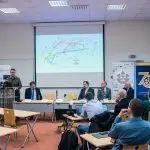
Professor Lev Vidmar of the University of Ljubljana will present a connection between breakdowns in quantum thermalization and quantum phase transitions on Monday, June 22nd, from 10:00-11:00. Vidmar’s work reveals that peaks in fidelity susceptibility, typically used to identify quantum critical points in ground states, can also indicate points where ergodicity breaks down, but at significantly higher energy densities. This challenges established methods for identifying these transitions, suggesting a deeper link between phenomena traditionally studied separately. The talk, part of the AMOP list series, also appears on lists including “Neurons, Fake News, DNA and your iPhone: The Mathematics of Information” and “Thin Film Magnetic Talks,” hinting at broad implications across multiple scientific disciplines.
This suggests a fundamental connection between phenomena previously studied in separate contexts, challenging conventional methods for locating these transitions. Vidmar’s work demonstrates that these ergodicity-breaking critical points manifest at energy levels far exceeding ground states, indicating a broader range for quantum transition identification. This overlap suggests that the mathematical underpinnings of quantum phase transitions and ergodicity breaking are more deeply intertwined than previously understood, potentially unifying disparate areas of quantum physics.
Quantum Phase Transitions & Thermalization Similarities
Researchers are increasingly recognizing connections between traditionally separate areas of quantum physics, specifically quantum phase transitions and the breakdown of thermalization, known as ergodicity breaking transitions. This challenges conventional methods for locating these transitions, suggesting a deeper underlying relationship than previously understood; the peak of the fidelity susceptibility, traditionally associated with ground states, now appears as a marker for transitions occurring far above those baseline energies. Vidmar’s findings suggest that the mathematical tools developed for understanding quantum phase transitions may be applicable to analyzing the complex behavior of quantum systems even when they are not in their lowest energy state, potentially unlocking new insights into non-equilibrium dynamics and thermalization processes.
For example, the peak of the ground-state fidelity susceptibility signals the quantum critical point.
Prof Lev Vidmar, University of Ljubljana
See today’s quantum computing news on Quantum Zeitgeist for the latest breakthroughs in qubits, hardware, algorithms, and industry deals.