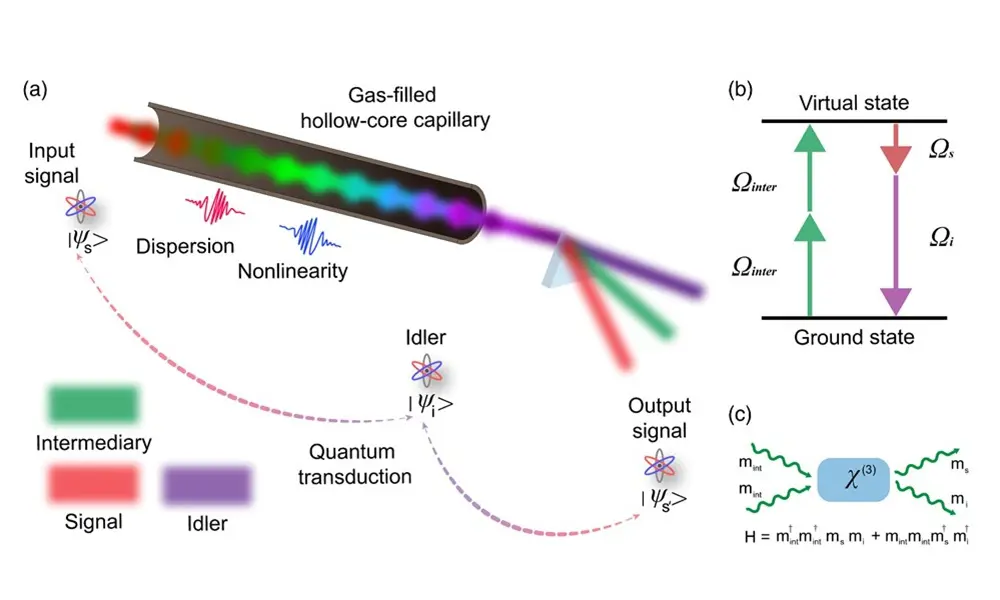
Researchers at UCLA, SLAC National Accelerator Laboratory, the University of Rochester, and the University of Ottawa are using xenon gas within hollow-core capillary fibers to address a critical challenge in building quantum networks: shifting quantum light to new wavelengths while preserving its delicate phase. Phase, which describes a light wave’s structure, is central to encoding and transmitting quantum information; unpredictable alterations can degrade or lose data.
The team modeled four-wave mixing, a process generating new wavelengths via interaction with a laser pulse, and found strong phase preservation, correlations exceeding 0.95 in many cases, across a range of conditions, UCLA says. Demonstrating phase-preserving conversion is a key step toward creating interfaces that allow different quantum technologies to work together.
Four-Wave Mixing Preserves Quantum Phase in Xenon Gas
Simulations reveal a high degree of phase preservation, with correlations exceeding 0.95 in many cases, when converting quantum light wavelengths using four-wave mixing within xenon gas. This fidelity is critical because quantum phase encodes vital information, and maintaining it during wavelength conversion is essential for building functional quantum networks. The research details a specific setup utilizing a hollow-core capillary fiber filled with xenon, where an input signal interacts with a strong laser pulse to generate a new wavelength through the four-wave mixing process.
The team systematically examined three conversion scenarios relevant to diverse quantum technologies: shifting infrared light to ultraviolet, and converting telecommunications-band light to both ultraviolet and visible wavelengths. These combinations aim to connect fiber optic communication with devices like optical clocks and trapped-ion quantum systems.
The conversion of telecommunications-band light to visible light proved particularly robust, maintaining high phase correlations across a broad range of tested conditions. This suggests a favorable balance between efficiency and coherence for practical applications. The study also identified a key tradeoff: increasing laser energy to improve conversion efficiency can simultaneously introduce phase distortion due to stronger nonlinear effects within the fiber. “These findings lay the groundwork for integrating heterogeneous quantum platforms across widely separated optical bands,” says Hao Zhang, corresponding author for the report.
Zhang clarifies that future work will focus on verifying these results with actual quantum states and entanglement, a crucial step toward realizing scalable quantum networks. The modeling suggests gas-filled hollow-core fibers offer a viable platform for bridging the spectral gaps between disparate quantum technologies, provided efficiency and coherence are carefully balanced.
These findings lay the groundwork for integrating heterogeneous quantum platforms across widely separated optical bands.
Hao Zhang, corresponding author for the report
Wavelength Conversion Scenarios for Quantum Technologies
Gas-filled hollow-core fibers offer a potential solution for linking disparate quantum systems, according to new modeling detailed in Advanced Photonics Nexus. The team analyzed how accurately phase information, essential for encoding quantum data, was transferred during the process, and did not solely assess conversion efficiency. “Successful quantum transducers will therefore need to balance efficiency and coherence rather than optimizing only one metric,” the researchers note. For infrared-to-ultraviolet conversion, efficiencies reached as high as 28 percent, while telecommunications-to-visible conversion achieved around 10.8 percent.
Phase Fidelity Tradeoffs with Efficiency in FWM Translation
Hao Zhang of UCLA led a modeling study revealing a critical balance between efficiency and coherence in quantum wavelength conversion using four-wave mixing. The team’s simulations, published in Advanced Photonics Nexus, focused on gas-filled hollow-core capillary fibers utilizing xenon gas to facilitate the frequency conversion process. Investigators systematically examined how well the phase of quantum light, essential for encoding and transmitting quantum information, was preserved during the conversion from one wavelength to another.
Performance varied significantly depending on the conversion pathway and operating conditions. Nonlinear effects within the fiber, amplified by higher laser energies, broadened the light spectrum and reshaped its phase, reducing translation accuracy. While infrared-to-ultraviolet conversion achieved efficiencies up to 28 percent, telecommunications-to-ultraviolet conversion reached 8.4 percent, and telecommunications-to-visible conversion reached about 10.8 percent; these gains often came at the expense of phase fidelity.

See today’s quantum computing news on Quantum Zeitgeist for the latest breakthroughs in qubits, hardware, algorithms, and industry deals.