A UC Santa Cruz physicist is applying a rigorous mathematical test to determine if dark matter candidates are truly “natural,” challenging long-held assumptions within the field. Stefano Profumo, professor of physics at the University of California, Santa Cruz, applied the Barbieri-Giudice measure as a “yardstick” to evaluate theories ranging from exotic particles to black holes formed moments after the Big Bang.
“There’s a habit of treating primordial black holes as the exotic, fine-tuned alternative, and particle dark matter as the safe, natural default,” Profumo said; however, his analysis of 12 scenarios reveals some black hole formations are as natural as the most forgiving particle models.
Barbieri-Giudice Measure Quantifies Dark Matter Model Naturalness
The Barbieri-Giudice measure, a mathematical tool applied by Stefano Profumo, offers a standardized way to evaluate the “naturalness” of competing dark matter models by quantifying how sensitive a model’s predictions are to slight changes in its initial parameters. This analysis moves beyond intuitive judgements of naturalness, providing a numerical framework for comparison and potentially reshaping the direction of dark matter research.
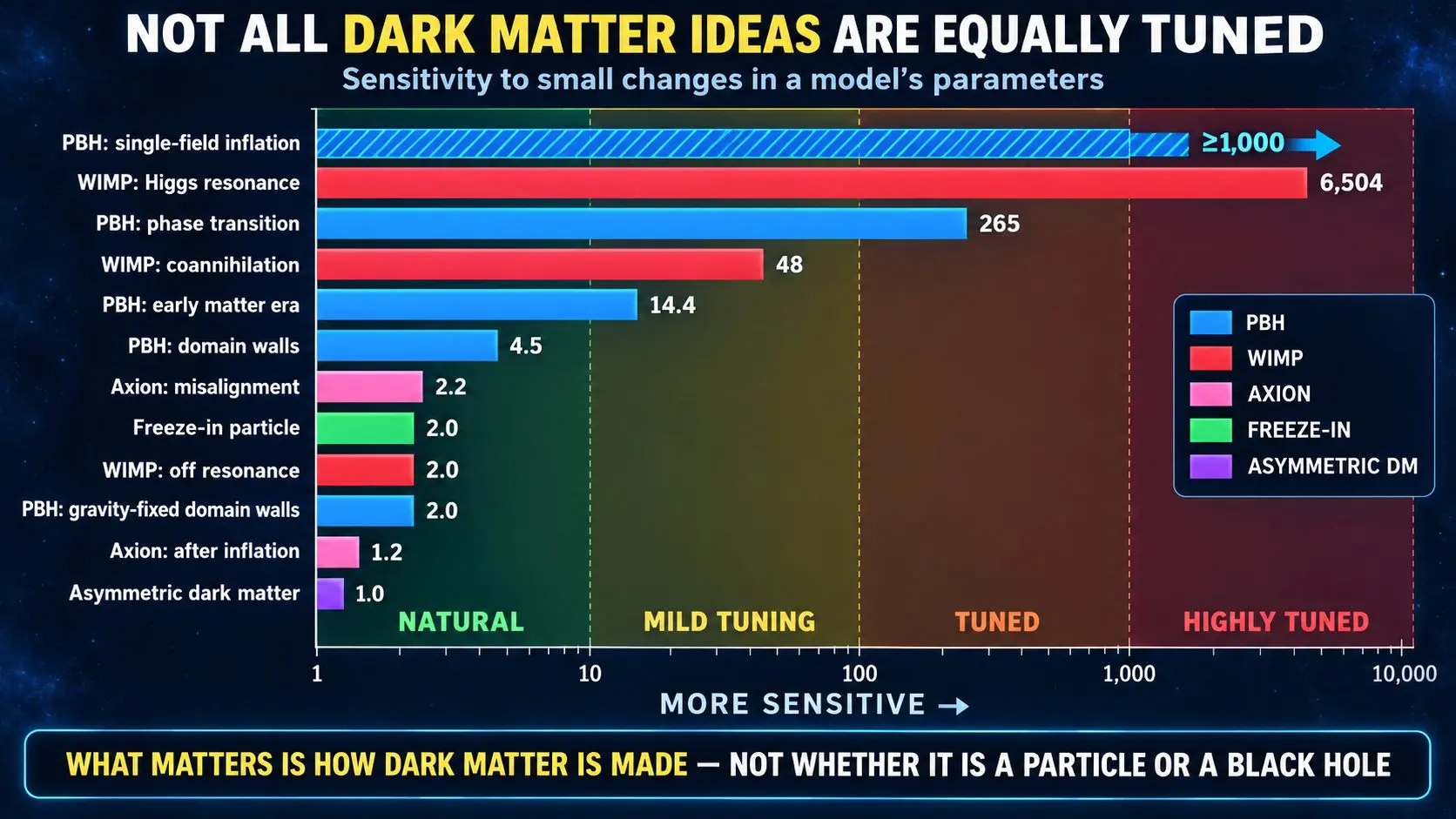
The study challenges a prevalent assumption within the field that particle dark matter is inherently more “natural” than models involving primordial black holes. Profumo discovered that certain black hole formation scenarios, specifically those involving collapsing networks of structures called “domain walls” came out among the most natural constructions in the entire study, comparable to the most forgiving particle models.
Conversely, one of the most widely studied particle scenarios, dark matter annihilation through a resonance linked to the Higgs boson, ranked among the most finely tuned, demanding its parameters be constrained to within a fraction of a percent. This finding suggests that the perceived naturalness of a dark matter candidate is not determined by its fundamental composition, but rather by the mathematical structure of the model itself.
The Barbieri-Giudice measure assesses naturalness by simulating small alterations to a model’s input values and observing the resulting impact on its predictions; a model that remains stable with minor input changes is considered more natural.
Profumo’s work demonstrates that some mathematical frameworks are inherently more forgiving of imprecise assumptions, while others amplify even slight variations into significant shifts in predicted outcomes, regardless of whether the underlying physics involves particles or black holes. “Naturalness has real power as a filter for deciding where to look next,” Profumo said, emphasizing the tool’s potential to guide future research efforts.
This quantitative approach to naturalness addresses a long-standing issue in the field: the subjective and often inconsistent application of the concept across different theoretical frameworks. Previously, researchers relied heavily on intuition and qualitative assessments, leading to potential biases in evaluating competing ideas.
The Barbieri-Giudice measure provides an objective standard, allowing for a more rigorous and impartial comparison of dark matter candidates. Profumo cautioned that it cannot be a shortcut for dismissing an entire category of ideas, like primordial black holes, just because a few individual models within that category happen to be tuned. He explained that the tuning exists within the specific model, not in the type of dark matter considered.
The implications of this research extend beyond simply re-evaluating existing dark matter candidates. By highlighting the importance of the underlying mathematical structure, Profumo’s work suggests that future model-building efforts should prioritize frameworks that are inherently robust and less sensitive to fine-tuning. This could lead to the development of more predictive and testable theories, ultimately accelerating the search for dark matter.
The study also underscores the need for caution when interpreting claims of naturalness, emphasizing that such assessments should be based on quantitative analysis rather than subjective intuition. The findings do not definitively identify a single winning dark matter candidate, but instead offer a refined methodology for comparing proposals on a level playing field. “When you actually run the numbers side by side, that story doesn’t hold up,” Profumo stated, referring to the previously held assumption of particle dark matter’s inherent naturalness.
The research is a reminder that the pursuit of dark matter requires a critical and unbiased evaluation of all potential candidates, guided by rigorous mathematical tools and a willingness to challenge established assumptions. The Barbieri-Giudice measure, therefore, represents a valuable addition to the arsenal of techniques employed by physicists in their ongoing quest to unravel the mysteries of the universe’s missing mass.
There’s a habit of treating primordial black holes as the exotic, fine-tuned alternative, and particle dark matter as the safe, natural default.
Stefano Profumo, deputy director for theory at the Santa Cruz Institute for Particle Physics



See today’s quantum computing news on Quantum Zeitgeist for the latest breakthroughs in qubits, hardware, algorithms, and industry deals.