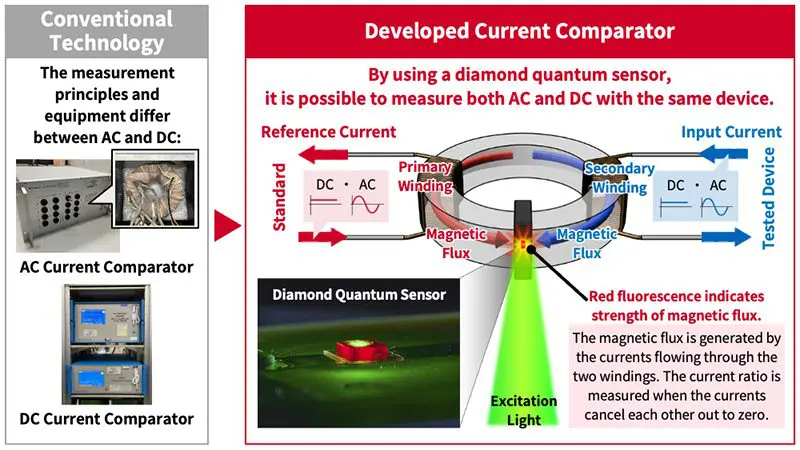
Researchers at AIST, the Institute of Science Tokyo, and the National Institutes for Quantum Science and Technology have created a single current comparator capable of evaluating both alternating and direct current ratios. Current comparators calibrate current measurement instruments vital to electric power generation, transmission and distribution. Conventionally, separate devices are used for AC and DC measurements. This development eliminates the need for a detection coil used in traditional AC measurements, miniaturizing the core component and clearing the way for unified calibration systems. The team reports, anticipating contributions to standardization in power grids.
Diamond Quantum Sensing Enables Unified AC/DC Current Ratio Evaluation
A new current comparator uses diamond-based quantum sensors to assess both alternating and direct current ratios with a single instrument, a feat previously requiring separate devices. This unified approach streamlines calibration processes essential for maintaining reliable electrical power systems, and eliminates the need for a traditional detection coil, reducing the instrument’s overall size.
Conventional AC current comparators rely on electromagnetic induction for measurement, a method incompatible with direct current, necessitating distinct systems for each current type. This separation complicates calibration and data management, particularly as power grids increasingly integrate both AC and DC sources from renewable energy.
The team’s innovation centers on using the sensitivity of diamond quantum sensors to magnetic flux, enabling accurate measurement of both AC and DC currents within the same setup, Type-I Technologies says. “Establishing measurement technology and a calibration system capable of handling both uniformly is a key challenge in promoting the wider and more efficient adoption of highly reliable current measurement throughout society,” researchers state in their published findings.
Founded in 2016 and headquartered in Chiba, Japan, QST’s approximately 1300 personnel focus on quantum technology innovation spanning sensing, materials, life science and radiological science. Recent collaborative efforts, beginning in August 2026, with TOYO Corporation and its spin-out Type-I Technologies, have focused specifically on developing NV-centre quantum sensing instruments, further solidifying QST’s position in the field. As a Q-STAR academic member, QST also plays a role in certifying spin-out companies like Type-I Technologies, supporting the commercialization of quantum technologies.
The miniaturization achieved by removing the electromagnetic induction coil represents a significant technical advancement, according to the company. The ability to accurately determine the ratio between original and converted currents, typically reducing high currents of several hundred amperes to a manageable few, is important for maintaining operational efficiency and safety. This progress is expected to contribute to the standardization of current measurement in power grids where AC and DC coexist due to the proliferation of renewable energy sources.



See today’s quantum computing news on Quantum Zeitgeist for the latest breakthroughs in qubits, hardware, algorithms, and industry deals.