Researchers from the University of Washington and Amazon Braket have achieved a first: the successful demonstration of a fermionic Laughlin state on a programmable quantum processor. This complex quantum state, embodying fractionalization and incompressibility, underpins the fractional quantum Hall (FQH) effect and offers insights into robust, fault-tolerant quantum computation. Unlike previous work that created bosonic analogs on other platforms, this research specifically realized the more intricate fermionic version, representing a key step forward in simulating complex matter. The approach utilizes IonQ’s trapped-ion quantum computers, accessed through Amazon Braket, and an efficient Hamiltonian Variational Ansatz. The researchers state that this work highlights how Amazon Braket connects academic discovery and real-world quantum applications.
Fermionic Laughlin State Realization on Trapped Ions
The successful creation of a fermionic Laughlin state on a programmable quantum processor marks a pivotal advance in condensed matter simulation, previously unrealized on a digital platform despite earlier bosonic analogs demonstrated with photons and cold atoms. This effect is not merely an academic curiosity; it holds promise for developing robust, fault-tolerant quantum computation due to the inherent stability of these exotic states. The team tackled a significant challenge: the Laughlin state’s complex interactions resist straightforward translation into the shallow quantum circuits typically used for simulation. To circumvent this limitation, the researchers developed a systematic protocol to construct an effective Hamiltonian, retaining only the dominant interaction terms.
They found that including interactions up to a specific range, “k + m ≤ 4,” achieved fidelity above 0.95 between the simulated state and the exact Laughlin state, computed via exact diagonalization. This careful truncation not only preserved high fidelity but also maintained the area-law entanglement scaling characteristic of a topological quantum liquid, a crucial indicator of the state’s topological properties. A less refined truncation, “k + m ≤ 3,” proved insufficient, failing to capture the full correlations necessary for an accurate representation. The HVA design incorporated two key principles: generalizing variational parameters across the lattice and utilizing the “squeezing rule of FQH physics” to order circuit layers. This approach resulted in a scalable circuit with a parameter count growing linearly with system size. Measurements were performed on IonQ’s Aria-1 (25 qubits, 98.5% two-qubit gate fidelity), requiring error mitigation strategies to overcome inherent noise.
The team combined IonQ’s native debiasing scheme with a custom symmetry-verification postselection protocol. The resulting data confirmed the hallmarks of topological order, including the expected density structure of edge modes and the incompressibility of the quantum liquid, validating the successful preparation of the fermionic Laughlin state. The researchers confirmed the achievement by extracting three independent diagnostics from the quantum hardware.
Effective Hamiltonian Construction via Interaction Truncation
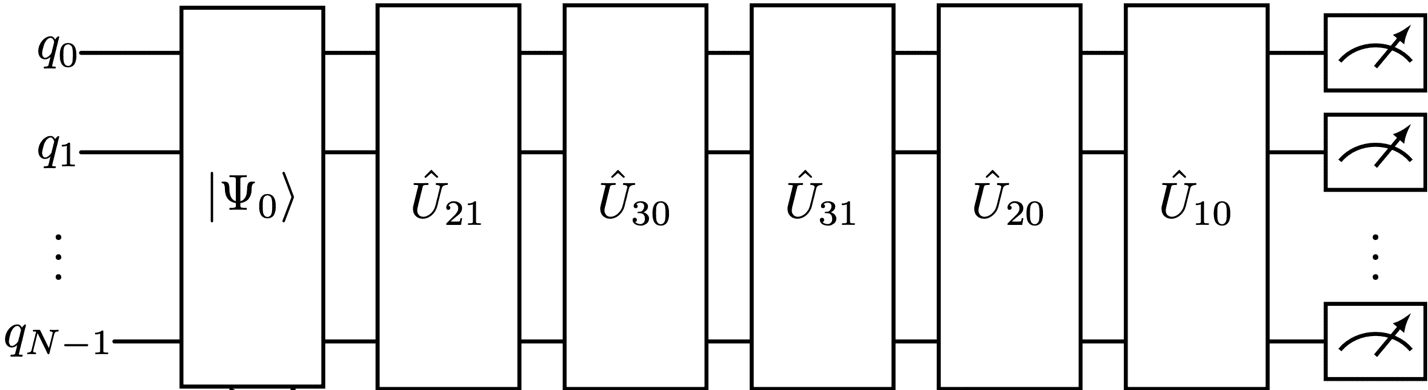
Beyond simply demonstrating the fermionic Laughlin state, a key achievement lay in the methodology used to construct an effective Hamiltonian, a simplified model capturing the essential physics. Researchers confronted the challenge that the full Hamiltonian, describing interactions between electrons, contains an impractical number of terms, scaling as O(N³) for N orbitals, making direct variational approaches untenable. This careful truncation proved crucial. This approach achieved fidelity above 0.95 between the exact Laughlin state and the ground state of the truncated Hamiltonian, as determined through exact diagonalization. The resulting effective Hamiltonian then informed the construction of a scalable Hamiltonian Variational Ansatz (HVA), translating the mathematical model into a quantum circuit. The researchers implemented two key principles to minimize circuit complexity: generalizing variational parameters across the lattice and utilizing the squeezing rule of FQH physics.
This approach allowed for a linear scaling of the total parameter count with system size. The team demonstrated that for 6 electrons (16 qubits) the circuit required 369 two-qubit gates, and for 12 electrons (34 qubits) it required 883 gates. They also found that error mitigation strategies, including IonQ’s native debiasing and a custom symmetry-verification postselection protocol, could yield meaningful results. This combination of Hamiltonian truncation and efficient circuit design represents a significant step toward simulating complex quantum matter on near-term quantum computers.
As quantum hardware continues to improve, methods like this could enable simulations of complex materials for energy, electronics, and pharmaceuticals, domains where classical computation struggles.
Scalable Hamiltonian Variational Ansatz for State Preparation
This builds on prior work creating bosonic analogs of Laughlin states using photonic and cold-atom systems, but represents a leap forward by achieving the more intricate fermionic version on a digital quantum processor. The core of their approach lies in an efficient and scalable Hamiltonian Variational Ansatz (HVA). This involved carefully selecting interaction terms, guided by two key criteria: quantitative fidelity, ensuring the truncated Hamiltonian’s ground state closely matches the exact Laughlin state, and qualitative preservation of topology and entanglement. The HVA itself is designed for scalability, with circuit layers corresponding to unitary evolutions generated by each interaction term. The researchers implemented two principles to keep the circuit compact, and importantly, parameters optimized on smaller systems can be directly transferred to larger ones as warm starts without reoptimization.
Laughlin State Diagnostics via Observable Extraction
The implications extend beyond fundamental physics, potentially informing the design of robust, fault-tolerant quantum computation schemes leveraging topological properties. Central to verifying the successful creation of this exotic state was a meticulous process of observable extraction. The team did not simply prepare the state and assume its validity; instead, they devised a systematic protocol to measure key characteristics directly from the quantum hardware. These diagnostics focused on identifying the defining features of the Laughlin state: the density structure of edge modes, the correlation hole indicative of an incompressible quantum liquid, and the topological entanglement entropy, a measure of long-range quantum entanglement. IonQ’s Aria-1 reported a mean two-qubit gate fidelity of 98.5% on the execution used for these measurements, when compared to exact diagonalization benchmarks. This careful truncation of the Hamiltonian, balancing accuracy and computational feasibility, was critical.
We demonstrate an end-to-end workflow, from Hamiltonian design and ansatz construction to error mitigation and observable extraction, that captures the defining diagnostics of the Laughlin state: density structures of the edge modes, the correlation hole of an incompressible quantum liquid, and the topological entanglement entropy.
Amazon Braket Implementation on IonQ Quantum Computers
The pursuit of simulating complex materials using quantum computers often runs into a surprising roadblock: systems easily described mathematically become computationally intractable for even the most powerful classical supercomputers, yet remain challenging to realize on current quantum hardware. The significance lies in the nature of the Laughlin state itself, embodying fractionalization, anyonic excitations, and incompressibility, hallmarks of the fractional quantum Hall (FQH) effect. These properties are not merely academic curiosities; they underpin potential advancements in robust, fault-tolerant quantum computation. The team tackled the inherent difficulty of simulating strong electron-electron interactions, which lack simple mappings to short-depth quantum circuits. Measurements were performed on IonQ’s 25-qubit Aria-1 device, accessed via Amazon Braket, and reported a mean two-qubit gate fidelity related to the execution performed on Aria-1.




See today’s quantum computing news on Quantum Zeitgeist for the latest breakthroughs in qubits, hardware, algorithms, and industry deals.