This is the 2026 reference guide to quantum computing terms. Below you will find a complete, structured tour of the glossary, covering theory, applications, and current research. Each section treats these definitions as a serious subject with concrete examples and references.
Top 20 Quantum Computing Terms You Need to Know
The essential vocabulary for understanding the quantum era
Quantum computing is reshaping the boundaries of what computers can do, but the field comes with its own dense vocabulary. Whether you are an investor evaluating quantum companies, a developer exploring quantum SDKs, or simply curious about the technology, these 20 terms form the conceptual core you need to get started.
Qubit
A qubit, short for quantum bit, is the basic unit of quantum information. Unlike a classical bit, which can be either 0 or 1, a qubit can exist in a superposition of both states simultaneously. The state of a qubit is represented as a linear combination of the basis states |0⟩ and |1⟩, with complex coefficients called amplitudes. Qubits can be implemented using various physical systems, such as the spin of an electron, the polarisation of a photon, or the energy levels of a superconducting circuit.
Superposition
Superposition is a fundamental principle of quantum mechanics which states that a quantum system can exist in multiple states simultaneously until a measurement is made. In quantum computing, superposition allows qubits to represent both 0 and 1 at the same time, enabling the exploration of many computational paths in parallel. It is one of the key properties that gives quantum computers their potential advantage over classical machines.
Entanglement
Entanglement is a phenomenon where two or more quantum particles become correlated in such a way that their quantum states cannot be described independently, even when separated by large distances. Measuring the state of one particle instantaneously determines the state of the other. Entanglement is a crucial resource in quantum computing, enabling quantum teleportation, superdense coding, and many quantum algorithms.
Quantum Gate
A quantum gate is a basic operation on one or more qubits, analogous to a classical logic gate. Quantum gates are unitary transformations that manipulate the quantum state of qubits and are the building blocks of quantum circuits. Common examples include the Hadamard gate, which creates superposition, the CNOT gate, which creates entanglement, and the Pauli gates (X, Y, Z), which perform rotations on the Bloch sphere.
Quantum Circuit
A quantum circuit is the most widely used model for describing a quantum computation. It represents a sequence of quantum gates, measurements, and resets applied to a set of qubits. Quantum circuits are drawn with horizontal lines for qubits and boxes for gates, and the order of gates determines the sequence of operations. Most quantum programming languages and SDKs use the circuit model.
Decoherence
Decoherence is the loss of quantum information in a qubit caused by its unwanted interaction with the surrounding environment. It is the primary obstacle to building practical quantum computers, as it destroys the fragile superposition and entanglement states that quantum algorithms depend on. Minimising decoherence through better hardware, cryogenic cooling, and error correction techniques is one of the central engineering challenges of the field.
Quantum Error Correction (QEC)
Quantum error correction is a set of techniques that protect quantum information from errors caused by decoherence and noise. QEC works by encoding a single logical qubit across multiple physical qubits so that errors can be detected and corrected without destroying the encoded information. Codes such as the surface code are considered among the most promising paths to fault-tolerant quantum computing.
Fault-Tolerant Quantum Computing
Fault-tolerant quantum computing is the ability to perform reliable computations even in the presence of hardware errors and noise. It is achieved through quantum error correction codes and carefully designed protocols that prevent errors from propagating uncontrollably. Reaching fault tolerance is widely regarded as the critical milestone that will unlock the full potential of quantum computers for complex, commercially relevant problems.
NISQ (Noisy Intermediate-Scale Quantum)
NISQ describes the current generation of quantum computers, which have tens to hundreds of qubits but are not yet fault-tolerant. NISQ devices are characterised by relatively high error rates and limited coherence times. Despite these constraints, they are valuable for exploring quantum algorithms, running hybrid quantum-classical workloads, and demonstrating early quantum advantage on specific problems.
Quantum Supremacy / Quantum Advantage
Quantum supremacy (also called quantum advantage) is the point at which a quantum computer performs a computational task that is practically infeasible for the most powerful classical supercomputers. Google first claimed this milestone in 2019 using its Sycamore processor on a random circuit sampling task. Demonstrating quantum advantage on commercially meaningful problems remains an active area of research and competition.
Shor’s Algorithm
Shor’s algorithm is a quantum algorithm that can factor large numbers exponentially faster than the best known classical algorithms. Developed by Peter Shor in 1994, it has profound implications for cryptography because widely used public-key systems such as RSA rely on the difficulty of factoring. Shor’s algorithm is a major driver behind the development of post-quantum cryptography.
Grover’s Algorithm
Grover’s algorithm is a quantum search algorithm that finds a target item in an unsorted database of N entries in O(√N) time, providing a quadratic speedup over the O(N) required classically. It works by iteratively amplifying the probability amplitude of the desired state. Grover’s algorithm has broad applications in optimisation, machine learning, and database searching.
Quantum Annealing
Quantum annealing is an optimisation technique that uses quantum fluctuations to find the global minimum of an objective function. The system starts in a superposition of all possible solutions and gradually evolves towards the optimal one. Quantum annealing is the approach used by D-Wave Systems and is primarily applied to combinatorial optimisation, logistics, and machine learning problems.
Superconducting Qubit
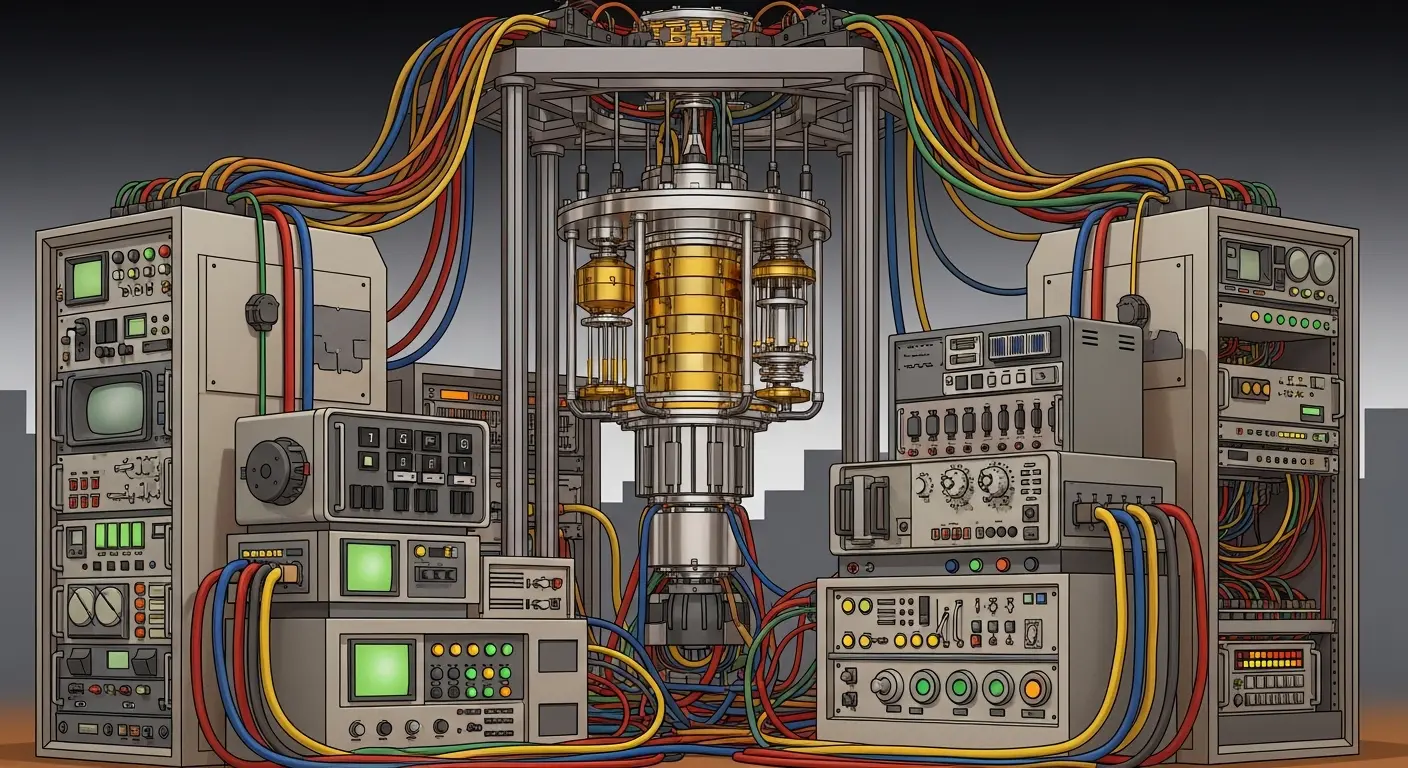
A superconducting qubit is a type of qubit built from superconducting circuits, typically incorporating Josephson junctions as nonlinear elements. Operated at millikelvin temperatures in dilution refrigerators, superconducting qubits are the platform used by Google, IBM, and Rigetti, among others. The transmon qubit is the most widely deployed variant, offering a good balance of coherence time and insensitivity to charge noise.
Trapped-Ion Quantum Computing
Trapped-ion quantum computing uses individual ions confined in electromagnetic traps as qubits. Quantum gates are implemented with precisely controlled laser or microwave pulses. Trapped-ion systems have demonstrated the longest coherence times and highest gate fidelities of any qubit platform, with companies such as IonQ and Quantinuum leading commercialisation efforts.
Quantum Volume
Quantum volume is a metric introduced by IBM to quantify the overall capability of a quantum computer. It accounts for the number of qubits, their connectivity, gate error rates, and measurement fidelity. A higher quantum volume indicates a more capable device. While useful for benchmarking, quantum volume is just one of several metrics used to evaluate quantum hardware performance.
Quantum Key Distribution (QKD)
Quantum key distribution is a method for establishing a shared secret key between two parties with security guaranteed by the laws of physics rather than computational assumptions. Protocols such as BB84 and E91 exploit quantum properties to detect any eavesdropping attempt. QKD is one of the most mature quantum technologies and is already deployed in commercial networks.
Post-Quantum Cryptography
Post-quantum cryptography (also called quantum-resistant or quantum-safe cryptography) refers to cryptographic algorithms designed to be secure against attacks by both classical and quantum computers. With Shor’s algorithm threatening current public-key systems, standards bodies such as NIST have been developing and standardising post-quantum algorithms based on lattice problems, hash functions, and error-correcting codes.
Variational Quantum Eigensolver (VQE)
VQE is a hybrid quantum-classical algorithm for finding the ground state energy of a quantum system. A quantum computer prepares a parameterised trial state while a classical optimiser tunes the parameters to minimise the energy. VQE is one of the most promising near-term algorithms, with applications in quantum chemistry, materials science, and drug discovery.
Quantum Teleportation
Quantum teleportation is a protocol that transfers an unknown quantum state from one location to another using shared entanglement and classical communication, without physically moving the particle itself. It is a fundamental building block for quantum networks, distributed quantum computing, and the future quantum internet. Quantum teleportation has been experimentally demonstrated over distances exceeding 1,000 kilometres via satellite.
External reference for quantum computing terms: Wikipedia survey of core quantum computing terms.
Quantum computing terms 2026 Outlook
The These definitions that beginners need to know shifted slightly during 2024-2026 with the rise of three new vocabulary categories: error-corrected logical qubits (Google Willow, IBM Heron), modular and networked quantum computing (Quantinuum H2, IBM Quantum System Two), and hybrid HPC-quantum workflows. Older terms like NISQ and quantum supremacy have not disappeared but their relative weight in industry discourse has dropped. The Google Willow logical qubit Nature paper (December 2024) exemplifies the new error-corrected vocabulary now entering mainstream The vocabulary.Why The Glossary Matters
Knowing the This terminology matters because most quantum computing news depends on precise distinctions that are easy to miss: quantum supremacy is not the same as quantum advantage, fidelity is not the same as error rate, and a logical qubit is not the same as a physical qubit. Without the glossary, news headlines about quantum milestones are easy to misinterpret in either direction (over-hyped or under-appreciated). A working vocabulary lets a beginner read industry announcements, research papers, and policy documents on quantum computing without being misled.The New Error-Correction Vocabulary
The The field’s vocabulary most worth learning in 2026 are the error-correction terms that have moved from research-only to industry mainstream: surface code, logical qubit, code distance, threshold theorem, magic state distillation, and lattice surgery. Google’s Willow chip (December 2024) demonstrated below-threshold operation of a surface code, and IBM Heron achieved similar milestones during 2025. These The term list were academic curiosities five years ago; they are now core working vocabulary for industry practitioners and the journalists covering them.What Comes Next
By 2030 the next wave of The glossary that beginners will need to know are likely to centre on networked quantum computing (entanglement distribution, quantum repeaters, quantum links, distributed algorithms), application-domain vocabulary (quantum chemistry, quantum optimisation, quantum machine learning), and the post-quantum cryptography terms (lattice-based, hash-based, code-based). The glossary will keep growing as the field matures, and an updated vocabulary list every two years remains a useful resource for new entrants.Quantum computing terms FAQ
What are the most important Quantum computing terms to learn first?
The most important Quantum computing terms for beginners are qubit (a two-state quantum system that is the basic unit of quantum information), superposition (a linear combination of basis states), entanglement (a correlation between qubits that cannot be reproduced classically), quantum gate (a unitary transformation applied to one or more qubits), and measurement (the operation that collapses a qubit to a classical bit). With these five terms a beginner can read most introductory material; the rest are extensions or operational details.
What is the difference between quantum supremacy and quantum advantage?
Two of the most-confused Quantum computing terms: quantum supremacy means a quantum computer performs a task that no classical computer could practically perform, regardless of whether that task is useful. Google claimed quantum supremacy with Sycamore in 2019 on a random circuit sampling task. Quantum advantage means a quantum computer performs a useful task faster, cheaper, or with higher quality than the best classical alternative. Quantum advantage is the higher bar and remains an active goal for industry as of 2026.
What is a logical qubit in Quantum computing terms?
A logical qubit is one of the most important Quantum computing terms of 2024-2026: a logical qubit is an error-corrected qubit built from many physical qubits using a quantum error-correcting code (typically the surface code). A single logical qubit may use 49, 105, or even 1000+ physical qubits depending on the code distance. Google’s Willow chip in December 2024 demonstrated the first below-threshold logical qubit, meaning increasing the code distance reduces the logical error rate, which is the gateway condition for fault-tolerant quantum computing.
What does NISQ mean in Quantum computing terms?
NISQ is one of the foundational Quantum computing terms coined by John Preskill in 2018: Noisy Intermediate-Scale Quantum. The NISQ era refers to quantum computers with 50 to 1000 noisy physical qubits without practical error correction, which is the regime current commercial quantum hardware operates in. The NISQ era is contrasted with the future fault-tolerant era when error-corrected logical qubits enable arbitrary-depth quantum circuits. As of 2026 the field is transitioning out of pure NISQ as logical qubits become available, but most commercial workloads still run on NISQ-era hardware.



See today’s quantum computing news on Quantum Zeitgeist for the latest breakthroughs in qubits, hardware, algorithms, and industry deals.