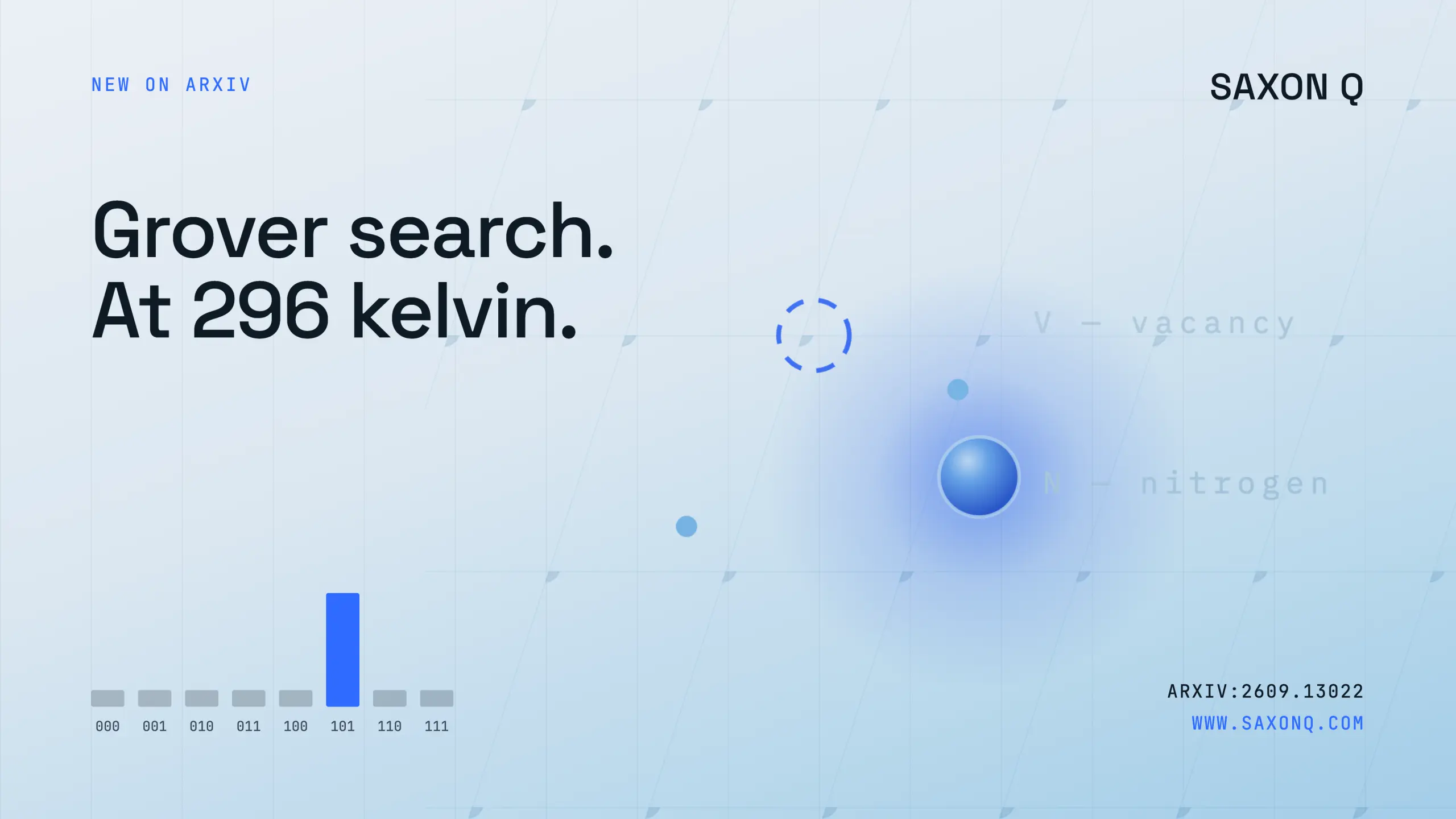
Fraunhofer IWU and SAXON Q report an 87.0% success probability for finding two marked states in an eight-state search, exceeding the 46.4% classical limit on a commercial, room-temperature quantum computer. The demonstration, performed at an average temperature of 296.3 Kelvin in open air, contrasts sharply with cryogenic systems requiring tens of kilowatts of power.
Researchers utilized nitrogen-14 and carbon-13 nuclei as qubits, retaining quantum state for milliseconds, roughly a thousand times longer than the system’s electron spin used for read/write operations. This approach, detailed on arXiv, exercises a full stack of gates with Grover’s algorithm, a standard stress test for quantum processors.
Three-Qubit Grover Search Achieves 87% Success on Room-Temperature Diamond
Achieving an 87.0% success probability, a three-qubit Grover search performed by SAXON Q IWU located two target states within an eight-state problem, exceeding the 46.4% limit possible with classical computers. This demonstration used a commercial quantum computer operating at 296.3 Kelvin, a standard room temperature, and in open air, a stark contrast to the cryogenic conditions demanded by many competing systems. The only published result higher, 89.4% on a silicon spin qubit processor, required temperatures of 15 millikelvin and readout post-selection.
The system’s qubits were not based on electron spins, a common approach, but instead used the nuclear spins of nitrogen-14 and two carbon-13 nuclei embedded within a diamond lattice. This extended coherence is attributed to the shielding effect of the surrounding carbon lattice, providing a stable environment for quantum information storage.
Single-qubit gate fidelities reached 99.98%, with an average single-qubit Clifford fidelity of 99.90%, while two-qubit subspace gate fidelities averaged 95.7%. Grover’s algorithm was selected as a benchmark because it provides a quadratic speedup over classical search methods and rigorously tests the full stack of quantum gates.
The IWU and SAXON Q system operates much like a solid-state ion trap, eliminating the need for vacuum pumps, cryostats, or optical traps required by trapped-ion systems, which have previously demonstrated 44 to 69% success rates in similar searches, the company says. The full details of this work are available on Arxiv.org.


See today’s quantum computing news on Quantum Zeitgeist for the latest breakthroughs in qubits, hardware, algorithms, and industry deals.