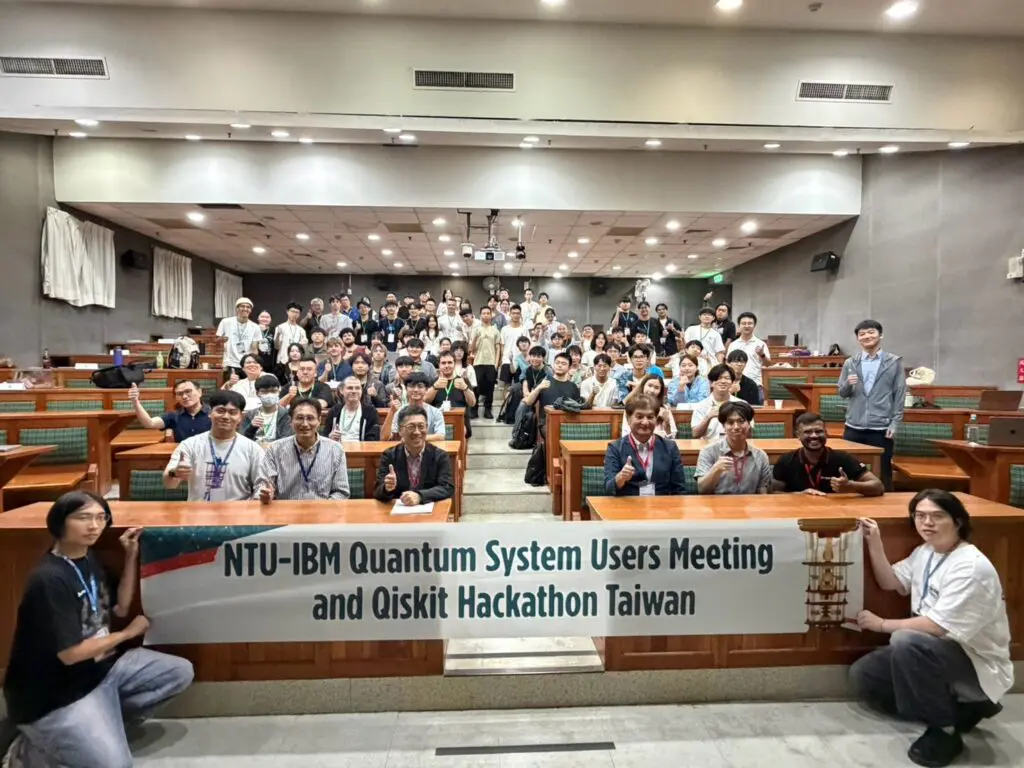
The National Taiwan University-IBM Quantum Computer Center recently concluded its 2026 Quantum Computing Hackathon, held August 12-14 within the Department of Physics and Solid State Theory Center at National Taiwan University. Established in January 2019 with funding from the National Science and Technology Council, the center hosted the event after a cancellation due to the pandemic in 2021. This year’s Hackathon drew over 80 participants and included international collaboration with teams in Japan, South Korea, and the Czech Republic, demonstrating progress in quantum computing education and outreach.
2026 Hackathon Highlights International Quantum Computing Collaboration
International collaboration was a key feature, with teams from Keio University in Japan, Yonsei University in South Korea, and the Czech Technical University in Prague joining Taiwanese participants. One winning team developed a variational quantum circuit framework requiring only 70 trainable parameters, significantly fewer than the 1282 of standard multilayer perceptron models.
Several teams focused on mitigating limitations in quantum computation; one explored tensor network-based approximate quantum compilation to compress time evolution circuits, while another tackled catastrophic forgetting in quantum continual learning. The event also showcased the potential of quantum reinforcement learning, with a team successfully reproducing 16 correct action decisions out of 16 on IBM’s Marrakesh quantum hardware, demonstrating progress in both algorithm design and hardware utilization.




See today’s quantum computing news on Quantum Zeitgeist for the latest breakthroughs in qubits, hardware, algorithms, and industry deals.