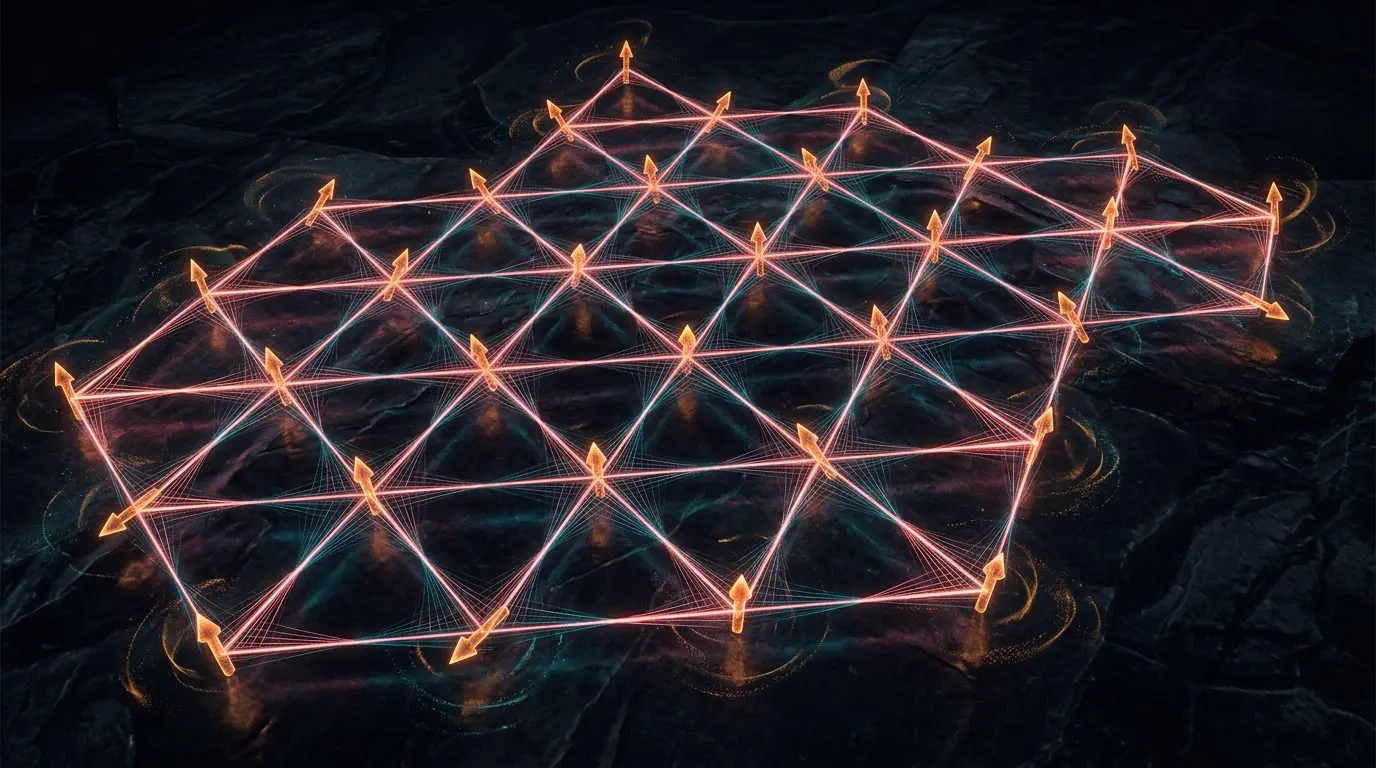
A new method for simulating quantum systems sharply reduces computational demands compared with previous approaches. It focuses on geometrically local Hamiltonians, where interactions occur only between nearby components, enabling more efficient digital simulations that better reflect natural quantum dynamics. Methods for modelling quantum systems using computers have been refined by lessening the computational resources needed for accurate simulations.
This improvement centres around how calculations are performed within these models; specifically, it streamlines processes for spatially confined scenarios where interactions happen only between nearby components. The team achieved near-optimal circuit depth, a measure of simulation efficiency, establishing fundamental limits regarding precision and opening new possibilities in understanding complex quantum behaviour. Researchers at Peking University devised an improved method for simulating quantum systems by reducing computational demands while maintaining accuracy.
This advancement focuses on ‘geometrically local Hamiltonians’, envisioning building with LEGO bricks where the Hamiltonian describes how each brick interacts only with its immediate neighbours to create a structure, this limits interactions to nearby components within the system. The team achieved near-optimal ‘circuit depth, akin to minimising layers in an assembly line for faster processing without sacrificing precision, establishing fundamental limitations regarding simulation accuracy.
By refining spatial decomposition techniques like breaking down a large map into smaller sections, they reduced logarithmic overhead from previous methods and clarified the relationship between locality and precision in complex simulations. However, determining how close these new circuits are to achieving ultimate efficiency remains an open question that their detailed analysis now addresses.
Logarithmic scaling reduces complexity for Hamiltonian simulations
Circuit depth for simulating *n*-qubit Hamiltonians has improved dramatically to O(*T* log(*nT*/ε)) from previously at O(*T* polylog(*nT*/ε)). This reduction enables simulations demanding less computation compared to prior methods that struggled as qubit numbers rose. The approach uses spatially localized corrections within logarithmic-scale blocks derived from the Lieb, Robinson decomposition, allowing exponential accuracy without increasing asymptotic circuit depth. A lower bound of Ω(log *n*/log *n*) exists for nearest-neighbour circuits simulating uniform XXZ Hamiltonians, confirming near-optimal performance and clarifying fundamental limits in quantum computation.
A gate count of O(*nT* log(*nT*/ε)) represents substantial gains over previous approaches. Finite-range Hamiltonians on fixed dimension lattices achieve this efficiency; confirmation comes through an unconditional lower bound of Ω(log *n*/log *n*) established for nearest-neighbour circuits simulating uniform XXZ Hamiltonians. Practical implementation currently requires substantial qubit numbers and connectivity because it assumes sufficiently large lattices to accommodate those logarithmic regions.
Lieb, Robinson decomposition enables efficient error correction within localised qubit computations
The breakthrough hinged upon a technique mirroring the breakdown of a large map into smaller sections: the Lieb, Robinson decomposition. This mathematical tool simplifies complex interactions in quantum systems by initially focusing on connections between nearby components before considering more distant relationships.
Applying this to an *n*-qubit Hamiltonian, where ‘n’ represents the number of qubits and the ‘Hamiltonian describes all their possible interconnections, created spatially localized blocks for computation. These allowed addressing errors using constant-order product formulas compensated through corrections implemented at depths proportional only to block size; computational demands remained manageable without sacrificing accuracy when simulating quantum behaviour.
Consequently, these localised blocks enable error correction with scaling dependent on block size rather than total qubit count. Achieving circuit depth comparable to theoretical limits for lattice Hamiltonian simulation is now possible, specifically matching an upper bound of O (log n).
Doubly Logarithmic Factors Bring Efficient Quantum Dynamics Simulations Closer to Theoretical Limits
Accurately modelling the behaviour of complex quantum systems remains a formidable challenge and is vital across fields like materials science and drug discovery. Near-optimal efficiency in simulating specific types of quantum dynamics has been achieved but relies on finite-range Hamiltonians within fixed lattices; researchers acknowledge this limitation. While they have successfully narrowed the gap with established theoretical lower bounds to just doubly logarithmic factors, fully eliminating it proves elusive.
This advance clarifies fundamental principles governing spatially constrained computation demonstrating how spatial localisation directly influences simulation precision. Utilising this mathematical tool, breaking down complex interactions into manageable blocks, circuit depth scales with only one logarithmic factor. This contrasts sharply with previous methods burdened by multiple such factors representing an improvement in computational efficiency and bringing simulations closer than ever before to their theoretical limits.
The research demonstrated a quantum circuit simulating the dynamics of an n-qubit Hamiltonian with improved efficiency. By utilising spatially localised blocks within the system, researchers reduced the polylogarithmic overhead previously required for accurate digital simulation to a single logarithm. This means that circuits can now achieve depths scaling more closely to established theoretical lower bounds for lattice Hamiltonian simulation, specifically O(log n). The method compensates errors using corrections proportional to block size, maintaining accuracy without increasing overall computational demand; authors suggest this approach offers benefits when working with finite-range Hamiltonians on fixed lattices.
👉 More information
🗞 Toward Optimal Circuit Depth for Geometrically Local Hamiltonian Simulation
✍️ Zhenyu Shen, Xiao Yuan and Yukun Zhang (Peking University); Yusen Wu (Beijing Normal University); Penghui Yao (Nanjing University)
🧠 ArXiv: https://arxiv.org/abs/2610.01839



See today’s quantum computing news on Quantum Zeitgeist for the latest breakthroughs in qubits, hardware, algorithms, and industry deals.