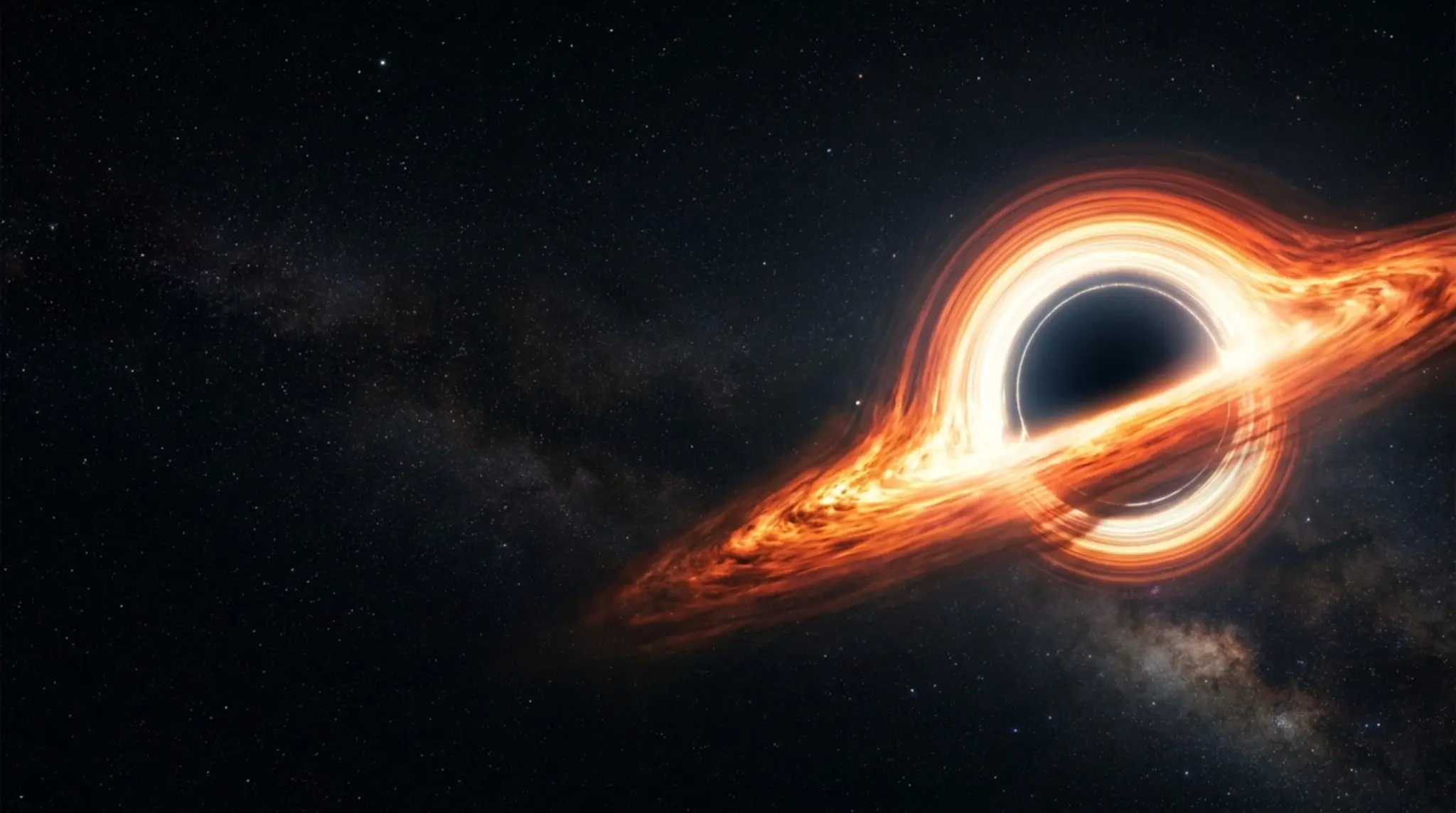
Researchers have discovered that supermassive black holes and their smaller stellar mass counterparts launch outflows governed by the same critical accretion rate. The work centers on tidal disruption events, where a star is torn apart by a black hole, providing a unique window to observe accretion flows evolving over years, a timescale impossible to study in typical active galactic nuclei.
The findings demonstrate that supermassive black holes exhibit the same accretion-outflow coupling as stellar mass black holes, establishing that the critical low accretion rate threshold for jet formation is scale invariant. This research naturally explains observed properties and detection rates for outflows in tidal disruption events, previously unsolved problems.
Tidal Disruption Events as SMBH Accretion Probes
Tidal disruption events offer a unique window into supermassive black hole accretion, revealing outflow launches during periods of super-Eddington accretion and again at a critical accretion rate identical to that observed in stellar mass black holes. This finding resolves a long-standing question regarding whether accretion-outflow coupling remains consistent across black holes of vastly different sizes, a challenge previously hampered by the extended timescales of typical active galactic nuclei.
Researchers used the relatively rapid evolution of accretion flows following tidal disruptions, occurring over years rather than millennia, to pinpoint the precise conditions triggering outflow formation. Analysis of a population of these events revealed a consistent pattern; modelled radio outflow launch times were calculated for flares, alongside the corresponding accretion rates at those moments.
The data show that outflows initiate not only during the initial, highly accreting phase but also at a specific accretion rate, a value that aligns with the critical rate known to govern state transitions and jet launches in stellar mass black holes. For example, ASASSN-14li exhibited a modelled outflow launch 44 days before its optical peak, while AT2019azh showed a launch 35 days prior. These values, and those from other observed events, consistently cluster around the critical threshold.
This scale invariance in accretion-outflow coupling is significant because it suggests a universal mechanism governing jet formation across all black hole masses. The inferred radio outflow launch dates and modelled accretion rates, as listed in the study, demonstrate a clear correlation between these parameters, providing strong evidence for a shared physical process. The ability to constrain these properties during tidal disruption events provides a new tool for probing the fundamental physics of accretion and outflow generation around black holes.
Scale Invariance of Accretion-Outflow Coupling
Prior to this work, determining this threshold in supermassive black holes proved difficult due to the extended timescales, thousands of years, over which typical active galactic nuclei evolve, hindering observation of critical transitions. Researchers used the comparatively rapid evolution of disrupted stellar remnants, spanning years, to constrain physical parameters and confirm this scale invariance. The observed mass invariance aligns with theoretical predictions suggesting a critical accretion rate threshold dependent on disk scale height and viscosity, but independent of black hole mass. The researchers write, confirming a long-held suspicion about the universality of these phenomena.
Super-Eddington Accretion and Outflow Launch in TDEs
Analysis of well-constrained tidal disruption events narrowed a sample to those with sufficient data quality to model disk behavior, ultimately excluding eleven sources with insufficient or late-time data. This focused approach allowed researchers to pinpoint accretion rates at the moment outflows initiate, revealing a surprising consistency with those observed in smaller black hole systems.
Population synthesis modeling further validated these findings, predicting a transition time remarkably close to observations. A null hypothesis test, simulating outflow launches independent of accretion flow state, revealed a significantly different distribution than observed, strengthening the conclusion that accretion rate is a key driver.
Viscous Timescales in TDE and LMXRB Disks
The viscous timescale of accretion disks formed during tidal disruption events depends primarily on the density of the disrupted star, not black hole properties. Calculations reveal this timescale is approximately 50 times the disrupted star’s radius to the power of 1.5 divided by its mass to the power of -0.5, and is independent of black hole mass to a leading order. This means the rate at which material spirals inward within these disks is dictated by the stellar material itself, offering a unique constraint on outflow mechanisms.
Low mass X-ray binaries, fueled by Roche-Lobe overflow, exhibit a strikingly similar viscous timescale. shares the same dependence on stellar characteristics. This shared scaling suggests a common underlying physics governing disk behavior across vastly different accretion scenarios, and provides a pathway to constrain disk properties through observation of the plateau-phase optical and UV luminosity in TDEs.
Modeling the full spectral energy distribution from optical to X-ray energies is important for inferring properties of TDE accretion flows. The ratio of viscous to orbital timescales, a dimensionless number expected to be significantly greater than one, varies across a population of TDEs. Researchers uniformly sampled values of this ratio, anchoring them within the range observed in disk-fits to the TDE population, as detailed in prior work.
This careful calibration allows for robust constraints on disk properties, even in the absence of detectable X-ray emission, and reinforces the conclusion that a universal critical accretion rate governs jet formation regardless of black hole size. The researchers write.
SMBH Disk Evolution Constrained by TDEs
Detailed modeling of ten tidal disruption events revealed posterior distributions of parameters influencing accretion rates, displayed in figures six and seven, allowing researchers to pinpoint disk properties and radio outflow launch dates with greater precision. These analyses focused on events where both disk parameters and radio outflow timing could be reliably determined through radio spectral observations, a method proving superior to relying on single-frequency radio lightcurves alone.
The team’s approach required robust constraints on the size of the emitting region over time, highlighting the importance of multi-frequency radio data for accurate outflow launch time determination. This finding is particularly significant given the vastly different timescales governing SMBH and stellar mass black hole systems; typical active galactic nuclei evolve over millennia, making it impossible to observe these critical transitions directly, while TDEs offer a window into SMBH accretion evolving over years.
The posterior distributions of parameters governing accretion rates at both early and late times were calculated for five TDE systems with well-constrained early X-ray emission, providing a detailed picture of disk behavior. Establishing a universality previously suspected but difficult to prove.
The analysis included consideration of the disk formation radius, a parameter for understanding early radio flares and the evolution of the inner disk, though its impact was limited in five TDEs where it was poorly constrained and did not affect late-time accretion. This work provides a natural explanation for observed properties and detection rates of both prompt and delayed outflows in TDEs, resolving long-standing questions about these energetic events and solidifying the connection between black hole accretion and outflow mechanisms across all mass scales.
Radio-X-ray Correlation in Active Galactic Nuclei
The existence of a consistent accretion rate triggering outflows across black holes of differing sizes has remained elusive until now, with supermassive black holes presenting a particular challenge due to their extended evolutionary periods. X-ray binaries, smaller black hole systems, exhibit defined accretion disk states and launch radio-emitting outflows during transitions between them; this new work demonstrates that supermassive black holes follow the same pattern.
This finding challenges the long-held assumption that jet formation mechanisms differ significantly between stellar and supermassive black holes. The team’s modeling incorporated the Kroupa initial mass function, a statistical description of the distribution of stellar masses, using a multiply broken power-law form with specific exponents for different mass ranges.
Physical Properties of Outflows in TDE Systems
Analysis of radio spectra from tidal disruption events allows scientists to estimate the minimum radius of outflowing material over time, revealing key physical properties like energy and magnetic field strength. This approach relies on modelling synchrotron emission, a process where charged particles spiral within magnetic fields, to constrain the self-absorption flux and frequency of the radio signals. Numerous studies of these TDE outflows indicate velocities consistent with approximately 0.1 times the speed of light.
These findings suggest distinct physical mechanisms drive the two temporally separate types of flares observed in TDEs. Researchers utilized the FitTeD code, a tool that solves time-dependent relativistic disk equations, to model multi-band light curves of each event. FitTeD generates a time and radius-dependent disk temperature profile, enabling the creation of light curves across various observing frequencies, including broad X-ray bands.
This modelling aims to constrain the physical properties of accretion flows at the moment radio outflows are inferred to launch from the system. By studying TDEs, which evolve on timescales of years, scientists can observe processes previously impossible to constrain in active galactic nuclei due to their millennia-long evolution.
Universal Critical Threshold for Jet Formation
Tidal disruption events reveal a consistent critical accretion rate governing outflow launch, mirroring observations from accreting stellar mass black holes, according to work published recently. This finding establishes a scale-invariant coupling between accretion flows and outflows, meaning the physics governing jet formation remains consistent regardless of a black hole’s size. Analysis of delayed flares from TDEs indicates they consistently originate when the Eddington-normalized mass accretion rate reaches around 0.02, with posterior averages confirming this value.
Prompt flares, occurring earlier in the disruption process, consistently launch at or above an accretion rate of 1, demonstrating two distinct outflow mechanisms at specific thresholds. This parallels the behavior of X-ray binaries, where disks undergo state transitions and initiate compact radio-emitting jets at a critical low accretion rate, and launch outflows during super-Eddington accretion.
The viscous timescale for LMXRB is approximately 50r⋆3/2m⋆−1/2 d, while the viscous timescale of TDE disks is approximately 50 times the disrupted star’s radius to the power of 1.5 divided by its mass to the power of -0.5. Population synthesis modeling predicted a super-Eddington phase frequency consistent with detected prompt radio outflows in TDEs.
Goodwin of the International Centre for Radio Astronomy Research, Curtin University. Andrew Mummery, of the School of Natural Sciences, Institute for Advanced Study, and colleagues utilized this approach to constrain disk properties at the precise moment radio outflows are initiated, yielding robust constraints on the physical processes at play.




See today’s quantum computing news on Quantum Zeitgeist for the latest breakthroughs in qubits, hardware, algorithms, and industry deals.