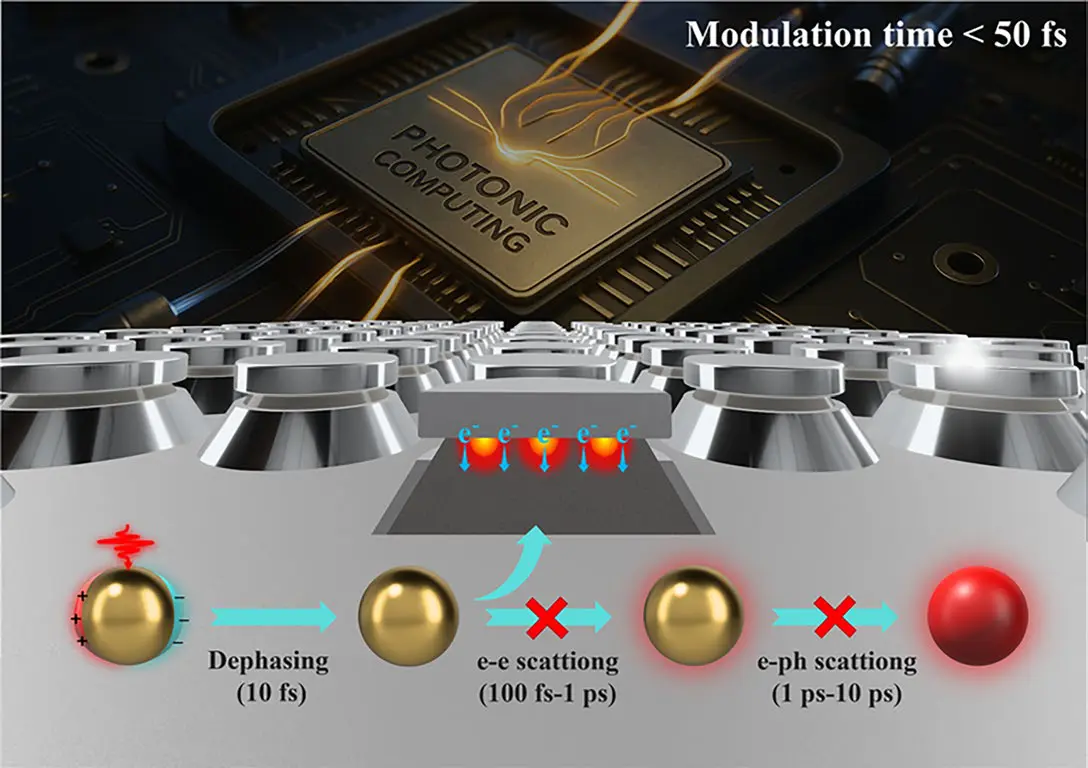
Researchers from Xiamen University and Hangzhou Dianzi University have experimentally achieved all-optical modulation in under 100 femtoseconds, a speed previously limited by electron-phonon relaxation in plasmonic materials. The team’s work centers on a metastructured silver-single-crystal silicon nanodisk antenna, designed to spatially co-localize energy deposition and metal-semiconductor transfer within a nanoscale volume, shortening hot-carrier transport pathways. This configuration establishes an interface-dominated modulation pathway that precedes electron-phonon thermalization, allowing modulation to occur before the typical speed-limiting process even begins. Published in Nano-Micro Letters, this work lays a physical foundation for ultrafast photonic modulation, with implications for femtosecond free-space computing and advanced signal processing systems.
Silver-Silicon Nanodisk Antenna Achieves Sub-100 Femtosecond Modulation
A newly designed antenna has achieved optical modulation speeds below 100 femtoseconds, surpassing the picosecond barrier previously imposed by fundamental material properties. The core of this advancement is a metastructured silver-single-crystal silicon nanodisk antenna (SSDMA), engineered to overcome limitations in conventional plasmonic materials. The team’s innovation is not simply material selection, but a deliberate architectural approach; the nanodisk design spatially co-localizes plasmonic energy deposition with the metal-semiconductor transfer boundary within a nanoscale-confined volume. This precise configuration dramatically reduces the distance hot carriers must travel, accelerating the extraction process. The researchers write that by enabling modulation on timescales comparable to intrinsic electronic response limits, they’ve established a pathway for ultrafast photonic modulation, opening doors for applications like femtosecond free-space photonic computing and temporal optical gating.
The conventional challenge in ultrafast optics is caused by lattice heating, but the SSDMA actively minimizes this effect by swiftly extracting energy before significant thermalization occurs. This interface-dominated modulation pathway, which precedes electron-phonon thermalization, represents a departure from traditional limitations. Using femtosecond pump-probe spectroscopy, the team verified their technology step-by-step, confirming the sub-100 femtosecond modulation. The implications extend beyond fundamental physics; the researchers envision a future where data processing and signal control occur with near-instantaneous speed. They state that as these metastructures are integrated into larger systems, sub-100 fs photonic processing is no longer a theoretical goal but a practical possibility, highlighting the potential for a new generation of photonic components. The journal Nano-Micro Letters has a JCR Impact Factor of 36.3 and a 2024 CiteScore of 53.1, reflecting its prominence in the field of nanophotonics.
Interface-Governed Carrier Dynamics Bypass Electron-Phonon Limits
The pursuit of ever-faster photonic computing has long been hampered by a fundamental constraint: the speed at which excited electrons lose energy to the material’s atomic lattice, a process known as electron-phonon relaxation. Conventional plasmonic modulators, while promising for manipulating light at nanoscale dimensions, typically operate within the picosecond range due to this bottleneck, limiting data throughput and energy efficiency. Recent work published in Nano-Micro Letters details a novel architecture that circumvents this limitation, achieving experimentally resolved all-optical modulation in under 100 femtoseconds, a timeframe previously considered unattainable. This precise configuration is not simply about faster materials; it’s about a fundamentally different mechanism. This breakthrough was verified using femtosecond pump-probe spectroscopy, allowing the team to demonstrate a stepwise confirmation of their technology’s efficiency. The researchers noted that the primary challenge in ultrafast optics is persistent lattice heating, which limits both switching contrast and recovery speed. By engineering the nanostructure to immediately extract energy before it heats the lattice, they effectively bypassed this issue. 1.
However, the intrinsic electron-phonon relaxation bottleneck in plasmonic materials has long constrained modulation speeds to the picosecond regime, hindering the realization of sub-100 fs modulation.



See today’s quantum computing news on Quantum Zeitgeist for the latest breakthroughs in qubits, hardware, algorithms, and industry deals.