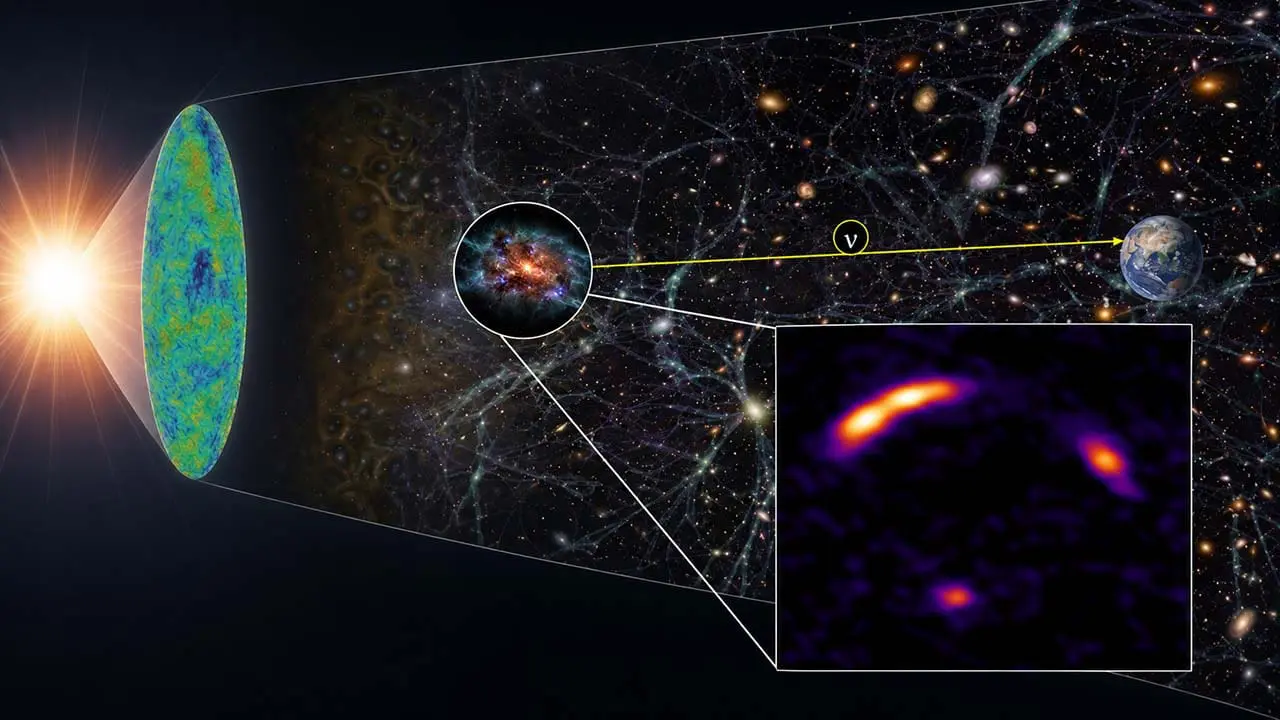
Astronomers have traced a high-energy neutrino burst, designated IC 210922A, back to an unexpectedly star-filled origin. Using the Atacama Large Millimeter/submillimeter Array (ALMA), an international team identified the galaxy JCMT0402−, nicknamed Shadow Blaster and located 11 billion light-years away, as the source. The team initially expected to find a supermassive black hole powering the remarkably bright galaxy, but observations revealed vigorous star formation as the driving force, challenging previous assumptions about the origins of these enigmatic cosmic particles. The team leveraged gravitational lensing, where a foreground galaxy created four distorted images of Shadow Blaster, to confirm the distant galaxy as the neutrino’s source, offering important observational evidence to help explain the mysterious origin of cosmic neutrinos.
ALMA Identifies “Shadow Blaster” Source of Neutrino Event IC 210922A
A galaxy once thought to harbor a powerful supermassive black hole is surprisingly fueled by intense star formation, a discovery reshaping our understanding of high-energy neutrino origins. The source, designated JCMT0402− and nicknamed Shadow Blaster, was pinpointed as the origin of the neutrino event IC 210922A detected by the IceCube Neutrino Observatory at the South Pole through observations with the Atacama Large Millimeter/submillimeter Array (ALMA). This identification addresses a long-standing puzzle; astronomers have struggled to reconcile the number of observed high-energy neutrinos with the limited number of galaxies definitively linked to their production. Located approximately 11 billion light-years away, Shadow Blaster presented a unique observational challenge due to its obscuration by dust and faintness in visible light, but it shines brightly at submillimeter wavelengths.
ALMA’s observations revealed no energetic emission indicative of a black hole, instead suggesting that the galaxy’s gas and dust are heated by vigorous star formation occurring within a remarkably compact core spanning 1,500 light-years. Analysis of this core revealed an extremely high density of gas and dust, a condition conducive to neutrino production, leading researchers to propose an alternative pathway for these enigmatic particles. They estimate that populations of similar compact, dusty starburst galaxies undergoing intense star formation could account for as much as 20% of the observed high-energy neutrino background, shifting the focus from black holes to star-forming regions as primary neutrino emitters.
A population of compact dusty starburst galaxies undergoing intense star formation may contribute a significant fraction, possibly up to around 20%, of the high-energy neutrino background.
Yuji Urata (MITOS Science CO., LTD. / National Central University, Taiwan)
Intense Star Formation in JCMT0402− Drives Neutrino Production
The team benefited from a phenomenon known as gravitational lensing, where the gravity of a foreground galaxy magnified and distorted the light from Shadow Blaster, creating four distinct images. This allowed for detailed study despite the galaxy’s immense distance and inherent faintness. ALMA’s observations revealed no evidence of a powerful black hole, instead indicating that intense star formation heats the gas and dust within Shadow Blaster, creating conditions conducive to neutrino production. Analysis pinpointed a region within the galaxy containing a large amount of gas and dust packed into an area only about 1,500 light-years across, an environment capable of generating these elusive particles.
Analysis revealed that the central region of Shadow Blaster contains a “compact core,” where a large amount of gas and dust is packed into a region only about 1,500 light-years across.




See today’s quantum computing news on Quantum Zeitgeist for the latest breakthroughs in qubits, hardware, algorithms, and industry deals.