

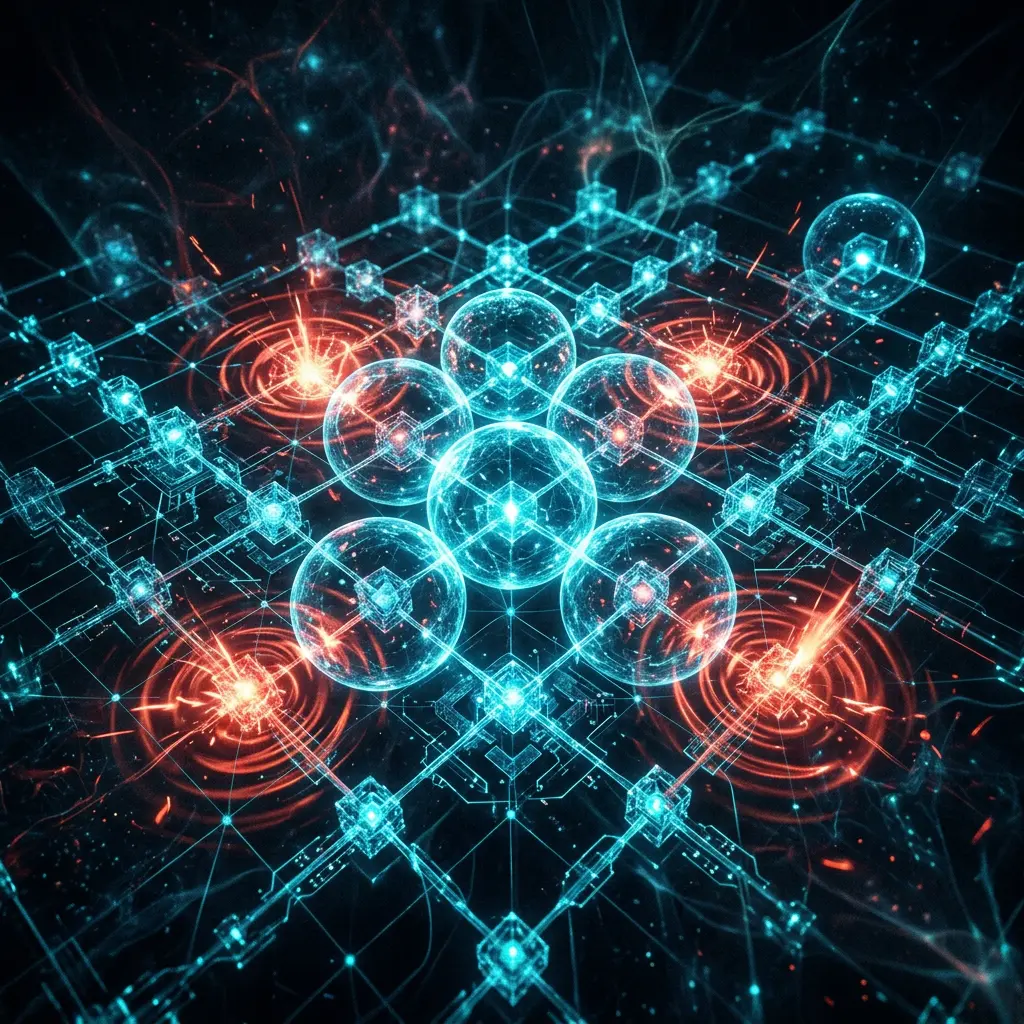
Researchers at the Nagoya University have discovered a surprising link between the acceleration of a moving mirror and the amount of quantum entanglement it generates. The work demonstrates that non-monotonic, time-dependent acceleration, or complex acceleration patterns, increases the amount of entanglement accessible to detectors. This simplified model is used to investigate Hawking radiation and black hole evaporation by quantifying entanglement between detector modes defined by window functions on a quantum field. The study further indicates that negative energy flux emitted by the moving mirror acts as a channel through which information can be returned, offering a new perspective on the long-standing information loss puzzle associated with black hole evaporation.
Moving Mirror Model & Ray-Tracing Function
Complex acceleration patterns applied to a moving mirror can increase the detectable quantum entanglement between detectors. This finding, emerging from research at the Nagoya University, reveals that the amount of entanglement increases with non-monotonic acceleration. The core of this investigation lies in understanding how information escapes a black hole as it evaporates, a problem known as the information loss puzzle. Researchers defined two localized Gaussian modes, detector modes An and B, placed at future null infinity to serve as probes for entanglement encoded in the emitted radiation. To quantify this relationship, the team studied three different classes of mirror trajectories, comparing the outgoing energy flux with the entanglement negativity of the detector modes. Their results reveal that during periods of negative energy flux emission, the observed entanglement negativity surpasses that of the standard Minkowski vacuum state.
This correlation between negative flux and increased entanglement is interpreted as a mechanism through which information can be returned, supporting the idea that information isn’t truly lost but rather encoded and retrieved through these quantum interactions. The paper reports that “the nature of the quantum correlations between detector modes An and B is strongly correlated with the dynamics of their partner particles,” highlighting the geometrical optics limit where partner particle trajectories are governed by the ray-tracing function. The team employed the partner formula and explicitly derived the profile of the partner mode that purifies detector mode A, further validating their claim that the occurrence of a negative radiation flux genuinely indicates the retrieval of the partner particles.
Current investigations into the quantum nature of black hole evaporation are increasingly reliant on simplified models that capture key theoretical challenges. This technique allows for a quantifiable analysis of Hawking radiation and the subtle entanglement that may hold the key to resolving the information loss paradox. The team’s recent work focuses on how the acceleration profile of this moving mirror impacts the generation of quantum entanglement between detectors placed at future null infinity. They discovered that non-monotonic, time-dependent acceleration increases the amount of entanglement, accompanied by the emission of negative energy flux. This negative energy flux acts as a channel through which information can be returned, suggesting a mechanism for information retrieval. This construction supports the claim that the occurrence of negative radiation flux genuinely indicates the retrieval of these partner particles, essential for maintaining unitarity, the principle that quantum information is never truly lost.
The Department of Physics, Graduate School of Science, Nagoya University, is investigating the quantum entanglement properties of analog Hawking radiation produced by a moving mirror. Rather than directly observing these phenomena, which remain experimentally inaccessible, researchers are defining two detector modes to measure entanglement and gain insight into the underlying quantum mechanics. This setup doesn’t rely on physical mirrors, but a model allowing precise control over acceleration profiles and the resulting quantum radiation. A surprising finding emerges from their analysis: entanglement isn’t maximized by smooth mirror trajectories. Instead, the amount of entanglement increases when the mirror follows trajectories with non-monotonic, time-dependent acceleration. This result suggests a complex relationship between acceleration patterns and quantum effects. The researchers discovered that these trajectories are accompanied by the emission of negative energy flux, central to their interpretation of information retrieval. They report that “during the intervals when this negative flux is emitted, the observed entanglement negativity exceeds the value associated with the Minkowski vacuum state,” indicating a heightened degree of quantum correlation.
Researchers are utilizing a moving mirror setup to investigate Hawking radiation and the quantum entanglement that underpins it. This indicates a mechanism by which information can be returned via negative energy flux, potentially resolving the unitarity issues inherent in black hole evaporation scenarios. The work demonstrates that the recovery of partner particles is linked to the conservation of information and the overall unitarity of the system.
Counterintuitively, the path a mirror takes through spacetime dramatically influences the degree of quantum entanglement detectable in the radiation it generates. Using two detector modes defined through window functions on a quantum field, the researchers quantify the bipartite entanglement established between these modes. Crucially, the study suggests that negative energy flux acts as a channel through which information can be returned. The research investigates one proposal, the vacuum fluctuation scenario, where vacuum fluctuations act as purification partners for Hawking radiation, offering a potential pathway to resolve the information loss puzzle and maintain unitarity, the principle that quantum evolution should be reversible, within the system.
👉 More information
🗞 Energy Flux as an Entanglement Current in Moving-Mirror Radiation
✍️ Yasusada Nambu and Riku Yoshimoto
🧠 ArXiv: https://arxiv.org/abs/2607.19763
See today’s quantum computing news on Quantum Zeitgeist for the latest breakthroughs in qubits, hardware, algorithms, and industry deals.



