A theoretical physicist who turns the strangest puzzles of quantum mechanics into plain explanation, one book and one podcast episode at a time.
He is a working physicist as well as a populariser. Sean Carroll holds a research post at Johns Hopkins and publishes on quantum foundations and cosmology. The public writing sits alongside the academic work rather than replacing it.
He argues for Many-Worlds in public, which few physicists do. Most working physicists hold an interpretation quietly or not at all. Carroll makes the case in books and lectures aimed at readers with no physics training.
The books changed who joins the argument. Titles aimed at general readers moved quantum foundations out of seminar rooms. That widened the audience and also widened the range of misunderstandings.
Mindscape gave him reach beyond physics. The podcast runs long interviews across science, philosophy and economics. It reached its 366th numbered episode on 31 August 2026 and has run weekly since 2018.
None of this changes how a quantum computer behaves. Interpretations describe what the mathematics means, not what the hardware does. A machine built by a Many-Worlds believer and one built by a sceptic run the same gates.
The open problem is probability. Many-Worlds still has to explain why the Born rule gives the odds it does when every outcome happens. That is the objection the argument keeps returning to.
- He does the research and the explaining at the same time
- His Johns Hopkins title is Natural Philosophy, and that is deliberate
- He argues Many-Worlds is the simplest reading of the equations
- Something Deeply Hidden makes the case at book length
- Mindscape runs weekly and reaches well past physics
- He keeps returning to superposition, entanglement and decoherence
- He explains quantum computers rather than building them
- He supplies the vocabulary the field runs on
- Frequently asked questions
He does the research and the explaining at the same time
Sean Carroll is an American theoretical physicist who holds the Homewood Professor of Natural Philosophy chair at Johns Hopkins University. He was born in Philadelphia in 1966, and he earned his PhD from Harvard University in 1993 under the astrophysicist George Field. The physics literature database INSPIRE-HEP lists 120 of his papers, carrying 21,747 citations between them, counted on 5 September 2026. His work spans cosmology, field theory and the foundations of quantum mechanics, which is the corner of physics his popular books keep returning to.
His public reputation rests on books and a weekly podcast as much as on the papers he publishes. Something Deeply Hidden appeared in 2019 and argues for the Many-Worlds interpretation. From Eternity to Here takes on the arrow of time. The Big Picture connects physics to questions of meaning. The Biggest Ideas in the Universe came later as a series, and it puts the real equations in front of general readers rather than only the analogies.
The podcast and the lectures reach past any classroom
Alongside the books he hosts Mindscape, a weekly podcast of long interviews, and he writes essays, gives lectures and answers listener questions in regular solo episodes. Books reach committed readers, the podcast reaches regular listeners, and the lectures and essays fill in the gaps for everyone else. The output is steady rather than occasional, and the podcast has kept a weekly slot since it began in 2018.
The public writing sits alongside the research rather than replacing it, and he has gone on publishing on quantum foundations and cosmology while the books and the podcast were appearing. He is not a physicist who left the field in order to write about it.
What he contributes to quantum computing is vocabulary rather than hardware. He designs no qubits and fabricates no processors, and his effect on the field runs through the words readers use to think about it.
His Johns Hopkins title is Natural Philosophy, and that is deliberate
Carroll spent a long stretch as a research professor at the Walter Burke Institute for Theoretical Physics at the California Institute of Technology, and that period anchored much of his published work. The papers from those years sit in gravitation, cosmology and statistical mechanics rather than in the foundations arguments he is better known for.
He now holds the title of Homewood Professor of Natural Philosophy at Johns Hopkins University, which he describes on his own site as “in effect, a joint appointment between physics and philosophy”. Natural philosophy is the older name for the subject, from the period before physics and philosophy were separated into different departments.
The Santa Fe post puts him in a third kind of institution
Carroll also serves on the Fractal Faculty at the Santa Fe Institute, the research centre where interdisciplinary questions about complexity and information are the main business. A physics department, a chair named for philosophy and a complexity institute make an unusual set of three, and between them they cover most of what he writes about.
His research has touched models of broken Lorentz invariance, closed timelike curves, topological defects and the dynamics of extra dimensions. Each is a technical question about the structure of space and time rather than about how a quantum measurement works.
A recurring thread in his cosmology is the arrow of time, which is the puzzle of why the past differs so sharply from the future. Carroll connects this to the low entropy of the early universe, arguing that the familiar flow of time traces back to special conditions near the Big Bang. From Eternity to Here is the book-length version of that argument.
He argues Many-Worlds is the simplest reading of the equations
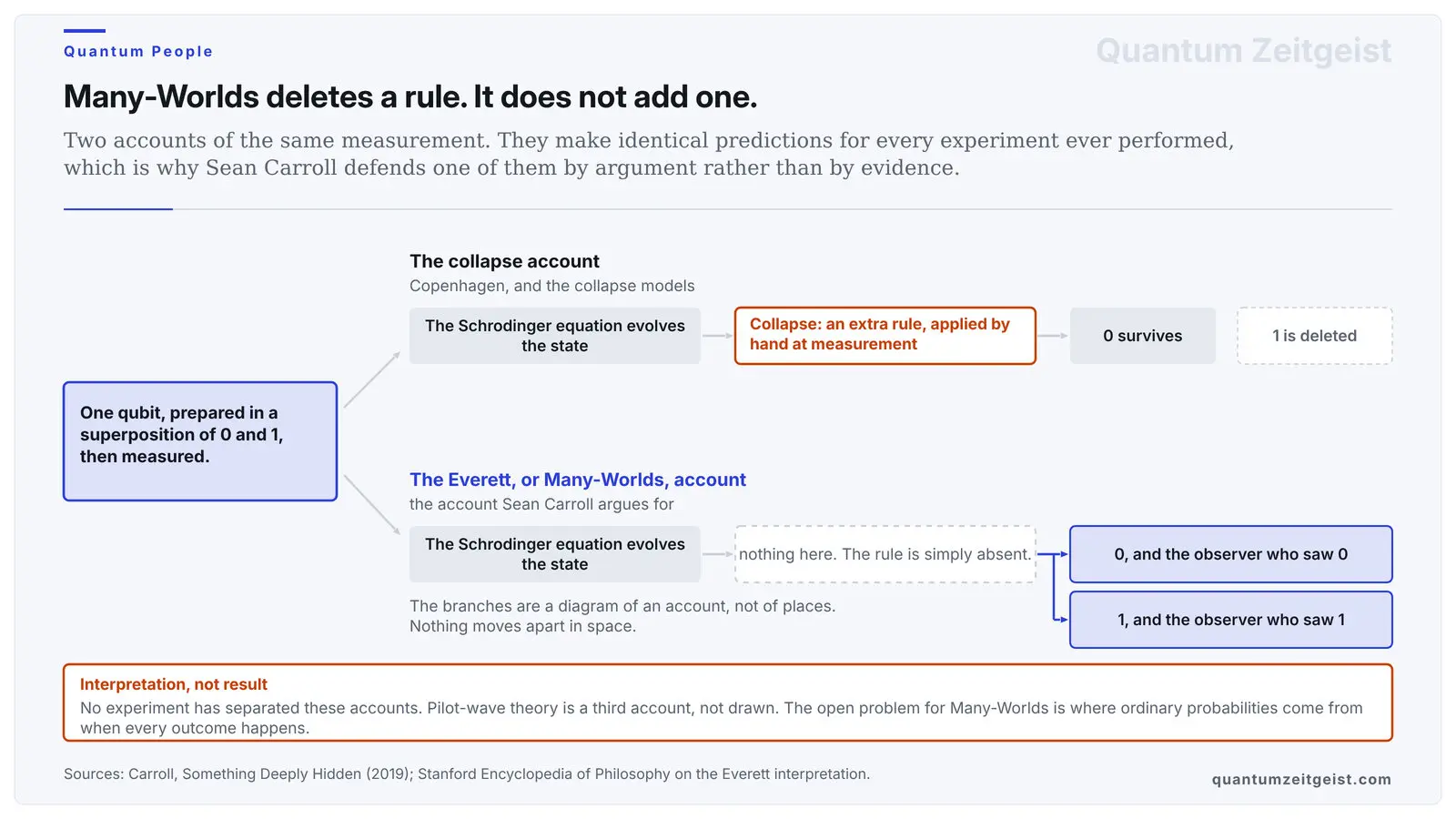
Carroll argues in public for the Many-Worlds interpretation of quantum mechanics, also called the Everettian view, in his books and in his lectures. In this picture the wave function never collapses, and every quantum outcome is realised in its own separate branch of reality, so nothing is ever discarded.
Something Deeply Hidden argues at book length that Many-Worlds is the simplest reading of the equations, because it takes the Schrödinger equation literally and adds nothing to it. Critics disagree, and the book presents the interpretation as a serious contender rather than as a settled result.
The evidence does not yet single out a winner
Many-Worlds is one interpretation of quantum mechanics rather than a proven fact, and that distinction survives every argument made for it. Other respected views include the Copenhagen interpretation, pilot-wave theory and various collapse models, and the experimental evidence does not yet single out a winner.
The argument for simplicity turns on what has to be added by hand. The Schrödinger equation already predicts branching, so a separate collapse rule means inserting machinery that the equations never asked for, and the extra worlds are what remains when that machinery is left out.
The interpretation has an open problem that the argument keeps returning to. If every outcome happens somewhere, it is not obvious what an ordinary probability is a probability of, and Many-Worlds still has to explain why the Born rule gives the odds it does.
Something Deeply Hidden makes the case at book length
Something Deeply Hidden, published in 2019, is a sustained and accessible case for the Many-Worlds interpretation and for the emergence of spacetime. It is the clearest statement of his position on quantum mechanics, and it is the book that carried quantum foundations to a general audience.
The book walks readers from the basic strangeness of the theory towards the claim that branching worlds are the honest consequence of the equations. It also sketches his more speculative ideas about how spacetime itself might emerge from patterns of quantum entanglement. It is structured as an argument rather than as a survey, so it does not simply list the interpretations side by side and leave readers to choose between them.
The earlier titles widened his reach across physics as a whole. From Eternity to Here explores the arrow of time, and The Big Picture connects physics to questions of meaning, life, and how the universe came to be the way it is.
The Biggest Ideas series shows readers the real equations
More recently he launched The Biggest Ideas in the Universe series, which deliberately shows readers the real equations rather than only the analogies. The first volume covers space, time and motion, and the second moves into quanta and fields.
The series treats the mathematics as part of the story rather than as an obstacle to be worked around. That sets it apart from popular accounts that stop at the vivid image and never show the reader an equation.
Mindscape runs weekly and reaches well past physics
Carroll hosts Mindscape every week, interviewing scientists, philosophers and thinkers from many fields. The show reached its 366th numbered episode on 31 August 2026, an interview with the physicist Jim Al-Khalili, counted from its own archive. The conversations run long and unhurried, which is the format the show has kept since 2018.
Mindscape extends his influence well past physics, covering neuroscience, economics, ethics and the arts, and it gives complex topics room to breathe in a way short interviews rarely allow. Through it, Sean Carroll has become a kind of public clearing house for serious ideas explained at length and without condescension.
The show also runs solo episodes, in which Carroll answers listener questions and works through a single topic at length without a guest. That format has helped spread his way of explaining quantum ideas.
He keeps returning to superposition, entanglement and decoherence
The books and the podcast return again and again to the same short list of ideas, which is superposition, measurement, entanglement and decoherence. Those are the concepts a reader has to hold in order to follow the interpretation debate at all.
Superposition is the idea that a quantum system can occupy a combination of possibilities until something interacts with it and the combination stops. It is the first of the four ideas, and the other three are hard to state without it.
Decoherence explains why the everyday world looks classical
Decoherence is the process by which quantum systems lose their delicate interference as they couple to their surroundings, and it carries a lot of weight in his account. It is what he uses to explain why the everyday world looks classical even though the underlying reality stays fully quantum.
Entanglement is the deep correlation that links quantum systems across distance, and he connects it directly to the branching story that Many-Worlds tells. That gives a reader one thread running through measurement, correlation and interpretation instead of three separate puzzles.
He explains quantum computers rather than building them
His own curriculum vitae lists no work in quantum hardware or in quantum algorithms. What he does instead is set how a broad public thinks about the principles that quantum technologies rely on. That groundwork is easy to overlook, even as it shapes how the field is understood and funded.
Many-Worlds, however well Carroll defends it, does not change how a quantum computer is engineered. The machines work the same way whichever interpretation a builder happens to favour, and a machine designed by a committed Many-Worlds advocate would be indistinguishable from one designed by a sceptic.
One misreading is worth correcting here, because it attaches itself to the Many-Worlds view in popular coverage. Quantum computers do not work by performing calculations in parallel universes, and the engineering does not depend on reading them that way. A quantum algorithm arranges the amplitudes so that wrong answers cancel and right ones reinforce, and that cancellation is a property of one wavefunction rather than a negotiation between separate worlds.
He supplies the vocabulary the field runs on
Sean Carroll equips a wide public with the vocabulary the field depends on. Superposition, entanglement, measurement and decoherence are the ideas his books and podcast explain, and they are the same ideas the hardware exploits.
By keeping interpretation in the public conversation he helps readers see that quantum mechanics is strange in ways that genuinely matter, rather than strange in a decorative way. That intuition is what makes the promises and the limits of quantum computing easier to evaluate honestly.
The translation work is the contribution
His advocacy of Many-Worlds is influential, and yet the more durable effect may be the plain insistence that the foundations are worth understanding at all. Readers who come to him for the cosmic questions leave with a sturdier grasp of the rules that govern any quantum device.
Sean Carroll’s role is therefore that of a translator and guide rather than an inventor. In a field where public misunderstanding runs deep, that translation work has real value for how quantum computing is discussed and supported.
Conceptual clarity is itself a contribution, and making superposition, entanglement and measurement intelligible to non-specialists lowers the barrier between frontier physics and an interested public. That matters more as quantum computing moves from laboratory curiosity towards a technology people will read about for years.
Frequently asked questions
Who is Sean Carroll?
What is Sean Carroll’s current job?
What is the Many-Worlds interpretation that Carroll supports?
Did Sean Carroll build quantum computers?
What are Sean Carroll’s most famous books?
What is the Mindscape podcast?
Why does Carroll focus so much on quantum foundations?
How does Carroll explain quantum concepts like superposition and entanglement?
Why does Sean Carroll matter for quantum computing?



See today’s quantum computing news on Quantum Zeitgeist for the latest breakthroughs in qubits, hardware, algorithms, and industry deals.