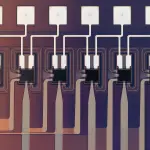
Researchers of China have achieved an ultra-low noise level of 35 counts per second in a quantum frequency converter, a reduction critical for extending the reach of future quantum communication networks. The device efficiently converts ultraviolet photons to the telecom C-band, wavelengths already used in existing fiber optic infrastructure. This advance, detailed in Nature, combines fabrication optimization with a noise suppression strategy, resulting in a record-high external efficiency of 28.8%. This high-performance quantum frequency conversion satisfies the stringent requirements for long-lived remote ion-ion entanglement in scalable quantum networks.
Ultraviolet to Telecom Conversion via Lithium Niobate
A newly demonstrated quantum frequency converter achieves an external efficiency of 28. The conversion process relies on a first-order quasi-phase matching period of 3. 07 micrometers, a precise structural requirement for efficient frequency mixing. Theoretical modeling played a large part in optimizing the converter’s performance, revealing a critical tolerance for domain defects within the lithium niobate waveguide.
Researchers found that domain defects, imperfections in the material’s structure, must be limited to ≤ 2 along the waveguide, excluding the ends, to maintain high conversion efficiency. This understanding enabled the fabrication of a device approaching a theoretical limit normalized conversion efficiency of 839% per Watt-centimeter squared, minimizing the pump power needed for optimal performance and suppressing nonlinear noise.
The team’s work, detailed in Nature, demonstrates a significant improvement over previous ultraviolet-to-telecom converters, which typically achieve efficiencies in the range of 0. 02% to 1. 1%. The design incorporates a noise suppression strategy that uses the counter-tuning behaviors of difference-frequency generation and spontaneous parametric down-conversion, two nonlinear optical processes. This approach effectively mitigates unwanted noise generated during the conversion process, a common challenge in short-wavelength pumping schemes.
By combining this strategy with ultra-narrowband filtering, the device achieves a substantial reduction in noise, reaching the record-low 35 counts per second. This level of noise suppression is essential for maintaining the integrity of quantum information over extended distances, as even a small number of spurious photons can disrupt delicate quantum states.
Yi Yang of the Hefei National Research Center for Physical Sciences at the Microscale and School of Physical Sciences, University of Science and Technology of China, Bin Wang of the Jinan Institute of Quantum Technology and CAS Center for Excellence in Quantum Information and Quantum Physics, University of Science and Technology of China, and their colleagues report that the external efficiency-to-noise ratio coincides with maximum conversion efficiency, a notable contrast to long-wavelength schemes where the ratio typically peaks before efficiency does. “Compared to previous demonstrations listed, this performance represents a major breakthrough for UV QFC, enabling practical, on-site configurable deployment,” the authors state. The device’s ability to efficiently convert 393 nanometer photons from 40Ca+ ions to the telecom C-band at 1550 nanometers is particularly significant, as it bridges a critical spectral gap.
This conversion allows quantum information encoded in the ultraviolet range to be transmitted over standard telecom fiber, potentially using existing communication infrastructure for quantum networks. The team’s work demonstrates a substantial leap forward in quantum frequency conversion technology. The combination of fabrication optimization and noise suppression strategies represents a powerful approach to overcoming the challenges of efficient and reliable quantum information transfer.
Short-Period Quasi-Phase Matching & Efficiency Limits
This constraint stems from the need to preserve coherent accumulation during the frequency conversion process, as defects induce phase mismatches that degrade performance. The team’s analysis correlated normalized conversion efficiency directly with these domain defects, establishing a quantifiable link between fabrication quality and device output.
Achieving a theoretical limit of 839%/(W·c m^2) for the fundamental guided mode necessitated precise fabrication optimization focused on minimizing these imperfections. Prior QFC efforts relying on higher-order quasi-phase matching or multi-stage difference-frequency generation have struggled with low efficiency and substantial optical losses, resulting in noise levels several thousand counts per second, far exceeding the demands of practical quantum networks.
Internal conversion efficiency reached a maximum of 93% at a pump power of 52 mW, as determined by characterizing the power at the waveguide output. This measurement is a key indicator of the effectiveness of the defect control measures implemented during fabrication. Following this initial filtering stage, the generated 1550 nm photons are coupled into a single-mode fiber with 80% efficiency. A subsequent ultra-narrowband filtering stage, consisting of a Fabry-Pérot cavity and a volume Bragg grating, further refines the signal, providing an overall transmission of 79%.
The normalized efficiency reported in most frequency conversion studies is typically limited to 30-70% of the theoretical value, a challenge exacerbated in ultraviolet-to-telecom conversion by the stringent requirements for short-period poling. Defects arising from intrinsic lattice pinning and waveguide fabrication disrupt coherent accumulation and reduce conversion efficiency.
Domain Defect Tolerance in Waveguide Fabrication
Controlling imperfections within the fabrication of short-period waveguides is now demonstrably linked to achieving near-theoretical limits in quantum frequency conversion efficiency, with researchers establishing a tolerance of no more than two domain defects along the waveguide length, excluding the ends. The team’s modeling revealed that even a small increase in defects rapidly diminishes performance, with the probability of achieving optimal conversion dropping to approximately 20% with just two defects present.
Fabrication optimization focused on a 20-millimeter-long ridge waveguide designed to down-convert 393 nanometer photons to the 1550 nanometer telecom band, using a lithium niobate thin-film platform. Achieving this required careful attention to both intrinsic lattice pinning, manifesting as hexagonal morphology defects, and defects introduced during the waveguide fabrication process itself, such as those stemming from photolithographic patterning or thermal instability.
The researchers emphasize that minimizing these defects is about enabling the practical application of this conversion technology. The theoretical framework developed by the team formulates the impact of randomly distributed domain defects on normalized conversion efficiency, using a mathematical representation of the nonlinear coefficient distribution. This model allows for a quantitative understanding of how phase mismatches induced by defects degrade performance and provides a benchmark for acceptable defect levels.
The resulting calculations informed the fabrication process, leading to a demonstrated normalized conversion efficiency of 839%/(W·c m^2), a value approaching the theoretical limit for this type of device. The ability to suppress pump-induced nonlinear noises is also directly linked to this defect control, as minimizing defects lowers the required pump power for maximum conversion efficiency. The researchers state.
The team’s approach to defect control relies on pre-selecting lithium niobate wafers with minimal intrinsic defects and mitigating poling defects through careful process management. This dual strategy, combined with rigorous characterization of the internal conversion efficiency, provides a pathway towards fabricating high-performance quantum frequency converters with predictable and reliable performance. The demonstrated ability to achieve near-theoretical efficiency and ultra-low noise levels positions this technology as a key enabler for extending the reach of quantum networks and integrating them with existing telecommunications infrastructure.
Noise Suppression Strategy for Quantum Frequency Conversion
Modeling revealed that these two processes, both driven by the 527-nanometer pump, exhibit distinctly opposing phase-matching responses to temperature fluctuations; DFG shifts at approximately -0. 01 degrees Celsius per picometer, while SPDC shifts at +0. 03 degrees Celsius per picometer. This counter-tuning behavior forms the basis of the noise suppression strategy, allowing for targeted mitigation of unwanted SPDC-generated noise. This technique moves beyond simple spectral filtering, a common but imperfect method for reducing noise in quantum frequency conversion, by actively addressing the source of the interference.
While spectral filtering establishes a low-noise baseline by minimizing pump power, residual noise remains a challenge for practical quantum networks. The theoretical framework developed by the researchers predicts that precise temperature control can selectively suppress SPDC noise without significantly impacting the desired DFG signal.
This is achieved by tuning the temperature to a point where SPDC is phase-mismatched, effectively minimizing its contribution to the overall noise floor. This integrated approach positions this technology as a viable solution for bridging the spectral gap between stationary qubits and low-loss optical communication channels. The researchers’ findings suggest that further refinements in material quality and temperature control could potentially push noise levels even lower.
Record 28.8% Efficiency & 35 Counts/Second Noise
Achieving 28. 8% external efficiency in ultraviolet to telecom band conversion, the demonstrated device surpasses previous benchmarks and establishes a new standard for quantum frequency conversion. The researchers found that maintaining domain defect counts at or below two, excluding the waveguide ends, was critical for maximizing normalized conversion efficiency, ultimately reaching 831% per watt-centimeter squared. This level of control over material quality directly enabled the high efficiency observed, a significant improvement over earlier devices.
The model developed to refine the noise-pump dynamics incorporated propagation losses, allowing for accurate prediction of the QFC process. This stage, transmitting with 79% efficiency, ensured single-peak transmission and minimized residual noise before detection by a superconducting nanowire single-photon detector with 85% detection efficiency. The combined effect of these optimizations, as measured with a flippable beam splitter for accurate characterization, resulted in the record-breaking 28. This performance is essential for distributing entanglement over long distances, a fundamental challenge in building practical quantum communication systems.
👉 More information
🗞 High-Performance Quantum Frequency Conversion from Ultraviolet to Telecom Band
✍️ Yi Yang et al.
🧠 DOI: http://link.aps.org/doi/10.1103/wx56-plcm



See today’s quantum computing news on Quantum Zeitgeist for the latest breakthroughs in qubits, hardware, algorithms, and industry deals.