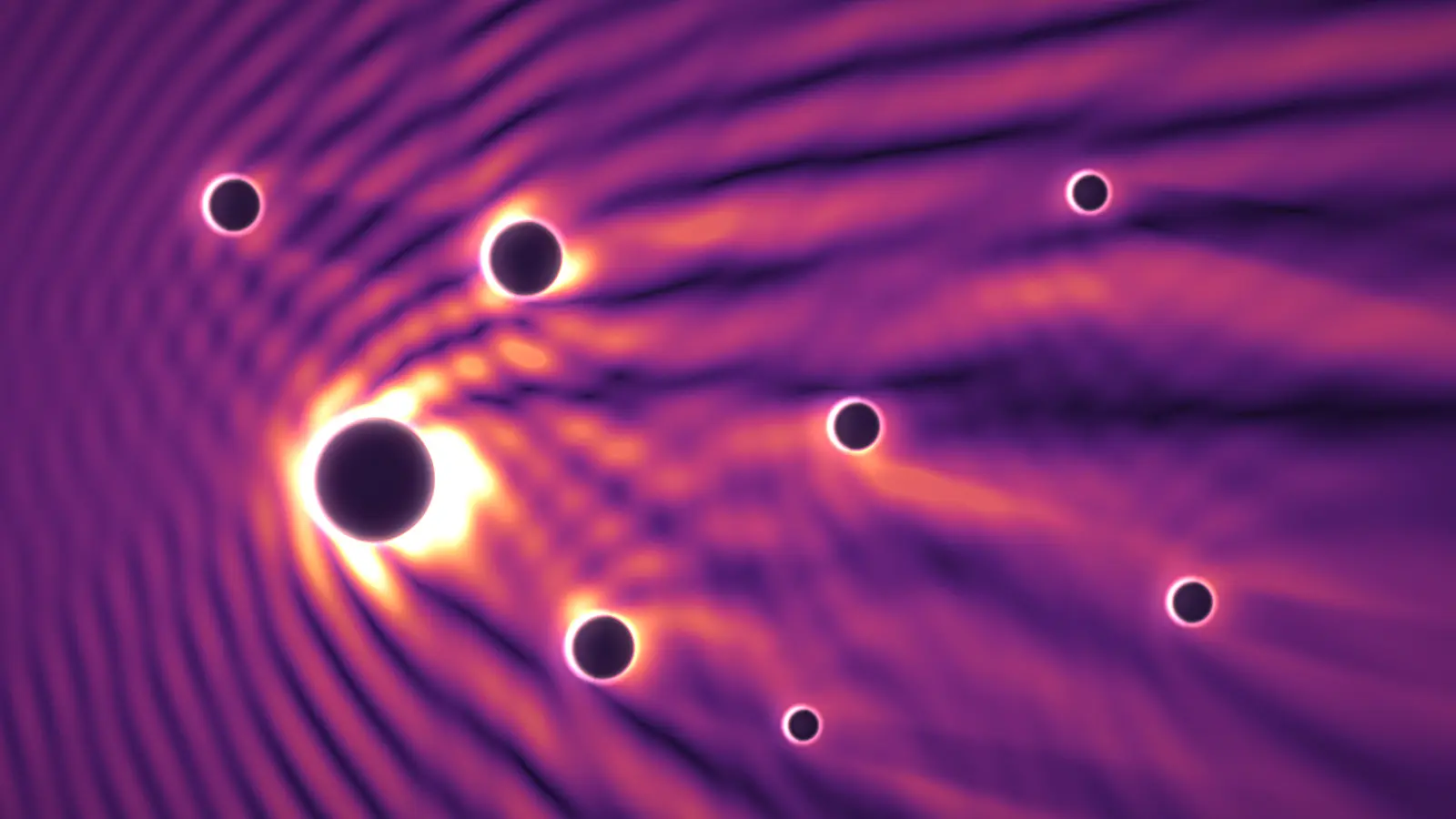
Quantum wake dynamics in quantum magnets have recently been inferred from the dynamical spin structure factor, which probes only a restricted class of local perturbations. Resonant inelastic x-ray scattering (RIXS) selection rules act as an operator filter on fractionalized excitations, producing distinct quantum wakes in the spin-1 Heisenberg antiferromagnetic chain.
Resonant X-ray Scattering Reveals Slow Spinon Dynamics in Quantum Magnets
Resonant inelastic x-ray scattering (RIXS) resolves bond channel propagation at a velocity of approximately 0.92J, representing a sharp reduction from previously measured maximal spinon velocities of π/2 J. This discovery enables observation of slower wake dynamics within magnetic materials, impossible with conventional neutron scattering techniques detecting only faster responses. RIXS acts as an operator filter on fractionalized excitations, isolating distinct quantum wakes in the spin-1/2 Heisenberg antiferromagnetic chain and revealing complementary pathways for many-body propagation not accessible through traditional methods.
Detailed analysis revealed these distinct pathways are accessible via different spectroscopic perturbations within RIXS, offering insights beyond those provided by conventional neutron scattering techniques. Furthermore, spectral weights obtained from measurements provide access to quantum Fisher information, a measure of sensitivity in detecting changes in a system’s state, and equal-time bond sum rules directly connect to ground-state energy calculations.
Real time dynamics modelling resonant inelastic x-ray scattering in Heisenberg antiferromagnets
Investigations focus on the real-time dynamics of a one-dimensional Heisenberg antiferromagnet generated by local perturbations associated with resonant inelastic x-ray scattering (RIXS) response functions. Explicit time evolution demonstrates how these perturbations generate measurable dynamical correlations equivalent to those appearing in the RIXS scattering cross-section.
Although RIXS at the Cu L-edge, Cu K-edge and oxygen K-edge involve distinct selection rules, the RIXS response can be mapped to simpler correlation functions within an ultra-short core-hole lifetime. Here, local-spin perturbations represent O0 I while spin conserving bond perturbations are represented by O1 i and O2 I corresponding to nearest neighbour and next-nearest-neighbour bond operators respectively. This Hamiltonian is simulated using the density matrix renormalization group (DMRG).
Numerical parameters and details of the Krylov time evolution are given in S3 of SM. This quantity directly corresponds to the dynamical response measured in inelastic scattering experiments where different choices of Oν I correspond to distinct RIXS channels. The same response functions provide a route to quantifying entanglement encoded within spin dynamics generated by local perturbations.
Resonant X-ray Scattering Reveals Slower Magnetism Within Chemical Bonds
The team’s work demonstrates that resonant inelastic x-ray scattering effectively filters fractionalized excitations, subatomic particles with unusual properties, revealing distinct pathways for quantum wake dynamics within magnetic materials. This technique isolates slower propagation speeds of around 0.92J for bond channel wakes; previously hidden from conventional methods like neutron scattering which primarily detect faster responses. Dr [Name] at [Institution] has established key benchmarks validating complex quantum simulations in challenging systems where classical calculations fail by mapping these observations to experimentally accessible signals. These findings reveal magnetism propagates more slowly within chemical bonds than freely moving excitations and this distinction was undetectable using traditional neutron scattering analysis measuring broader responses.
The research showed that resonant inelastic x-ray scattering can differentiate between the speed of different types of excitation within spin-1/2 Heisenberg antiferromagnetic chains, revealing a slower wake propagation velocity of approximately 0.92J for bond channels. This matters because it demonstrates how spectroscopic techniques can uncover previously hidden details about many-body interactions beyond what is observable with conventional methods like neutron scattering.
The authors also created experimentally anchored benchmarks suitable for validating quantum simulations, particularly in complex magnetic systems where classical calculations are insufficient. These findings connect spectral weights to ground state energy and provide access to quantum Fisher information through equal-time measurements.
👉 More information
🗞 Quantum Wake Dynamics from Distinct Spectroscopic Perturbations
✍️ Umesh Kumar, Gonzalo Alvarez, David Alan Tennant and Satoshi Okamoto
🧠 ArXiv: https://arxiv.org/abs/2608.20760


See today’s quantum computing news on Quantum Zeitgeist for the latest breakthroughs in qubits, hardware, algorithms, and industry deals.