

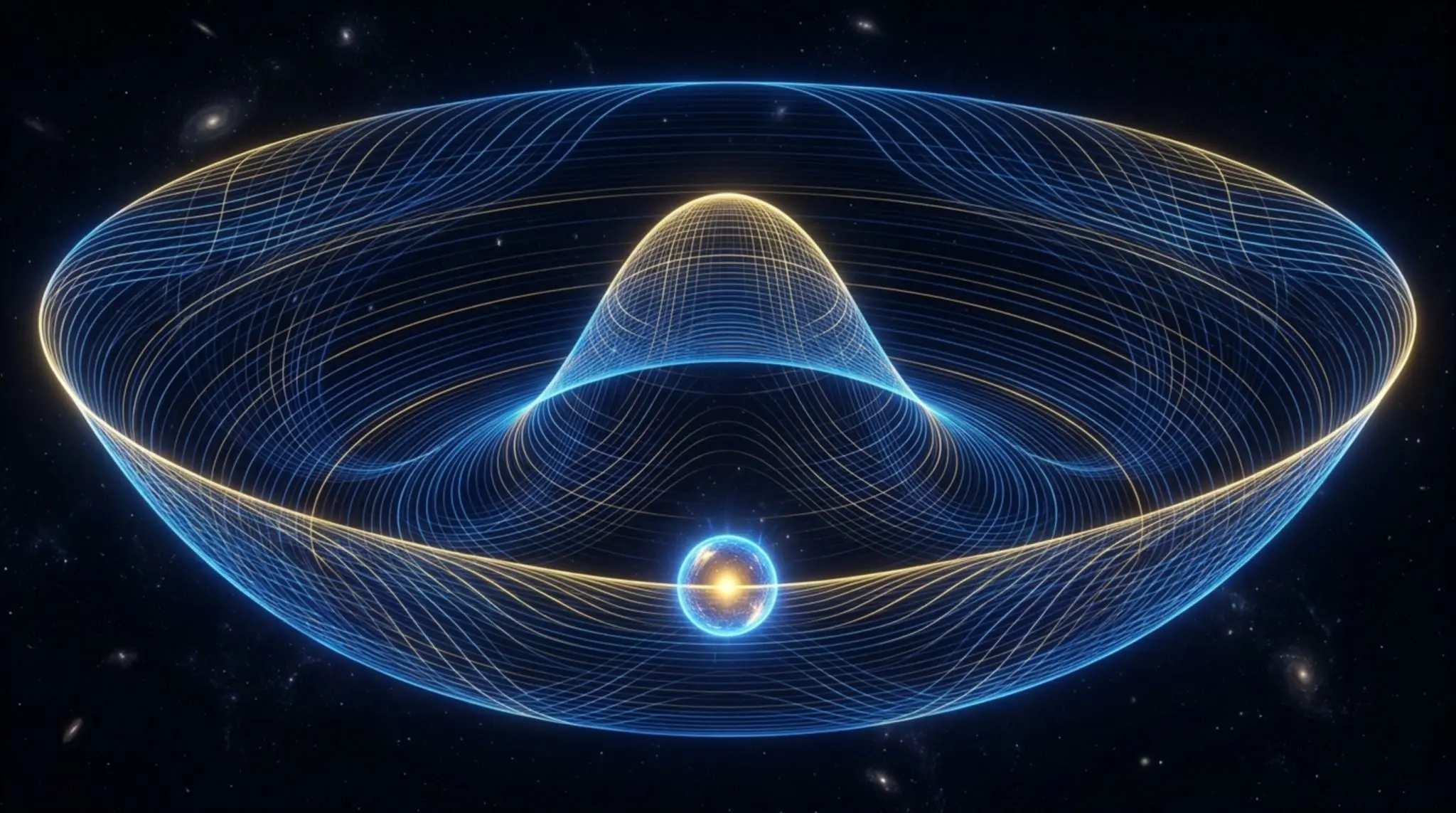
Quantum simulations reveal one-dimensional Dirac dynamics and two-dimensional massless Weyl dynamics. Programmable simulation of massive two-dimensional Dirac dynamics remained experimentally unexplored until now. A two-dimensional free Dirac Hamiltonian is realised in circuit QED, featuring independently tunable spin-momentum couplings and mass via a single Rabi-driven qubit coupled to two modes of a multimode cavity. Observations confirm rotational Zitterbewegung of a two-dimensional massive Dirac particle and its dependence on the effective mass. Time-dependent master-equation simulations support these findings.
Realisation of programmable massive Dirac dynamics in a circuit quantum electrodynamics platform
A fully programmable simulation of two-dimensional massive Dirac dynamics has been achieved, exceeding the limitations of prior quantum simulations restricted to either one dimension or massless behaviours in two dimensions. The new approach allows independent control over both momentum components, represented as quantum operators, and mass within their circuit QED system, something earlier fixed-parameter techniques could not accomplish. Using a transmon qubit linked to two cavity modes enabled observation of rotational Zitterbewegung and verification of its relationship with effective mass.
Technion scientists rigorously verified the system’s accuracy through detailed simulations incorporating known imperfections such as spin-locking decoherence alongside corrections beyond standard approximations used in circuit QED calculations; they also accounted for non-ideal behaviour exhibited by their superconducting qubits. Time-dependent master equation simulations accurately reproduced observed dynamics, confirming that factors like qubit decay and control fluctuations were adequately addressed during experimental design.
Despite current limitations stemming from decoherence and imperfect controls preventing scaling towards more complex systems or practical quantum computation based on these principles, this work opens new avenues for exploring intricate physics related to relativistic particles possessing mass.
Simulating Relativistic Quantum Mechanics via Superconducting Qubit Control and Observation of Mass-Dependent
Programmable simulation of a two-dimensional free Dirac Hamiltonian using multimode circuit QED has been demonstrated through the combination of superconducting qubits with microwave cavities; rotational Zitterbewegung was also successfully observed. This represents an enhanced level of control when simulating such systems compared to previous experiments limited to one dimension or massless particles, which restricted independent manipulation of both momentum and mass.
The authors acknowledge their current implementation models only “free” Dirac dynamics without external forces or interactions necessary for modelling realistic materials. Earlier approaches mapped these properties onto static coupling strengths between qubits restricting dynamic control, whereas this offers fully programmable representation of both momentum components utilising quantum operators instead.
Tunable relativistic electron dynamics simulated via programmable superconducting circuits
A programmable two-dimensional system mimicking the behaviour of electrons governed by principles of relativistic quantum mechanics has been realised, demonstrating a setup capable of simulating conditions previously inaccessible through direct observation. The researchers and Technion achieved this using circuit QED, a technique employing superconducting circuits to create artificial atoms. A key advance lies in independently controlling both momentum and mass within their simulation; previous methods often fixed these parameters or relied on lattice structures that restricted flexibility.
Rotational Zitterbewegung, an oscillatory movement predicted by Dirac’s equation describing relativistic electrons, was observed confirming its dependence upon effective mass as expected. Future work will concentrate on extending this capability to explore dynamical and topological properties within gapped Dirac systems, materials where electron energy levels exhibit gaps due to atomic structure. Multimode circuit QED provides a compact platform for investigating higher-dimensional relativistic dynamics laying groundwork for future investigations into novel material design and condensed matter physics.
Simulations accurately reproduced experimental results incorporating decoherence effects, errors arising from interaction with the environment degrading quantum information. Technion scientists have demonstrated a programmable platform capable of simulating how relativistic particles move observing ‘Zitterbewegung’, a jittery motion predicted by Dirac’s equation crucial to understanding electron behaviour in solids. This achievement surpasses previous work limited to one dimension or massless particles, as they independently controlled both momentum components and particle mass using a single superconducting qubit coupled to two microwave cavities. By engineering this system, researchers observed rotational Zitterbewegung validating theoretical predictions about massive Dirac fermions.
Researchers successfully simulated a two-dimensional system exhibiting properties similar to electrons behaving under the rules of relativistic quantum mechanics. This demonstration matters because it provides a programmable platform for studying these complex behaviours without needing real materials, allowing independent control over both momentum and mass within the simulation. The team verified their results by observing ‘Zitterbewegung’, an oscillatory movement predicted by Dirac’s equation, and confirmed its relationship with effective mass. They intend to extend this work towards exploring dynamical and topological characteristics in gapped Dirac systems.
👉 More information
🗞 Quantum Simulation of Two-Dimensional Free Dirac Hamiltonian in Multimode Circuit QED
✍️ Jiwon Kang, Jiuk Lee, Eliya Blumenthal, Shay Hacohen-Gourgy and Eunseong Kim
🧠 ArXiv: https://arxiv.org/abs/2609.16628




See today’s quantum computing news on Quantum Zeitgeist for the latest breakthroughs in qubits, hardware, algorithms, and industry deals.



