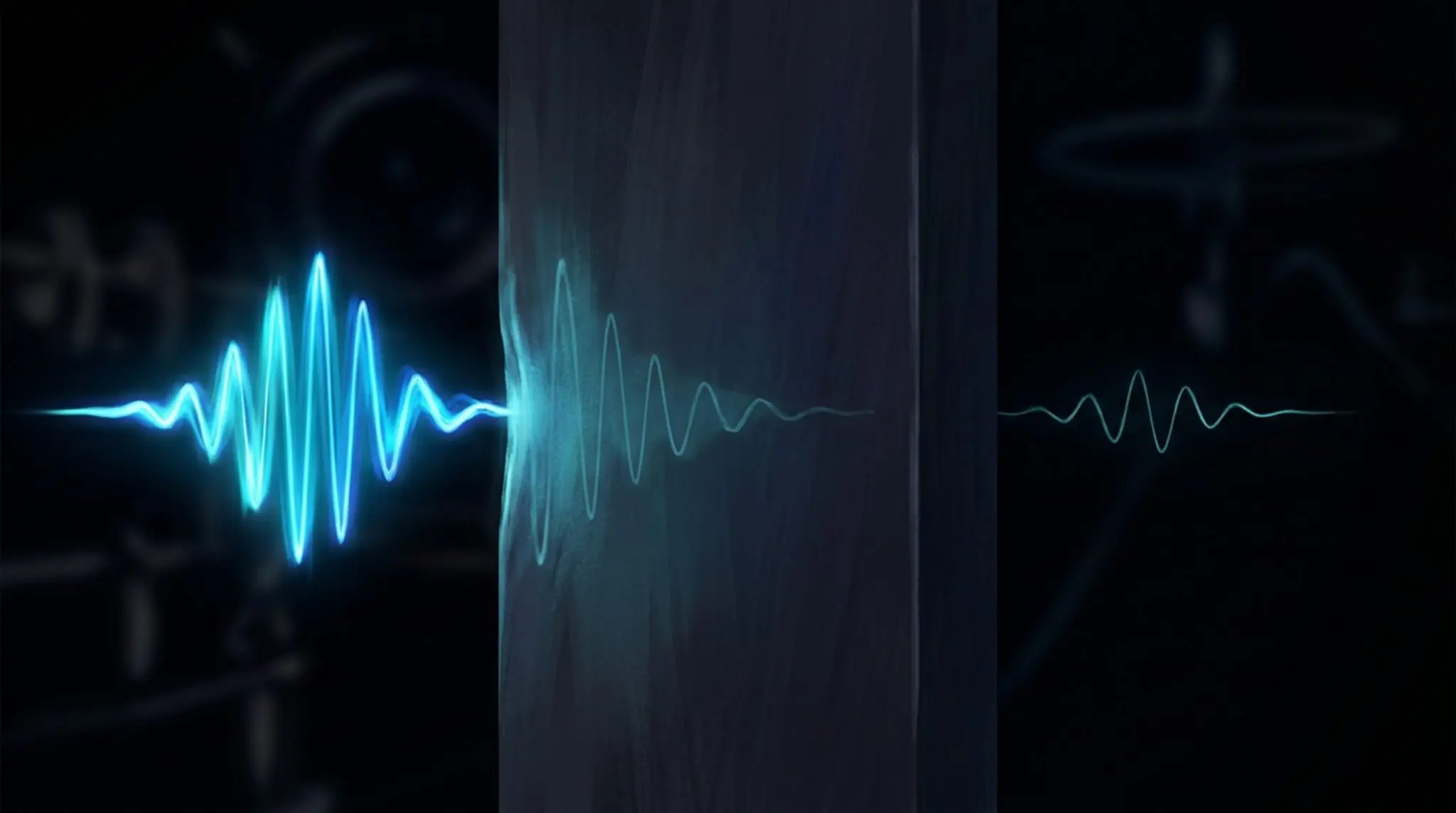
Researchers have developed a quantum master equation to calculate phonon decoherence caused by two-level tunneling states in quartz microresonators. The work addresses a surprising limitation; even as fabrication techniques improve and resonators achieve the quantum ground state, phonon lifetimes are restricted by these tunneling states found in native oxides or damaged surface layers.
This suggests a previously underestimated source of decoherence, as mechanical losses decrease and TLS emerge as the dominant mechanism. The team finds that phonon coherence time is maximized at low temperatures despite increased mechanical dissipation, and phonon-TLS coupling can be reduced for modes with strain nodes at surfaces.
Two-Level Tunneling States Drive Phonon Decoherence
These TLSs, inherent to amorphous materials, introduce a dissipation mechanism that unexpectedly intensifies at lower temperatures, a phenomenon observed in silicon, lithium niobate, quartz, and other crystalline media. The research detailed in a paper published on September 22, 2026, focuses on understanding and quantifying this decoherence source as fabrication techniques improve and push the boundaries of quantum coherence.
Prior to this work, a quantitative description of the interplay between phonon modes and large ensembles of TLSs remained elusive, hindering progress in optimizing these systems for quantum applications. This suggests that simply lowering the temperature, a common strategy for reducing noise, is insufficient to overcome TLS-induced decoherence and highlights the need to directly address the tunneling states themselves.
The researchers utilized the standard tunneling state model, assuming TLSs arise from atoms within asymmetric double-well configurational potentials, to achieve these results. The empirically validated standard two-level tunneling state model assumes TLSs reside within layers on the top and bottom surfaces of the bulk acoustic resonator. Known TLS parameters for silica glass, including the density of states and deformation potential, were incorporated into the calculations to illustrate the impact of surface-dwelling TLSs on phonon decoherence.
While the precise distribution and deformation potentials of these TLSs are not fully known, the model provides a valuable tool for predicting and mitigating their effects. Expressions for the fidelity of state storage versus time were derived for phonon Fock state superpositions, and applied to quartzBAR systems as a function of temperature.
These results demonstrate that while resonant absorption by TLSs diminishes with increasing temperatures, a saturation effect, decoherence remains rapid even in this “high” temperature regime. This finding underscores the persistent challenge posed by TLSs, even when their direct absorption of phonons is suppressed. The microscopic origin and nature of TLS couplings are still not fully understood, but the model used in this work makes quantitative predictions consistent with observations.
“As advances in fabrication and processing continue to extend phonon coherence times, the consideration of TLSs in the quantum dynamics of phonons across a broad range of systems will become increasingly significant,” the paper states. This suggests that as quantum systems become more refined, the influence of these subtle imperfections will only become more pronounced, demanding continued research into their origins and mitigation strategies. The work provides a step towards understanding and controlling a previously underestimated source of decoherence in emerging quantum technologies.
Quantum Master Equation Models Phonon-TLS Interactions
The derived quantum master equation allows for direct calculation of phonon decoherence stemming from two-level tunneling states, offering a new analytical approach to understanding these interactions within mesoscopic systems. This model moves beyond numerical and experimental investigations of limited tunneling states by considering the impact of a large ensemble of these states, relevant to bulk acoustic resonators where the influence of the phonon on the TLS ensemble is negligible.
The resulting Lindblad-form equation defines phonon decoherence through transition rates determined by TLS-phonon interactions, a quantitative framework previously absent for these complex systems. The work details how the master equation was constructed using the standard tunneling state model, applied to crystalline systems exhibiting these energy levels that resonantly interact with phonons. Specifically, the researchers utilized techniques from open quantum systems to account for interactions with a thermalized ensemble of TLSs, calculating dynamics to second order in the coupling strengths.
Calculations reveal that the transition rates are significantly influenced by temperature, with resonant absorption dominating at lower temperatures despite an overall increase in dissipation. This counterintuitive finding, that quantum state lifetime is maximized at low temperatures, arises because the decreasing thermal occupation of phonons precisely compensates for the increased mechanical decay. The team demonstrated this effect through equations showing that the relevant parameters become insensitive to temperature within a specific range.
“Although the dissipation increases with lower temperatures, we find that the quantum state lifetime is maximized in the low-temperature regime,” the paper states, highlighting the nuanced relationship between temperature and coherence. The model’s utility was illustrated through analysis of a quartzbar system, demonstrating the ability to calculate the quantum dynamics of a phonon mode using the analytical solution to the derived master equation.
This analysis extended to evaluating the fidelity of Fock superposition state storage over time, providing a metric for assessing the longevity of quantum states proposed for qubit encoding. The researchers further connected their findings to established TLS physics, referencing prior work on measuring TLS parameters and utilizing existing techniques for calculating time-dependent reduced density matrices. The derived master equation’s final form, presented in the paper, relies on explicitly evaluated transition rates that connect directly with known resonant and relaxation absorption processes of TLSs.
While resonant absorption saturates at higher temperatures, the model confirms that TLSs remain a substantial source of decoherence due to the activation of relaxation processes. This persistence of decoherence, even when direct phonon absorption diminishes, underscores the need to address TLSs directly rather than solely focusing on temperature reduction. The team’s approach provides a pathway for predicting and potentially mitigating these decoherence mechanisms in advanced quantum systems.
The researchers acknowledge the importance of conditions that allow for simplification of the quantum master equation, specifically the satisfaction of two key criteria that enable approximation and facilitate analytical solutions. By defining specific parameters and utilizing the Fourier transform, they were able to derive the transition rates governing phonon behavior. These rates, in turn, are linked to known TLS resonant and relaxation absorption processes, providing a clear connection between the model and established physical phenomena.
The resulting equations, including those governing the high-temperature limit, offer a robust framework for calculating quantum dynamics and understanding the interplay between phonons and TLSs. This analytical approach allows for a deeper understanding of the complex interactions between phonons and TLSs.
The paper concludes by emphasizing the model’s potential for analyzing a variety of systems and predicting the behavior of quantum states in the presence of these ubiquitous tunneling states. “In this paper, we have derived the quantum master equation for a selected phonon mode interacting with an ensemble of TLSs,” the authors state, summarizing the core contribution of their work.
Quartz Microresonators Exhibit Maximized Coherence at Low Temperatures
Quartz microresonators, despite achieving the quantum ground state, exhibit maximized phonon coherence at temperatures where mechanical dissipation increases; this counterintuitive finding challenges conventional approaches to extending quantum information storage times. The observed effect stems from the interplay between phonon behavior and two-level tunneling states, or TLS, residing within surface layers of the resonators, and is not simply a matter of reducing thermal noise. These TLSs, common in native oxides and damaged layers, introduce dissipation that unexpectedly diminishes at lower temperatures, offsetting the rise in mechanical decay.
The research demonstrates that the lifetime of a quantum state within these resonators is not solely dictated by minimizing energy loss, but by a complex balance between multiple decoherence mechanisms. This compensation occurs because the resonant absorption, a key source of phonon loss, is largely temperature-independent, allowing the phonon quantum state lifetime to remain maximized even as dissipation rises.
The analytical solution derived by the researchers allows for the calculation of quantum dynamics for any initial phonon state, offering a significant advancement over previous approaches. The work builds on progress in the design and fabrication of ultrahigh-quality-factor mechanical resonators, including electrically coupled bulk quartz acoustic wave resonators and optomechanical crystals, by providing a means to quantify and mitigate the effects of surface disorder. The team focused on quartz microresonators hosting a thin surface layer of tunneling states, estimating the lifetime of several quantum states within these devices.
This suppression is significant because it demonstrates a pathway for designing resonators that minimize TLS-induced decoherence. The results are applicable not only to quartz resonators but also to a broad range of mechanical systems and materials impacted by TLSs, including nano- and micromechanical devices, optomechanical systems, crystalline resonator systems, and hybrid quantum systems.
The study’s findings have implications for the development of advanced quantum technologies that rely on the precise control and measurement of phonons. The ability to predict and mitigate decoherence mechanisms is essential for realizing the full potential of these systems for storing, processing, and transmitting quantum information. The team’s approach provides the tools to calculate the quantum dynamics and estimate the lifetime for exotic quantum states of phonons in emerging systems.
TLS-Induced Losses Limit Quantum State Storage Fidelity
Calculations reveal that even when crystalline quartz resonators operate in the quantum regime, the lifetime of stored quantum states is demonstrably affected by the presence of two-level tunneling states (TLS) within surface layers. This limitation arises despite advances in resonator fabrication and operation, which have achieved the quantum ground state for phonons, suggesting a previously underestimated source of decoherence. The research team’s analysis focuses on how these TLS impact the fidelity of phonon-based quantum memories, specifically those proposed for qubit encoding in hybrid quantum architectures.
The team determined that the storage time for quantum states can be estimated by tracking the decay of fidelity, the probability of finding the system in its initial state, over time. Results show the time required for fidelity to decay to 90% as a function of temperature, demonstrating a complex interplay between mechanical dissipation and quantum coherence.
While lower temperatures generally enhance phonon coherence, the team found that they also increase mechanical dissipation caused by TLS, presenting a trade-off for quantum memory design. This counterintuitive finding underscores that simply cooling the system is not a sufficient solution and emphasizes the need to directly address the TLS themselves. Notably, the study demonstrates that dissipation caused by TLS can be reduced if the thickness of the disordered surface layer is significantly less than the phonon wavelength.
This finding stems from the observation that strain vanishes at the resonator surfaces for the examined system, effectively suppressing TLS-induced dissipation in that region. The team modeled a fundamental dilatational mode of a confocalBAR resonator, neglecting crystal anisotropy and simplifying calculations by assuming a crystal length much less than the Rayleigh range and a beam waist exceeding the phonon wavelength.
The calculations also show that the effective fill fraction of TLS, a measure of their density and impact, is highly suppressed at the resonator surfaces where strain vanishes. By carefully controlling the resonator geometry and surface properties, it may be possible to create environments where TLS have a minimal impact on quantum coherence.
👉 More information
🗞 Phonon decoherence produced by two-level tunneling states
✍️ Ryan O. Behunin, Taylor Ray, Dylan Chapman, Andrew J. Shepherd, Yizhi Luo and Peter T. Rakich
🧠 DOI: http://link.aps.org/doi/10.1103/732t-38bj



See today’s quantum computing news on Quantum Zeitgeist for the latest breakthroughs in qubits, hardware, algorithms, and industry deals.