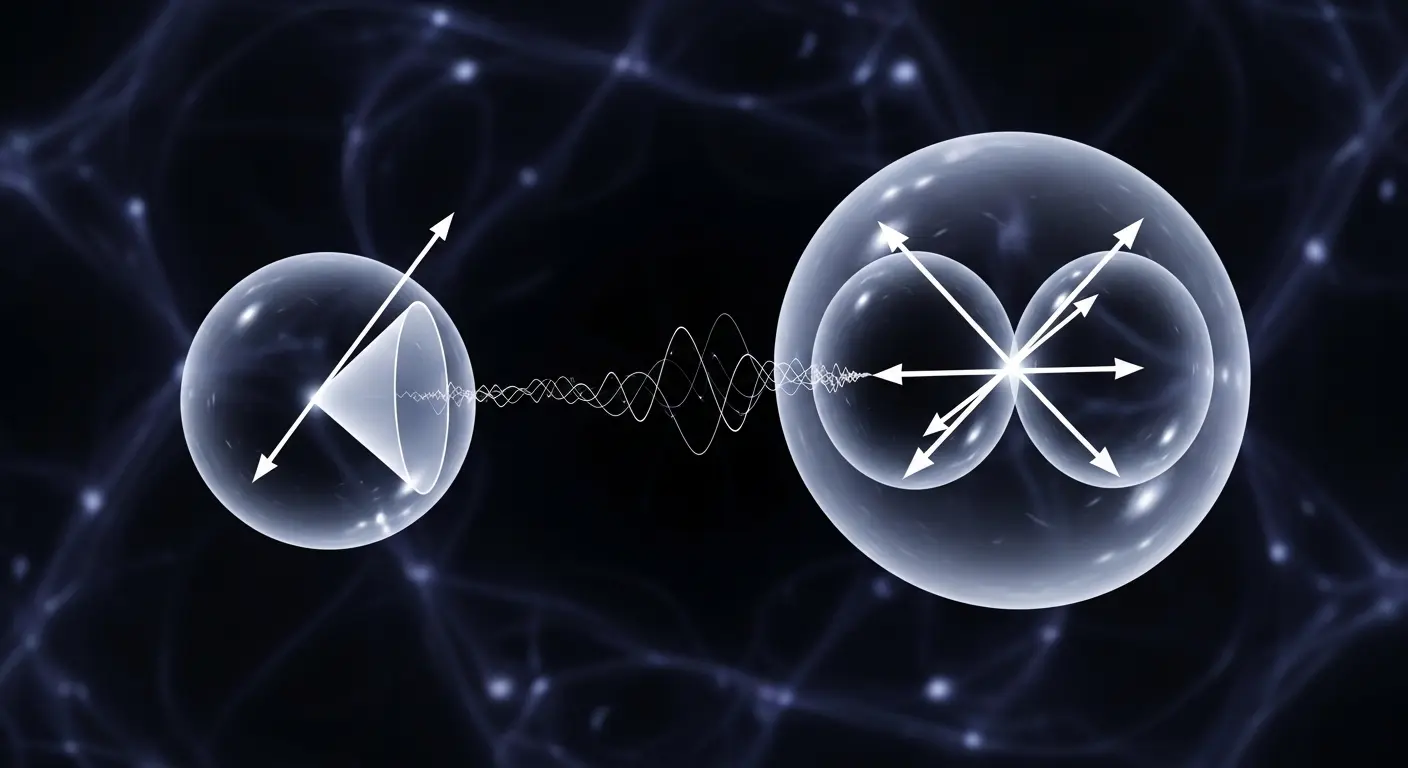
Jeonghyeon Shin and colleagues at Korea Department of Mathematics and Research Institute, in collaboration with Korea Institute of Science and Technology, Korea University of Science and Technology, Pohang University of Science and Technology, Korea Institute, Kyung Hee University, and Korea University of Science and Technology (UST), have investigated the impact of imperfect measurements on quantum teleportation, a key element of quantum information science. Their analytical work reveals a precise relationship between measurement entanglement, channel entanglement, and successful, high-fidelity teleportation, offering a strategy to mitigate limitations imposed by realistic, partially entangled measurements. The findings provide a practical pathway towards achieving faithful quantum teleportation without necessitating substantial hardware alterations, and offer fundamental insight into the key role of measurement entanglement
Restoring teleportation fidelity despite weak joint measurement entanglement
Unit teleportation fidelity, previously unattainable with imperfect measurements, has now been recovered even when joint measurements are only weakly entangled. Earlier methods were limited by the entanglement quality of both the quantum channel and the joint measurement, a simultaneous assessment of quantum particles. However, fidelity can now be restored regardless of joint measurement weakness, provided measurement imperfections are accounted for. Quantum teleportation, at its core, relies on the sharing of entanglement between a sender (Alice) and a receiver (Bob). Alice performs a Bell-state measurement on the qubit to be teleported and her half of an entangled pair, effectively transferring the quantum state to Bob’s half of the entangled pair. The fidelity of this transfer is critically dependent on the quality of the entanglement used in both the channel and the Bell-state measurement. Traditional analyses assumed ideal Bell-state measurements, meaning perfect entanglement and no errors. This assumption is unrealistic in any practical quantum device.
This breakthrough relies on a measurement-reversal framework, deliberately manipulating flawed measurement outcomes to isolate and correct for errors through classical data processing; this allows a precise relationship between measurement entanglement, channel entanglement, and the probability of successful, high-fidelity teleportation to be defined. The measurement-reversal framework operates by effectively ‘undoing’ the effects of the imperfect Bell-state measurement at Bob’s end. Classical communication of the measurement results from Alice to Bob achieves this, allowing Bob to apply a corrective operation to his qubit. The specific corrective operation is determined by the known imperfections in the Bell-state measurement. This approach decouples the performance of the teleportation protocol from the quality of the initial entanglement used for the Bell-state measurement, allowing for high-fidelity teleportation even with weakly entangled measurements. The framework’s implementation, where the receiver applies a corrective operation based on measurement outcomes, allowed limitations to be bypassed and unit fidelity to be achieved regardless of joint measurement weakness, provided imperfections are known. An exact equation was derived, quantifying the relationship between measurement entanglement, channel entanglement, and the probability of successful, high-fidelity teleportation, and this was validated using both elegant joint measurements and realistic error models simulating imperfections in superconducting qubits and ion traps. The equation incorporates parameters describing the degree of entanglement in both the quantum channel and the Bell-state measurement, allowing for a precise prediction of teleportation fidelity under various conditions. Validation involved simulating the performance of the protocol using both idealised scenarios and realistic error models based on the characteristics of current quantum computing platforms, such as superconducting qubits and trapped ions.
This analytical work highlights a previously unrecognised intrinsic limitation of standard teleportation methods, proving that reductions in measurement entanglement directly decrease teleportation fidelity even with perfect quantum channels. This finding underscores the critical importance of optimising Bell-state measurements in any quantum teleportation scheme. Even a perfect quantum channel cannot compensate for a poor-quality Bell-state measurement. Further investigation will explore the framework’s performance against decoherence and other noise sources inherent in quantum channels or environmental disturbances, broadening its applicability to real-world quantum systems. Decoherence, the loss of quantum information due to interaction with the environment, is a major challenge in building practical quantum computers and communication networks. Understanding how the measurement-reversal framework performs in the presence of decoherence is crucial for its implementation in real-world scenarios. The team’s findings offer a key baseline for improvement and allow engineers to optimise existing quantum hardware without necessarily pursuing entirely new technologies. By focusing on improving the quality of Bell-state measurements, engineers can enhance the performance of quantum teleportation without requiring significant changes to the underlying quantum hardware.
Entanglement quality in joint measurements defines limits to quantum teleportation fidelity
Quantum teleportation promises secure communication by transferring quantum states, but realising this potential demands overcoming limitations in real-world devices. This work analytically demonstrates that the entanglement within the joint measurement, a simultaneous assessment of quantum particles, directly impacts teleportation success. The joint measurement, specifically the Bell-state measurement, is the crucial step where the quantum state is transferred from Alice to Bob. The quality of this measurement, as quantified by its entanglement, directly determines the fidelity of the teleported state. Pinpointing this as a key performance limiter provides a key pathway towards more reliable quantum communication networks, allowing engineers to refine current quantum hardware and improve performance without radical redesigns. Improving the entanglement quality of the Bell-state measurement is therefore paramount for achieving high-fidelity quantum teleportation.
Scientists have devised a method to restore perfect state transfer, termed unit teleportation fidelity, even when these measurements are imperfect by analytically demonstrating this link. This achievement bypasses a key limitation of previous work, which assumed ideal measurement conditions; the new framework allows for reliable teleportation without extensive hardware changes. The ability to achieve unit fidelity with imperfect measurements is a significant advancement, as it relaxes the stringent requirements on hardware performance. This makes quantum teleportation more feasible in the near term, as it acknowledges and addresses the inherent challenges of building and maintaining complex quantum systems. Achieving this with imperfect measurements represents a sharp step towards practical quantum communication, as it acknowledges and addresses the inherent challenges of building and maintaining complex quantum systems. The framework offers a practical solution for mitigating the effects of imperfect measurements, paving the way for the development of more robust and reliable quantum communication networks.
Scientists demonstrated that quantum teleportation fidelity can reach unity even with partially entangled Bell-state measurements. This is important because it removes a major obstacle to building practical quantum communication systems, which previously relied on the assumption of perfect measurement conditions. The research establishes a clear relationship between the entanglement of joint measurements, channel entanglement, and successful teleportation. The authors analytically showed how to overcome limitations imposed by imperfect measurements, offering a framework for improving existing quantum hardware without radical redesigns.
👉 More information
🗞 Quantum teleportation with coherent error in Bell-state measurement
🧠 ArXiv: https://arxiv.org/abs/2605.12130




See today’s quantum computing news on Quantum Zeitgeist for the latest breakthroughs in qubits, hardware, algorithms, and industry deals.