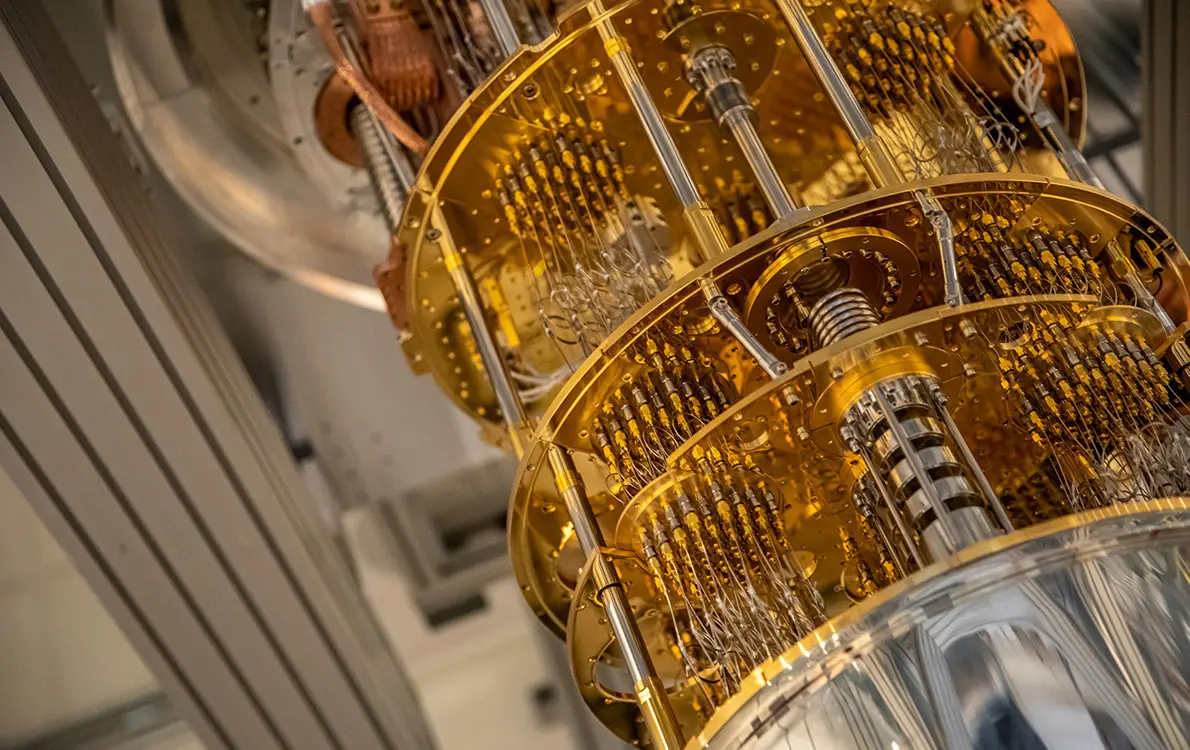
Maintaining a temperature of 20 millikelvin, approximately 0.02 degrees above absolute zero, colder than outer space, is critical for the function of superconducting quantum processing units (QPUs). Researchers at Lawrence Berkeley National Laboratory are addressing the challenge of building a complete system around this core requirement. This effort extends beyond qubits themselves, demanding an integrated collection of hardware, software, and controls to harness quantum science for practical applications. “Making a functional quantum computer requires much more than qubits alone,” explains Chris Spitzer, operations lead at the Advanced Quantum Testbed (AQT). This collection includes a dilution refrigerator, visually resembling a golden chandelier with cables transmitting microwaves from room temperature down to the millikelvin range, and a rack of control electronics ensuring precise synchronization for quantum computations.
Superconducting QPU and Cryogenic System for Quantum Control
The base of this collection is a superconducting quantum processing unit, but the supporting cryogenic infrastructure presents a significant hurdle in scaling quantum computation. Above the QPU resides the cold stage of a dilution refrigerator, a device that must maintain temperatures below 20 millikelvin, approximately 0.02 degrees above absolute zero, to prevent environmental interference and preserve the delicate superconducting state essential for quantum information. These cables are critical for controlling the quantum chip, delivering the precise signals needed for qubit manipulation and “gating,” the process enabling qubits to interact as required for computation. The Advanced Quantum Testbed (AQT) utilizes QubiC, an open-source superconducting qubit control system developed within Berkeley Lab’s Accelerator Technology & Applied Physics Division (ATAP), alongside custom software to optimize quantum programs.
Chris Spitzer, operations lead at the AQT, emphasizes that a holistic approach is vital. An entire technology collection is needed to harness quantum science for real-world applications. Any component within this collection can become a limiting factor; for example, achieving high qubit coherence, the stability of quantum information, is insufficient if pristine microwave signals cannot be delivered to the processor. Current wiring technology, with one or more wires per qubit, will become unsustainable as systems scale beyond a few thousand qubits, necessitating research into low-noise wiring solutions that optimize coherence. Researchers are currently working on building processors with performance increases of roughly 1,000 times compared to current processors, optimizing their operation within the full collection and applying them to real-world scientific problems.
QubiC Control System & Microwave Signal Precision
The pursuit of functional quantum computers extends beyond simply increasing qubit counts; current efforts center on refining the entire supporting infrastructure, a complex collection of technologies crucial for harnessing quantum phenomena. At the Advanced Quantum Testbed (AQT) within Lawrence Berkeley National Laboratory, researchers are meticulously addressing the challenges of controlling and interfacing with these delicate quantum processors. Maintaining stable qubit states requires an extraordinarily precise environment, approximately 0.02 degrees above absolute zero, and receiving data back. This bidirectional communication is essential for manipulating and reading the state of qubits. AQT focuses heavily on achieving high qubit coherence, ensuring quantum information remains stable for as long as possible.
However, Spitzer explains, “a quantum processor doesn’t do you any good if you aren’t able to deliver pristine microwave signals to it.” Scaling up the number of qubits presents a significant wiring challenge; current systems utilize one or more wires per qubit, a configuration unsustainable for processors containing thousands of qubits. Researchers are actively investigating new types of low-noise wiring technology that can optimize coherence or the lifetime of quantum information. The ATAP team is also now looking into developing QubiCML, “an AI-assisted readout for quantum computers that would allow us to do things like quantum-error correction or more advanced hybrid algorithms.”
Making a functional quantum computer requires much more than qubits alone. It takes an entire technology stack that can harness quantum science for real-world applications.
Chris Spitzer, operations lead at the Advanced Quantum Testbed (AQT)
Scalability Challenges with Quantum Processor Wiring
The pursuit of viable quantum computers extends beyond simply increasing qubit counts; a significant hurdle lies in physically connecting and controlling increasingly complex processors. At the Advanced Quantum Testbed (AQT), researchers are actively addressing these challenges, recognizing that scaling up quantum systems demands innovation in wiring and control infrastructure. Current quantum processors rely on one or more wires per qubit to deliver control signals and extract information. While manageable for processors with a few dozen qubits, this approach quickly becomes impractical as systems scale towards the thousands of qubits needed for meaningful computation. The physical space within dilution refrigerators, essential for maintaining a temperature of 20 millikelvin, approximately 0.02 degrees above absolute zero, is severely limited. The limitations of existing wiring necessitate research into new types of low-noise wiring technology that can optimize coherence or the lifetime of quantum information.
Error Correction via AI and Classical Computing
Maintaining stable quantum information presents a significant hurdle in building practical quantum computers, and addressing this requires a sophisticated interplay between artificial intelligence and conventional computing power. While quantum processing units (QPUs) garner much attention, the entire collection of technologies, hardware, software, and controls, must function cohesively to achieve error correction. A critical aspect of this holistic approach is recognizing that limitations can arise from any component within the collection. For instance, maximizing qubit coherence, the duration quantum information remains stable, is paramount, but delivering pristine microwave signals to the processor is equally vital. Ensuring signal integrity necessitates careful attention. These refrigerators actively manage microwave transmission, sending signals down to the millikelvin range and receiving data back.
Larger-scale systems already need classical computing resources to detect and correct errors as they arise in the quantum processors. “Figuring out what the error was and what you need to do as the corrective step is a very computationally intensive task,” Spitzer notes. This integration of AI isn’t merely about processing data; it’s about actively improving the performance and reliability of the quantum system itself, paving the way for large-scale, error-corrected quantum computations capable of tackling problems currently intractable for even the most powerful supercomputers.
Figuring out what the error was and what you need to do as the corrective step is a very computationally intensive task.
See today’s quantum computing news on Quantum Zeitgeist for the latest breakthroughs in qubits, hardware, algorithms, and industry deals.