Quantum teleportation is one of the most misunderstood ideas in physics, because the name promises something it does not deliver. It does not beam objects or people across space. What it actually does is move the exact quantum state of one qubit to a distant qubit, using a shared pair of entangled particles and two ordinary bits of information sent down a normal channel.
Real quantum teleportation is a precise protocol, first written down in 1993 and demonstrated with photons in 1997, and today it runs across city fibre and up to satellites. This guide explains how it works step by step, why the original is always destroyed, why it can never send a message faster than light, and why it matters for the future quantum internet.
Only the state moves. Quantum teleportation transfers the quantum information describing a qubit, not any matter or energy. Bob’s qubit was already at his end.
The recipe is fixed. Moving one qubit takes one shared entangled pair plus two classical bits of communication, no more and no less.
It is not faster than light. The two classical bits are mandatory and travel no faster than light, so no usable message ever outruns a phone call.
It is a move, not a copy. Alice’s measurement destroys the original, so the no-cloning rule is respected and only one copy of the state ever exists.
It is the backbone of the quantum internet. Teleportation and entanglement swapping are how quantum repeaters will link distant quantum computers.
- What quantum teleportation actually moves
- The one rule that makes it sound like magic
- How the protocol works step by step
- Why the original qubit has to be destroyed
- Why this can never beat the speed of light
- What gets teleported and what stays behind
- From theory in 1993 to photons in 1997
- Teleporting to space and across fibre
- How it differs from superdense coding
- Entanglement swapping and the quantum internet
- Frequently asked questions
What quantum teleportation actually moves
Teleportation moves the description of a quantum system rather than the system itself. Alice has a qubit in some unknown state, and after the protocol Bob’s qubit ends up in that exact state while Alice’s no longer holds it. Nothing physical travels between them, which is the single fact that dissolves most of the confusion.
The reason a simple copy will not do is that quantum states cannot be inspected without disturbing them, and an unknown state cannot be measured to reveal its full identity. Teleportation is the clever workaround that transfers the state perfectly without ever learning what it was.
The one rule that makes it sound like magic
The trick rests on entanglement, the deep link between two particles that behave as a single system no matter how far apart they are. Alice and Bob each hold one half of an entangled pair that was prepared in advance, and that shared resource is what carries the state across. If you are new to the idea, our guide to quantum entanglement is the place to start.
Entanglement alone is not enough, though. On its own it cannot send any information, so a second ingredient is always needed, an ordinary classical message of two bits. Quantum teleportation is precisely the combination of these two resources, and neither works without the other.
How the protocol works step by step

Start with Alice holding the unknown qubit and one half of the shared entangled pair, while Bob holds the other half. Alice performs a joint measurement on her two qubits together, in what is called the Bell basis, which entangles the unknown state into the shared pair. That measurement gives her two classical bits, one of four equally likely results.
Alice sends those two bits to Bob over a normal channel. Depending on which of the four results she got, Bob applies one of four simple corrections to his qubit, either doing nothing or flipping it in one or both of two ways. After that correction his qubit is in the original unknown state, and the transfer is complete.
Why the original qubit has to be destroyed
Alice’s Bell measurement does not just read out information, it fundamentally changes her qubits. The instant she measures, her copy of the unknown state is gone, which is not a flaw but the very thing that keeps the protocol honest. At no point do two copies of the state exist at once.
This is required by the no-cloning theorem, proved in 1982, which says an unknown quantum state cannot be duplicated. The protocol sits comfortably alongside that rule precisely because it is a transfer and not a duplication, more like moving a file than copying one.
Why this can never beat the speed of light
It is tempting to think that because entanglement links the two halves instantly, the state arrives instantly too. It does not. Before Bob receives Alice’s two classical bits, his qubit is in a completely scrambled state that carries no information at all, and only the arrival of those bits tells him which correction to apply.
Since the classical bits travel no faster than light, the state is never transferred faster than an ordinary message could travel. This is not an engineering limit that better technology might beat, it is a firm consequence of the laws of physics, and it is why quantum teleportation cannot be used for faster-than-light communication.
What gets teleported and what stays behind
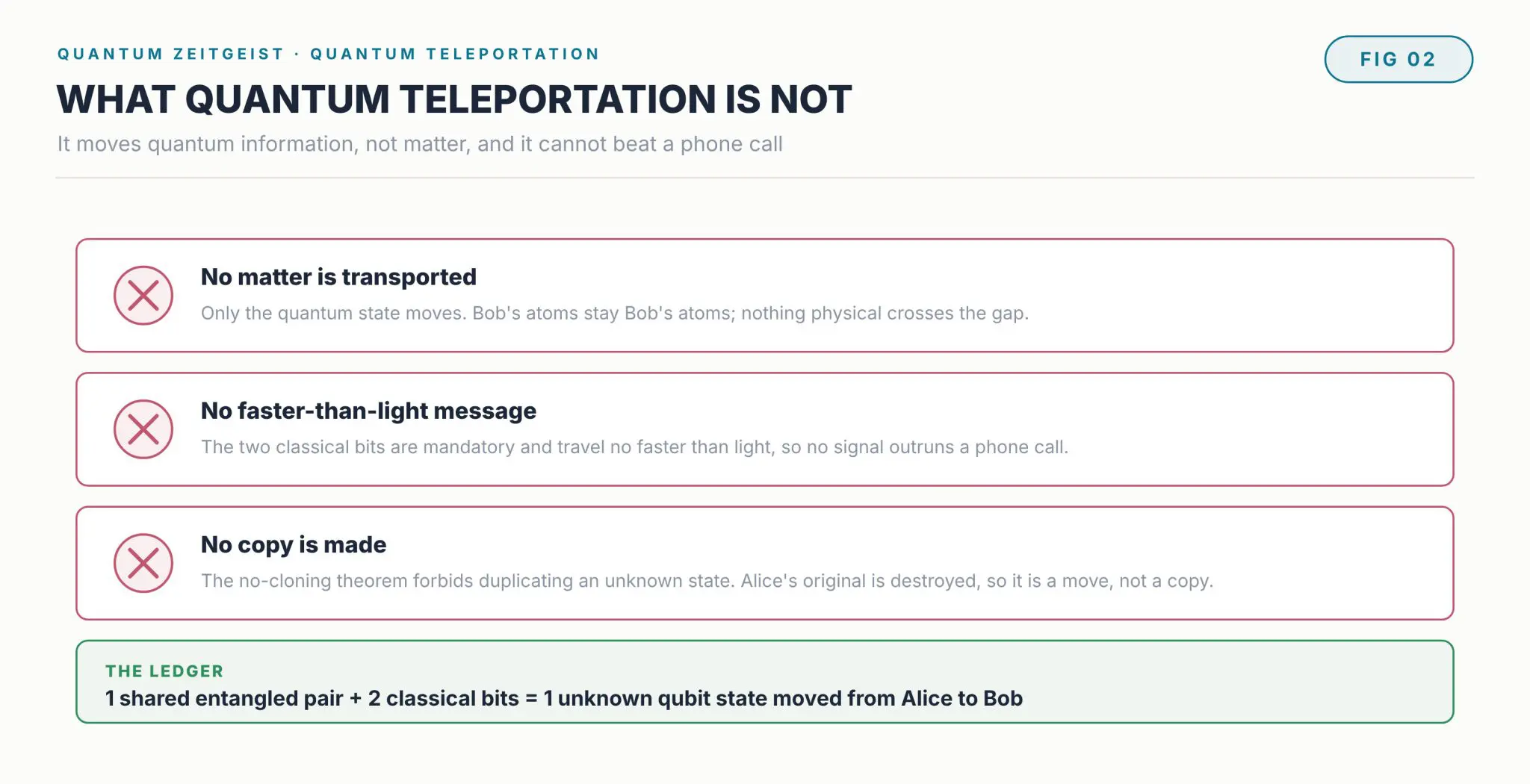
What travels is pure information, the quantum state, and nothing else. Bob’s qubit is a physical system that was sitting at his location the whole time, so no atoms, mass or energy cross the gap. The science-fiction image of a body dissolving in one place and reassembling in another has no counterpart in the real protocol.
This is why the word teleportation, while catchy, oversells the effect. A more honest label would be state transfer, and keeping that in mind removes almost every misconception people carry into the subject.
From theory in 1993 to photons in 1997
The protocol was invented in 1993 by Charles Bennett, Gilles Brassard, Claude Crepeau, Richard Jozsa, Asher Peres and William Wootters, in a paper that also coined the term. It was a purely theoretical proposal at first, a recipe on paper that showed the transfer was possible in principle.
Four years later, in 1997, a team led by Anton Zeilinger in Innsbruck carried out the first experimental demonstration using photons, with a parallel result from a group in Rome soon after. These early experiments were probabilistic and worked only some of the time, but they proved that quantum teleportation was real and not just a mathematical curiosity.
Teleporting to space and across fibre
Teleportation has since travelled a long way from the laboratory bench. In 2017 a Chinese team led by Jian-Wei Pan teleported photon states from a ground station in Tibet up to the Micius satellite, a distance of up to 1,400 kilometres, using the thin high-altitude air to reduce loss. In 2022 researchers at Delft teleported a state between two non-neighbouring nodes of a small quantum network built from nitrogen vacancy centres in diamond.
Perhaps the most striking recent result came in 2024, when a Northwestern University team performed quantum teleportation through 30 kilometres of ordinary optical fibre while that same fibre was carrying 400 gigabits per second of live internet traffic. By placing the quantum photons at a carefully chosen wavelength, they showed that quantum and classical signals can share the very same cable.
How it differs from superdense coding
A close cousin of quantum teleportation is superdense coding, and the two are easy to mix up because they use the same ingredients in mirror image. Teleportation spends one entangled pair and two classical bits to move one qubit of quantum information. Superdense coding runs the trade the other way, spending one entangled pair and sending one qubit to deliver two classical bits.
Another relative is entanglement swapping, which is teleportation applied to a qubit that is itself part of an entangled pair. Instead of moving an independent state, it leaves two particles that never met sharing entanglement, and that subtle difference is the key to stretching entanglement across long distances.
Entanglement swapping and the quantum internet
Teleportation is not just an elegant demonstration, it is a working component of the quantum networks now being built. A photon sent directly down a long fibre is quickly lost, and because of no-cloning it cannot be amplified the way a classical signal is. Quantum repeaters get around this by breaking a long link into short segments, building entanglement on each, and stitching the segments together with entanglement swapping.
The same primitive lets separate quantum processors share states and act as one larger machine, a leading strategy for scaling up. Teleportation is therefore the transport layer of the coming quantum internet, and it connects directly to the wider effort described in our guide to quantum computing. The 1993 protocol is set out in the original quantum teleportation paper, which remains one of the most cited results in the field.
Frequently asked questions
What is quantum teleportation in simple terms
It is a way to move the exact quantum state of one qubit to a distant qubit without sending the qubit itself. It uses a shared pair of entangled particles and two ordinary bits of information. Only the state travels, never any matter.
Can quantum teleportation move matter or people
No. Teleportation transfers only quantum information, the state of a particle, not the particle itself. Bob’s qubit is a physical system that was already at his location, so no atoms, mass or energy are transported.
Is quantum teleportation faster than light
No. The protocol requires two ordinary classical bits to be sent from Alice to Bob, and those travel no faster than light. Until they arrive, Bob’s qubit holds no usable information, so no message ever beats light.
Does quantum teleportation copy the quantum state
No, it moves it. Alice’s measurement destroys her original copy, so only one copy of the state ever exists at any moment. This is required by the no-cloning theorem, which forbids duplicating an unknown quantum state.
Has quantum teleportation actually been done
Yes, many times. The first photonic demonstration was in Innsbruck in 1997. States have since been teleported up to the Micius satellite over 1,400 kilometres in 2017 and through 30 kilometres of live internet fibre in 2024.
What is the difference between teleportation and entanglement
Entanglement is the shared link between two particles that the protocol relies on. Teleportation is the full procedure that uses that link, together with two classical bits, to move a state. Entanglement is an ingredient, teleportation is the recipe.
Why does quantum teleportation matter
It is the transport step for a future quantum internet. Combined with entanglement swapping, it lets quantum repeaters carry fragile quantum states across long distances and lets separate quantum computers link into one larger machine.
What is superdense coding
It is the mirror image of teleportation. Where teleportation spends an entangled pair and two classical bits to move one qubit, superdense coding spends an entangled pair and one qubit to deliver two classical bits.



See today’s quantum computing news on Quantum Zeitgeist for the latest breakthroughs in qubits, hardware, algorithms, and industry deals.