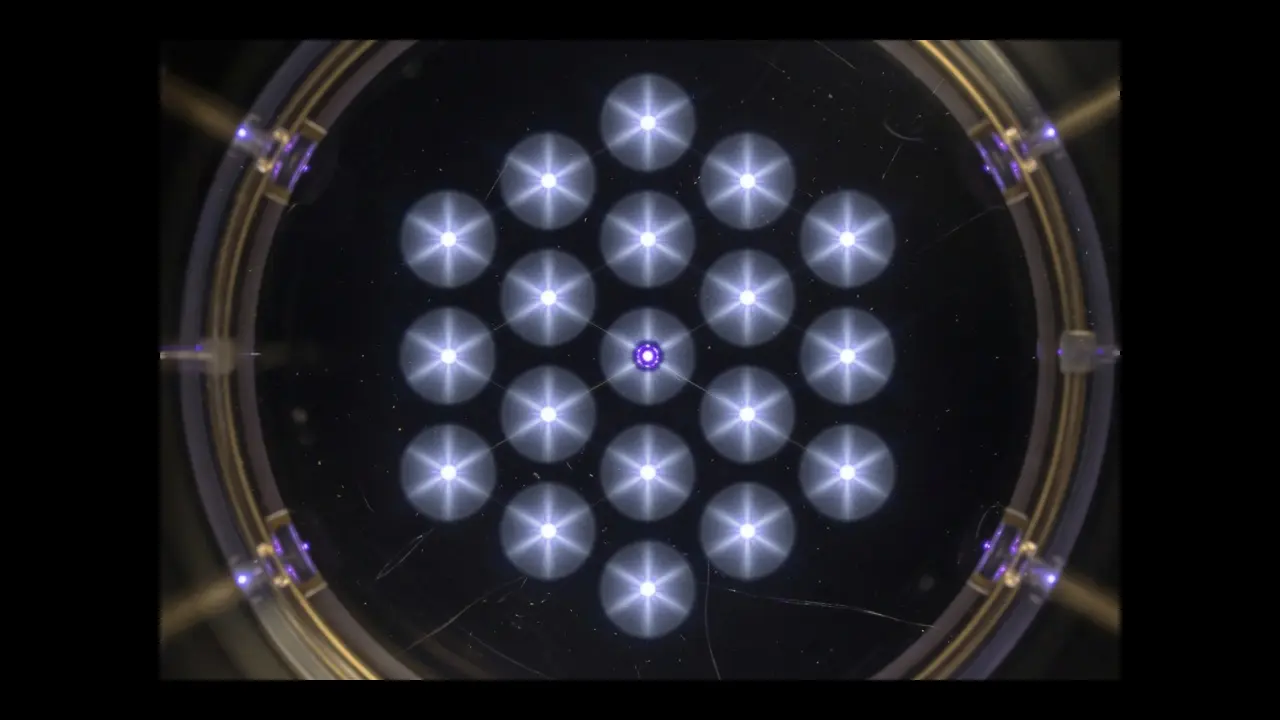
Calculating how much information a quantum system retains about its reset history previously proved elusive; now, this ‘Holevo information’ directly links to entanglement entropy. With a specific type of reset, a Bell-state reset, this retained information grows consistently with chain length across systems evaluated up to 12 qubits. Measurements on superconducting circuits confirmed predictions for key measures of entanglement, revealing differing responses to noise within reconstructed states.
Repeatedly “resetting” quantum systems returns qubits to a fixed state during operation and creates stable conditions not normally achievable; these resets leave an imprint on how connected the system’s parts are. The connection between this retained information regarding when a reset last occurred and measurable properties like overall connectedness within the system is now established. Researchers from the Research Institute CODE, University of the Bundeswehr Munich have linked how much information a quantum system remembers about its reset history, termed ‘Holevo information’, directly to entanglement entropy.
With a Bell-state reset, this retained knowledge increases consistently as more qubits are added to the system; evaluations extended up to 12 qubits. Periodically “resetting” these systems prevents errors from building up and potentially creates unique operating conditions. The difference between two types of measured entropies equals this Holevo information, similar to knowing roughly where someone parked their car based only on tire tracks rather than precise coordinates.
Holevo Information Scales With System Size While Entanglement Diagnostics Show Discrepancies
Entanglement measures now reveal Holevo information, knowledge about when a reset last occurred, grew steadily with chain length up to 12 qubits without saturation; previously determining retained information proved impossible. Physicists Quantum AI demonstrated that stochastic resetting creates unique stationary states inaccessible through standard quantum evolution. Measuring entanglement entropies before and after resets closely matched theoretical predictions *without* parameter adjustments, yet concurrence consistently fell below expectations across hardware measurements, indicating differing sensitivities between diagnostic tools due to their focus on distinct components within the reconstructed state.
Measurements taken on a superconducting processor showed calculated entropies before and after resets aligned well with theoretical models, confirming model accuracy. However, concurrence, an entanglement measure focusing on qubit correlations, consistently underperformed in hardware readings; a depolarizing model captured this suppression using only one adjustable parameter. This discrepancy suggests different diagnostic tools respond uniquely because they assess distinct aspects of the reconstructed quantum state, while also demonstrating that the difference between two types of entropy equals Holevo information about reset timing.
Stochastic Resetting Reveals Entanglement Dynamics in Transverse Field Ising Chains
The scientists employed stochastic resetting, repeatedly returning qubits to a fixed initial state during operation, akin to periodically hitting “refresh” on a quantum computer. The process was designed to stabilise systems and create unique conditions not normally achievable. Tracking whether reset histories were fully understood or merely averaged over revealed critical differences in entanglement behaviour within their chosen system: the transverse-field Ising chain, a physicist’s simplified model of magnetism at an atomic level; they focused on chains containing up to 12 qubits.
This technique creates nonequilibrium stationary states unattainable with uninterrupted operation. Measurements were performed using a superconducting processor without calibration adjustments. Entanglement entropies and concurrence served as key metrics for assessing system behaviour following resets.
Entropy Measurement Reveals Reset Timing Despite Superconducting Qubit Noise
The work elegantly links measurable entropy to information about reset timing, effectively creating ‘memory’ within the system, but highlights ongoing tension in quantum characterisation techniques. Reliance on superconducting qubits introduces noise that differentially affects diagnostic tools like entanglement entropies and concurrence; this discrepancy necessitates careful interpretation of experimental data and raises questions regarding which measures most accurately reflect underlying quantum states. Still, despite discrepancies due to inherent qubit noise, meaning some measurements are more affected by errors than others, this remains significant: it establishes a direct link between measurable characteristics and the timing of resets.
Quantifying retained information about reset events, returning qubits to a known state, is possible through analysing differences in quantum entanglement using something called the Jensen gap of entanglement entropy. Evaluating systems up to 12 qubits revealed this ‘reset memory, quantified as Holevo information, consistently increased alongside chain length suggesting potential for larger-scale applications; physicists Quantum AI demonstrated these findings. This connection allows scientists to quantify how much history the quantum system remembers.
This research demonstrates that introducing stochastic resetting creates unique stationary states in transverse-field Ising chains, systems containing up to 12 qubits, which are not achievable with standard operation. The study found measurable entanglement entropies closely matched theoretical predictions despite noise inherent in superconducting qubit measurements, while concurrence showed some suppression requiring a single parameter adjustment to account for errors.
Importantly, differences between certain entropy measures reveal information about when the last reset occurred within the chain, effectively creating a form of ‘memory’ regarding reset timing; this Holevo information grew consistently as chain length increased. This connection establishes how quantum system history can be quantified through observable characteristics.
👉 More information
🗞 Entanglement diagnostics of stochastic-resetting steady states: theory and measurement on superconducting qubits
✍️ Jakob Murauer and Sabine Tornow (Research Institute CODE, University of the Bundeswehr Munich); Manas Kulkarni (Tata Institute of Fundamental Research); Eli Barkai and Monalisa Singh Roy (Bar-Ilan University); Satya N. Majumdar (Université Paris-Saclay)
🧠 ArXiv: https://arxiv.org/abs/2610.40638



See today’s quantum computing news on Quantum Zeitgeist for the latest breakthroughs in qubits, hardware, algorithms, and industry deals.