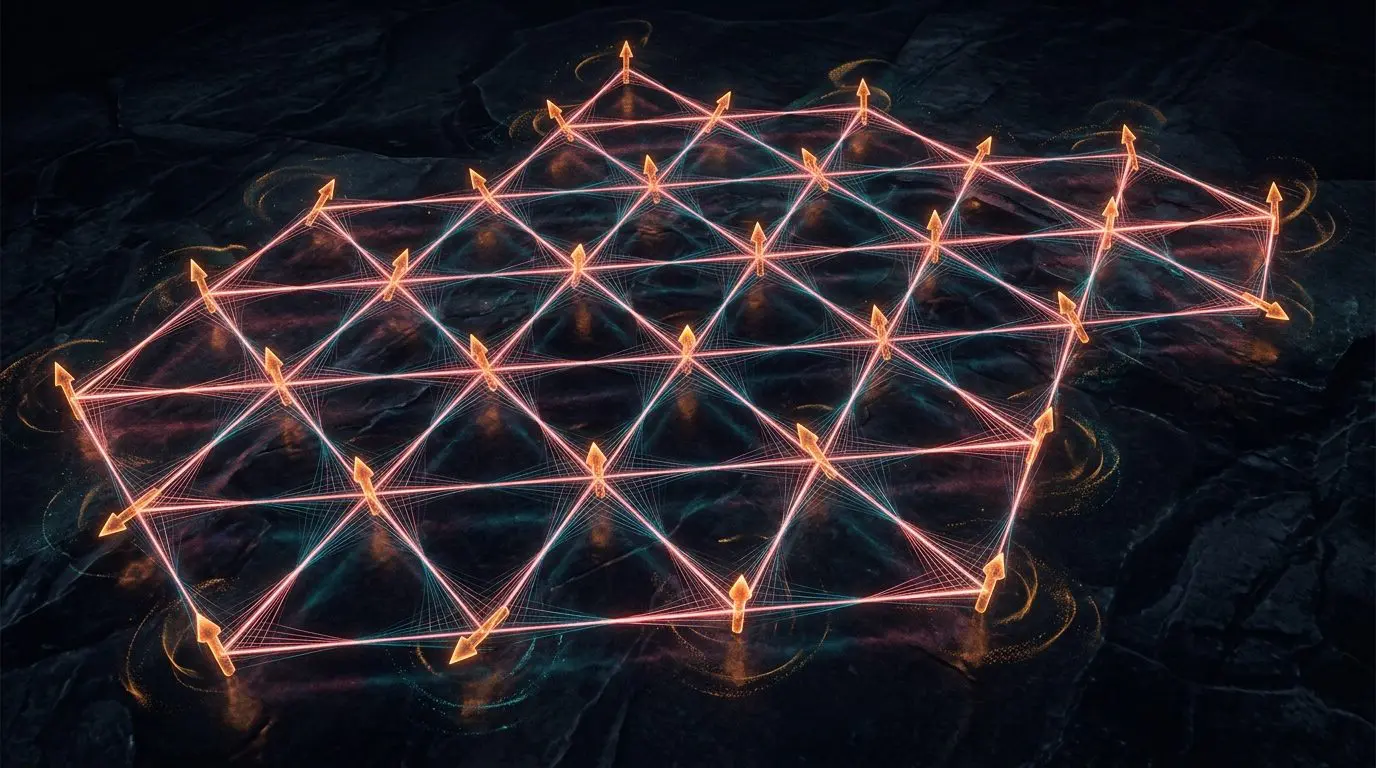
A new technique exists for evaluating the difficulty of creating specific quantum states within complex systems known as dense quantum spin glasses. The method assesses state preparation complexity by examining ‘profile complexity’, derived from measurements termed Pauli profiles that record expectations of all operators supported on exactly p qubits. A principle now evaluates how challenging it is to create specific quantum states within these complex systems; this goes beyond previous methods reliant on simplistic calculations based solely on circuit size.
The technique evaluates ‘profile complexity’, determined by measurements called Pauli profiles which quantify expectations of operators acting on qubits, the fundamental units of quantum information. This approach evaluates ‘profile complexity’ determined by measurements called Pauli profiles recording expected values when applying operations to qubits, the basic units of quantum information, much like taking multiple readings with different filters when analysing light. Effective profile complexity can be understood as a measure of how ‘spread out’ information about a quantum state is across many qubit combinations, analogous to measuring the diversity of patterns in an image.
Effective profile complexity reduces gate count for preparing quantum spin glass ground
Scientists at MIT and the Operations Research Centre have achieved a major leap forward in assessing complexity when preparing quantum states. Attaining near ground-state energy now requires only Ω(n²/log n) one- and two-qubit gates, a substantial improvement over previous methods lacking such precision. This threshold represents a fundamental limit on algorithm efficiency in creating these states within dense quantum spin glasses, previously unachievable with guaranteed performance bounds.
The new technique utilises ‘effective profile complexity’, moving beyond calculations reliant solely on circuit size to map information content across qubit combinations; this is analogous to measuring diversity in an image pattern. Work at MIT and the Operations Research Centre has advanced understanding of computational complexity by establishing a relationship between circuit size and ancillary workspace. Specifically, attaining near-ground-state energy necessitates Ω(n²/log n) one- and two-qubit gates regardless of utilising any number of temporary qubits.
This extends previous findings that established energetic separation for states beyond product systems, quantum systems lacking entanglement, and introduces profile complexity derived from metric entropy of Pauli profiles recording expectations of all p-qubit operators. Furthermore, analysis indicates entangled components within nearly minimal energy states must be logarithmically sized, preventing arbitrary growth without increasing computational demands.
Limitations of magic state distillation using shallow circuits and Clifford groups
This work offers a refined understanding of the resources needed to create complex quantum states; however, its analysis reveals inherent obstructions within Parham’s magic hierarchy which pose key challenges for building increasingly powerful circuits. Improvements over existing methods reliant on circuit lightcones, calculating how far information can travel in a given timeframe, were demonstrated. The framework struggles with certain scenarios involving shallow circuits followed by unrestricted Clifford operations, though.
Examining qubit expectations through ‘effective profile complexity’ provides an alternative route beyond traditional circuit lightcone calculations when quantifying state preparation difficulty. By establishing that achieving low-energy states in dense quantum systems demands at least Ω(n²/log n) one- and two-qubit gates, even with auxiliary computational assistance, scientists pinpoint fundamental limitations on algorithmic efficiency.
This goes beyond simply assessing circuit size or the distance information travels within it; instead, this new approach considers the inherent structure of complex quantum states and their impact on resource requirements for creation. The research highlights a crucial balance between minimising gate count and maintaining sufficient entanglement to achieve desired energy levels in these intricate quantum systems.
The researchers demonstrated that attaining near-ground-state energy requires Ω(n2/ log n) one- and two-qubit gates. This finding establishes a lower bound on computational resources needed for state preparation, moving past limitations of methods based solely on circuit lightcones. By introducing ‘effective profile complexity’ derived from metric entropy, the study offers an alternative way to quantify difficulty when creating complex states. The work also reveals inherent obstructions within Parham’s magic hierarchy which impact building increasingly powerful circuits; future investigations may explore these challenges further.
👉 More information
🗞 Beyond Light Cones: State Preparation Complexity in Quantum Spin Glasses
✍️ Omar Al-Ghattas, David Gamarnik and Bobak T Kiani (MIT)
🧠 ArXiv: https://arxiv.org/abs/2610.02166


See today’s quantum computing news on Quantum Zeitgeist for the latest breakthroughs in qubits, hardware, algorithms, and industry deals.