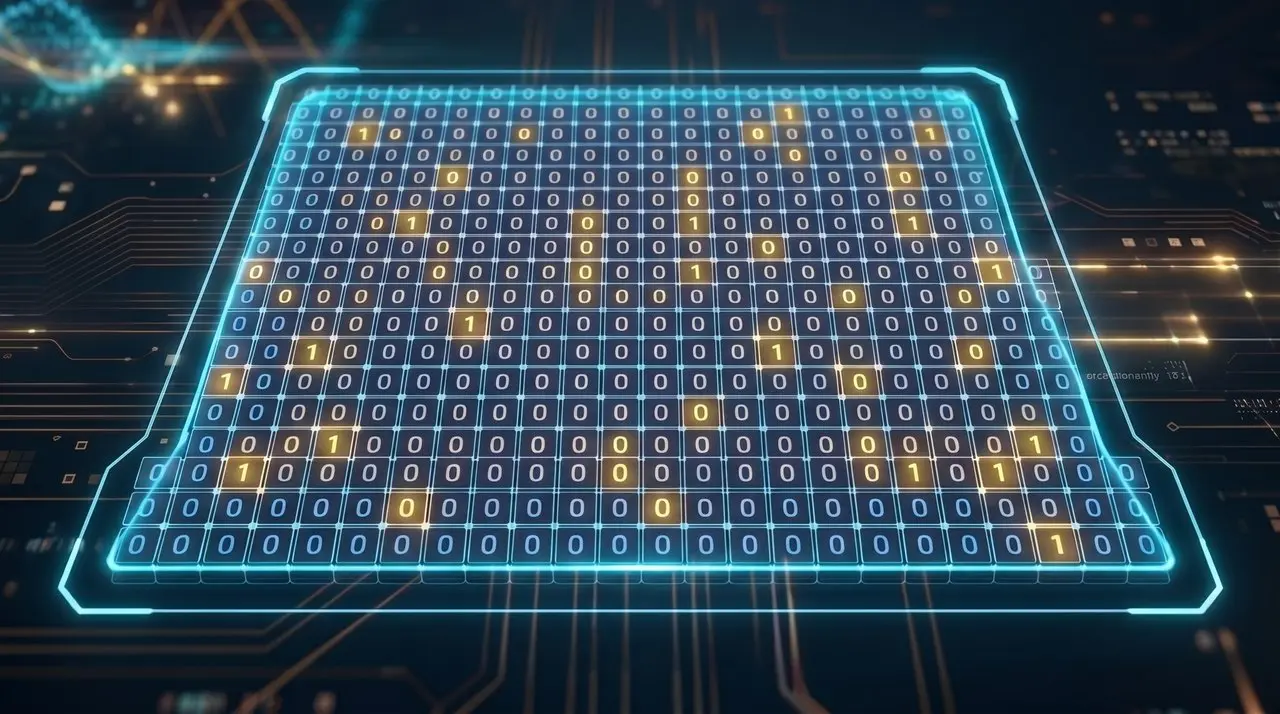
Any quantum low-density parity-check code can be transformed into another capable of single-shot quantum error correction using an efficient local decoder. This transformation enhances error suppression without requiring the original code to already possess single-shot properties; it allows for improved protection against errors during computation and data storage. The resulting decoder operates in a time proportional to the logarithm of system overhead, independent of overall size, offering key computational benefits.
A technique improves quantum error correction within existing codes without needing them to be inherently strong. The resulting decoder operates quickly, its processing time increases with only the logarithm of system overhead, regardless of overall size, potentially broadening applicability across various designs for quantum computers.
A method bolsters quantum error correction within existing codes without requiring inherent robustness; it transforms any quantum low-density parity-check code into one capable of single-shot error correction, correcting errors after one measurement attempt, much like immediately fixing a typo instead of multiple reviews. This advancement centres on enhancing error suppression and operates with an efficient decoder whose processing time grows very slowly as system size increases; specifically, it scales proportionally to the logarithm of system overhead, similar to rapidly narrowing down a search in a large alphabetically sorted list. The technique offers key computational benefits while maintaining bounded check weights and qubit degrees, potentially broadening applicability across diverse designs for quantum computers.
Single-shot error correction via QLDPC code transformation enhances fault tolerance
A key gain in protecting quantum information against errors has been achieved, improving error suppression from Ω(nβ) to Ω(mαnβ). Specifically, the team maintained a constant threshold (*p*RG), while simultaneously boosting error suppression capabilities when an initial decoder’s threshold (*p*c ) falls below that value. This resulted in improved error suppression reaching Ω(mαnβ), where ‘m’ functions as a scaling factor and α represents another positive constant indicating enhanced protection proportional to nβ, ‘n’ denoting system size and β defining the initial decoder’s capability.
Maintaining *p*RG as a consistent operational threshold was achieved even with lower performance from the original decoder (*p*c ). Furthermore, their local decoding method operates swiftly, completing within O (log m) parallel time.
Constructing towers of quantum low density parity check codes for single shot
The team centred its work on transforming any QLDPC code, a specific encoding scheme protecting information in qubits, into one capable of single-shot error correction; this allows errors to be corrected after one attempt, similar to fixing a typo immediately upon spotting it. This relies on constructing a ‘tower’ of codes through repeated application of a carefully designed level map and cleaning procedure, building layers onto an initial seed code without compromising structure. The team utilised a sparsity preserving level map alongside the seed code, defined by parameters including layer size bounds and maximum check weight/qubit degrees, enhancing error suppression while maintaining decoder independence for reliable operation.
Single-shot quantum error correction via reshaping CSS low-density parity-check codes
Iceberg Quantum researchers have demonstrated a powerful technique to retrofit existing quantum error correction codes; any CSS QLDPC code can be reshaped to correct errors with one measurement attempt instead of multiple checks, akin to spotting and fixing a typo immediately rather than repeated proofreading. However, this transformation is not universally beneficial as it relies on *p*RG, the operational threshold for noise suppression, which may prove difficult in imperfect real-world devices. Operating below this threshold does not invalidate the advance but highlights current hardware limitations. This method offers a pathway towards sharply faster error correction by identifying and resolving issues within one attempt, vital as quantum computers scale up. This transformation enhances error suppression without requiring inherent self-correcting properties in the original coding structure, broadening its applicability across diverse designs for future computers.
Researchers demonstrated that any existing CSS low-density parity-check (QLDPC) code could be reshaped to perform single-shot quantum error correction, meaning errors are identified and resolved with a single measurement attempt. This reshaping improves error suppression by combining the characteristics of both codes involved, defined by parameters *n* and *m*. While effective below a specific noise threshold (*p*RG), this approach offers potential benefits as quantum systems increase in complexity because it reduces the number of steps needed to correct errors. The team showed how transformation enhances error suppression without requiring self-correcting properties within initial coding structures.
👉 More information
🗞 One-Shot any Code
✍️ Andrew C. Yuan (Affiliation: Iceberg Quantum)
🧠 ArXiv: https://arxiv.org/abs/2610.02137
See today’s quantum computing news on Quantum Zeitgeist for the latest breakthroughs in qubits, hardware, algorithms, and industry deals.