

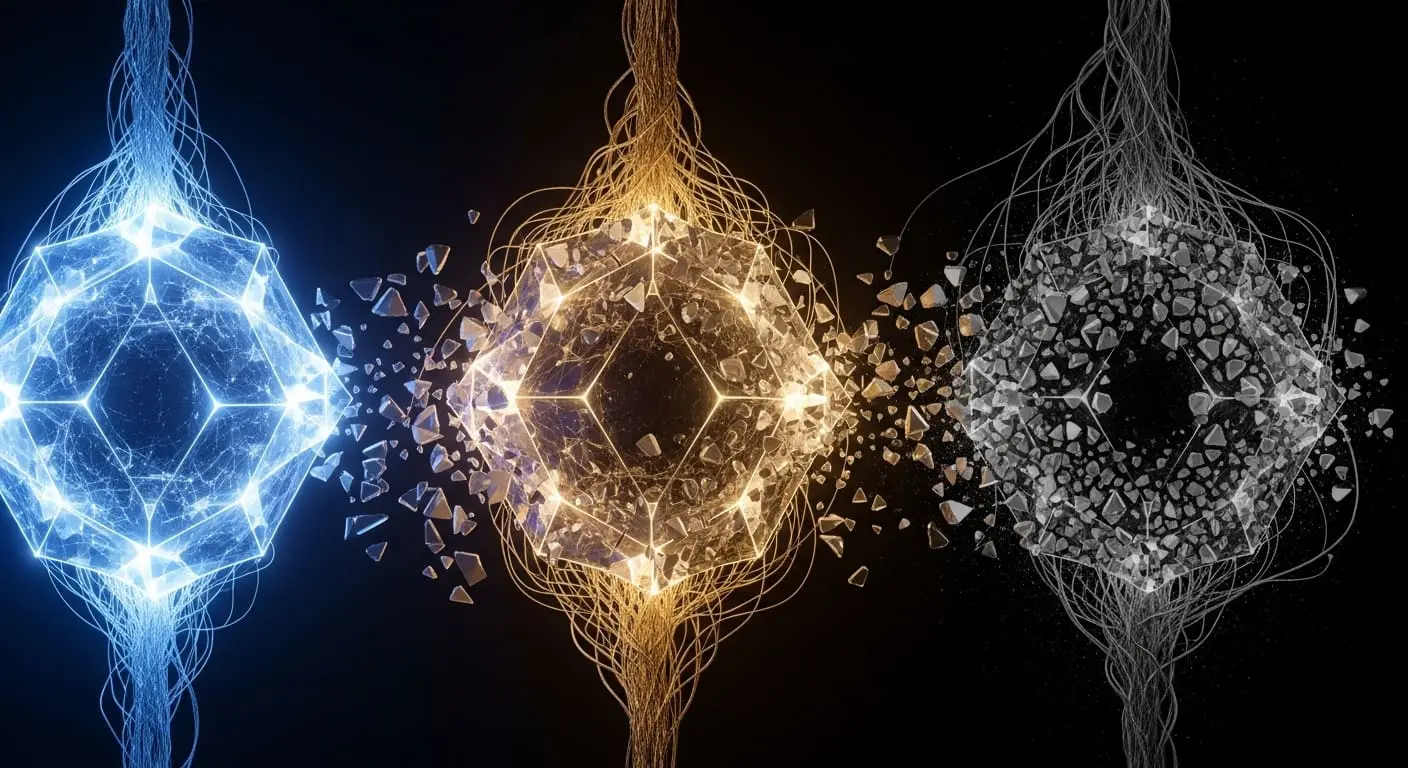
Understanding how quantum systems lose coherence near black holes previously required complex global calculations. Ran Li of Qufu Normal University and colleagues from Stony Brook University have, for the first time, shown that the rate of this quantum decoherence, the loss of superposition, depends directly on the quantum state of the surrounding field. The analysis reveals that the Boulware vacuum results in no decoherence, while the Unruh and Hartle-Hawking vacua induce decoherence with a rate of 0.1. This clarifies how quantum superpositions, where a particle exists in multiple states simultaneously, are affected near black holes.
The team discovered that the rate at which quantum coherence is lost directly relates to the quantum state of the surrounding space, specifically the theoretical ‘vacuum’ of that space. A ‘Boulware vacuum’ prevents decoherence, while ‘Unruh’ and ‘Hartle-Hawking’ vacua induce it at a measurable rate. Ran Li and colleagues have refined our understanding of how quantum systems lose coherence, a process similar to static on a radio signal, gradually scrambling a clear message, when near black holes.
Their work demonstrates that the rate of this quantum decoherence is directly linked to the quantum state of the surrounding space, revealing that certain theoretical descriptions of empty space, known as vacua, have markedly different effects. Specifically, a ‘Boulware vacuum’ prevents decoherence altogether, while ‘Unruh’ and ‘Hartle-Hawking’ vacua induce it at a rate of 0.1; these vacua can be imagined as viewing the same empty space through different lenses. The team reformulated a thought experiment involving a particle near a black hole, describing the loss of quantum coherence using a mathematical set of tools called the Wightman function, which measures how quantum fields fluctuate in spacetime, much like measuring the ripples on a pond.
Vacuum state determines quantum superposition loss near event horizons
A major advance in understanding quantum decoherence near black holes has been made, with a measurable decoherence rate of 0.1. Previously, calculations required complex global approaches, hindering precise determination of this value. Modelling a particle as a classical source interacting with a quantum scalar field enabled a local expression of decoherence dependent on the surrounding field’s quantum state. The analysis reveals that the Boulware vacuum, a specific theoretical depiction of empty space, prevents decoherence entirely, while the Unruh and Hartle-Hawking vacua, representing thermal effects, induce it. This highlights the key role of the environmental quantum state in preserving or destroying quantum superposition.
The calculations reformulated decoherence by treating a particle as a classical source coupled to a quantum scalar field, deriving a local expression for the decoherence functional in terms of the Wightman function. In the long-time limit, the decoherence rate is characterised by the low-frequency behaviour of the Wightman function, a measure of particle correlations. Decoherence depends on the quantum state of the environmental field; the Boulware vacuum yields vanishing decoherence for a static superposition, while the Unruh and Hartle-Hawking vacua can induce decoherence due to thermal effects. The integral representing the decoherence rate depends on the proper distance between the components of the superposition and can be expressed using the scalar field’s correlation function. This approach allows detailed examination of the relationship between the decoherence rate and the properties of the surrounding quantum field, providing insights into the mechanisms driving quantum information loss.
Local decoherence calculations reveal quantum coherence loss near black holes
Unifying quantum mechanics with general relativity presents a persistent challenge, demanding fresh perspectives on how quantum systems behave in extreme gravitational environments. This work offers a new way to calculate the loss of quantum coherence, the fading of a particle’s ability to exist in multiple states at once, near black holes. It sidesteps previously intractable global calculations by focusing on local decoherence, acknowledging that calculating quantum effects near black holes involves considerable theoretical uncertainty.
A detailed method, examining the rate of quantum superposition loss, provides a tractable pathway for understanding the interaction between gravity and quantum information, and opens avenues for exploring the limits of quantum mechanics in strong gravitational fields. This framework allows investigation of the interplay between gravity and quantum information, and exploration of how different vacuum states affect the preservation of quantum coherence. The rate of quantum superposition decay isn’t solely determined by the gravitational environment, but is fundamentally linked to the quantum state of the surrounding space, offering a new perspective on the quantum-gravity interface.
The research demonstrated that quantum coherence, a particle’s ability to exist in multiple states, can be lost near black holes, and this loss is dependent on the quantum state of the surrounding field. This matters because understanding how quantum systems behave in strong gravitational fields is a key challenge in unifying quantum mechanics with general relativity. Researchers calculated the rate of this decoherence by focusing on local effects and utilising the Wightman function with the Boulware, Unruh, and Hartle-Hawking vacua, revealing that thermal effects from Hawking radiation can induce this quantum coherence loss. The authors suggest this method allows detailed examination of the relationship between decoherence and the properties of the surrounding quantum field.
👉 More information
🗞 Note on the local calculation of decoherence of quantum superposition in the static black holes
🧠 ArXiv: https://arxiv.org/abs/2606.14178

See today’s quantum computing news on Quantum Zeitgeist for the latest breakthroughs in qubits, hardware, algorithms, and industry deals.



