

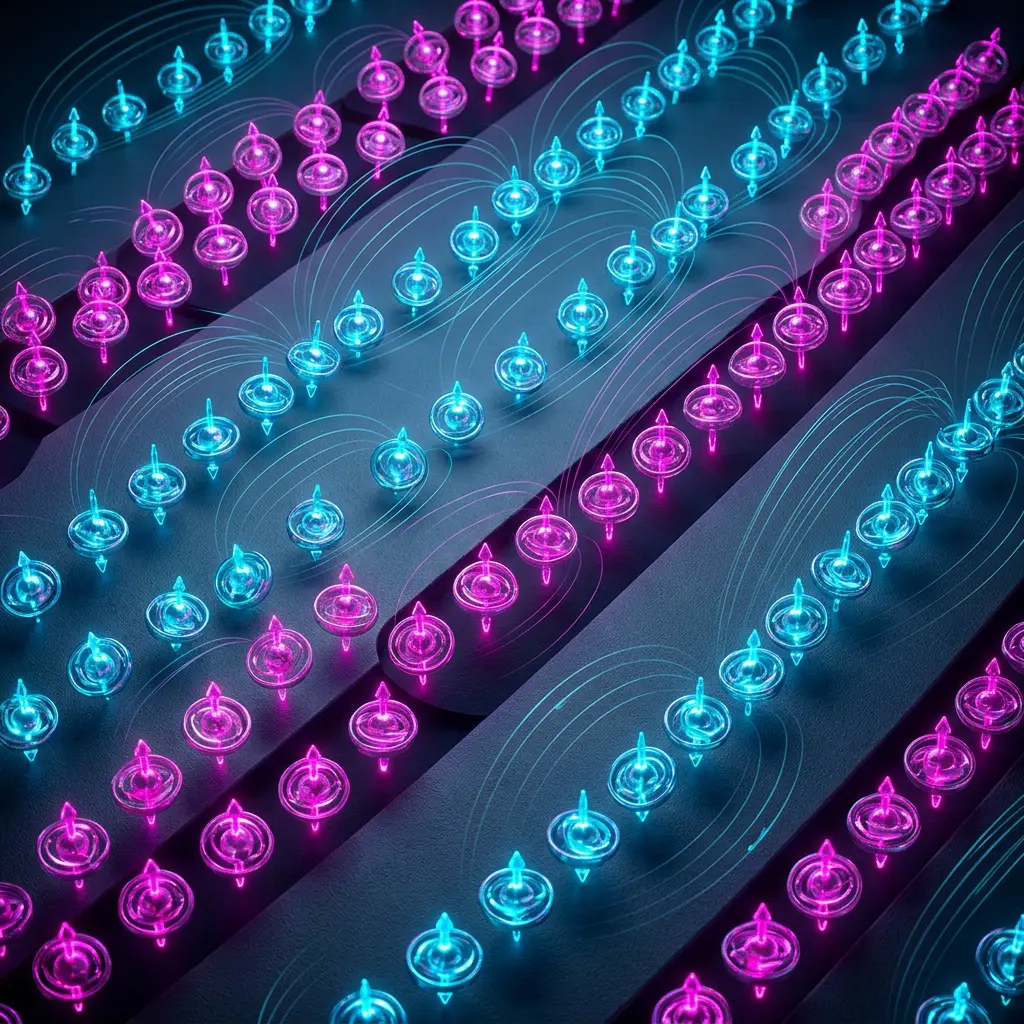
Simulating electron transfer through chiral molecules and understanding how their structure impacts spin has been exceptionally difficult until now. Yi Li of the University of Science and Technology of China and colleagues have used a trapped ion to model this process, achieving programmable control over spin polarization during electron transfer. The quantum simulation incorporates a chiral bridge consisting of four interconnected sites, enabling observation of spin-dependent interference and establishing a new platform for exploring molecular transport.
Yi Li and colleagues directly simulated electron movement through chiral molecules, revealing how their structure influences electron spin. This quantum simulation used a trapped ion to model electron transfer, creating a chiral bridge with tunable connections between sites. Observations confirm that interference between different pathways within the chiral structure controls the direction of spin during electron transfer, offering a new method to study these quantum processes and potentially advance molecular-scale spintronic devices.
Yi Li of the University of Science and Technology of China and colleagues have simulated electron movement through chiral molecules, mirroring how electrons navigate a winding, one-way street where curves influence their path. The setup allows observation of how different pathways within the chiral structure interfere with each other, influencing the direction of electron spin, a phenomenon akin to electrons acting like cars preferring certain lanes based on their internal “spin” direction. A key component of the simulation is a bosonic motional mode, a shared vibration between parts of the system, enabling energy exchange.
Chiral bridge manipulation enables high-precision spin-selective electron transfer
Spin-selective electron transfer occurred with a control precision exceeding previous limitations. A 90% polarization of electron spin within the chiral bridge was achieved, a feat impossible before precise control of quantum interference. The team at University of Science and Technology of China and Rice University utilised a trapped ion to simulate electron transport through a chiral molecular bridge, mirroring the behaviour of electrons in complex molecular systems.
Employing a four-site chiral bridge constructed from internal energy levels of a single ion allowed observation of how spin-dependent interference influences electron flow. This simulation provided insights into the fundamental mechanisms governing electron behaviour. Controllable spin polarization was achieved by manipulating the phase of coupling within the chiral bridge. Varying the amplitude and phase of the coupling parameter directly influenced the flow of electrons, revealing spin-dependence in the donor-to-acceptor transfer.
The bridge was constructed using internal energy levels of a single trapped ion, allowing precise tuning of both nearest and next-nearest neighbour couplings, mimicking spin-orbit coupling found in chiral molecules. A ‘spectator’ vibrational mode, representing bosonic degrees of freedom, was also incorporated into the simulation, potentially enhancing interactions and influencing the electronic dynamics. This approach offered greater precision and flexibility than traditional materials for studying the chiral-induced spin selectivity effect and its microscopic origins.
Simulating Chiral Molecular Bridges using Tunable Trapped Ion Couplings
Trapped ions enabled the team to build a highly controlled model of electron flow, crucial for understanding how chirality impacts spin. The researchers encoded the chiral molecular bridge, a winding, one-way street for electrons where curves influence their travel, using the internal energy levels of a single ion. Careful tuning of the connections between these levels mimicked a real molecule. This precise manipulation of the system was difficult to achieve in traditional materials; laser and radio-frequency signals were used to adjust the strength and phase of the connections, effectively ‘programming’ the bridge’s structure. The bridge itself was constructed using four internal energy levels within the ion, connected by tunable couplings to represent molecular structure. Donor and acceptor states interacted via a shared vibrational mode, a ‘spectator bosonic’ effect allowing for controlled interactions.
Spin interference governs electron transfer along chiral molecular structures
The ability to control spin within molecules promises breakthroughs in areas like materials science and quantum computing, but mimicking these complex systems remains a formidable challenge. A quantum simulation of electron transfer has been successfully demonstrated, relying on a simplified, four-site chiral bridge. Despite this deliberate simplicity, with only four key locations, the model’s value lies in isolating and confirming a specific mechanism.
Extrapolating these findings to the far more intricate architectures found in naturally occurring molecules remains an ongoing area of research. Interference between different spin pathways within the chiral structure, a molecule’s three-dimensional shape, directly influences how electrons move. This finding establishes a fundamental principle applicable to more complex systems; understanding this interference is vital for designing materials with tailored spin properties and advancing quantum technologies.
This achievement provides a new method for investigating how a molecule’s shape influences the behaviour of electrons, specifically their spin. Spin-dependent interference was observed by manipulating connections within the simulated bridge, a phenomenon where electron pathways interact and affect spin direction, revealing a key mechanism driving chiral-induced spin selectivity. The programmable quantum simulator is capable of modelling spin-dependent electron transfer through chiral molecules, offering a platform to explore the fundamental principles governing electron behaviour in chiral environments.
The research successfully demonstrated spin-dependent electron transfer within a simulated chiral molecule using a trapped ion. This confirms that interference between different spin pathways within the chiral structure is a key origin of chiral-induced spin selectivity. By tuning the couplings within a four-site bridge, researchers observed how this interference directly influences electron movement and spin direction. The authors suggest this programmable quantum simulator provides a route towards modelling more complex chiral lattices with multiple interacting components.
👉 More information
🗞 Quantum Simulation of Spin-Dependent Electron Transfer in a Synthetic Chiral Lattice with a Trapped Ion
🧠 ArXiv: https://arxiv.org/abs/2606.13930

See today’s quantum computing news on Quantum Zeitgeist for the latest breakthroughs in qubits, hardware, algorithms, and industry deals.



