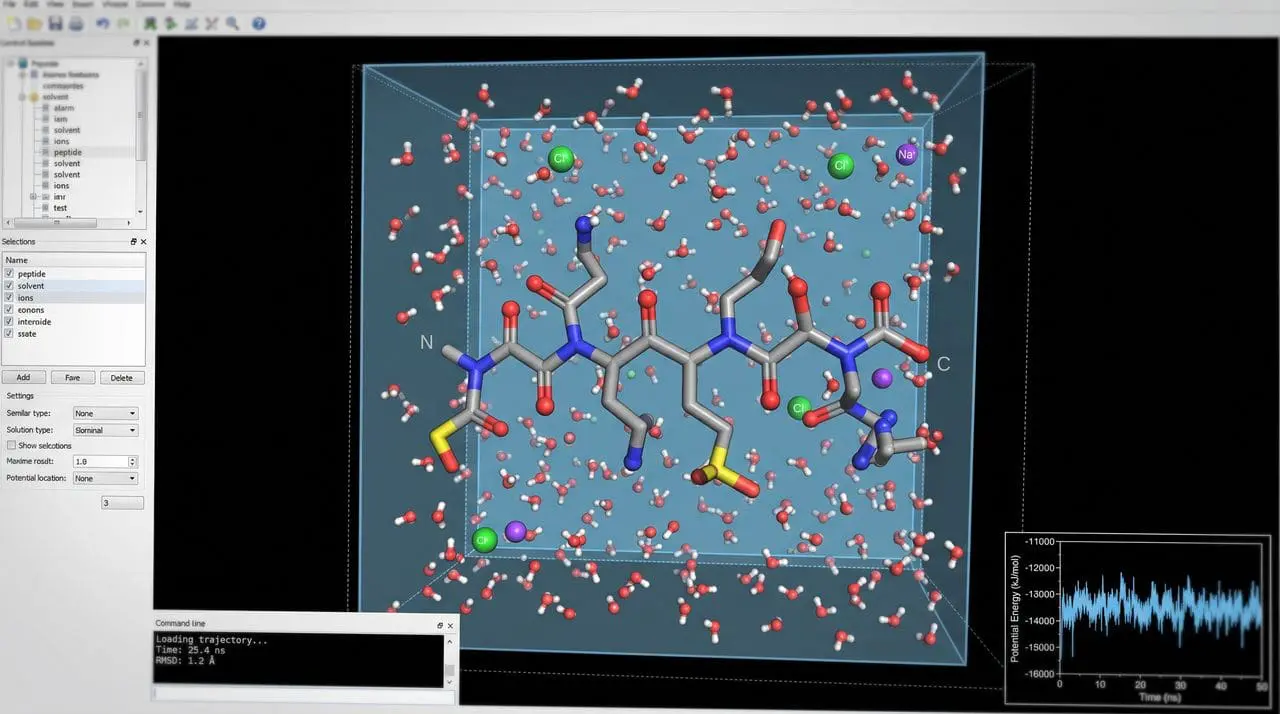
Scientists have, for the first time, traced the quantum movements of a hydrated proton as it “hops” between six water molecules, offering a detailed view of a phenomenon first observed in the nineteenth century. An international research team led by scientists at Heidelberg University’s Institute for Physical Chemistry performed the complex simulations, revealing how water governs proton mobility, not as a simple drift, but as a transfer from molecule to molecule. This “hopping” motion, known as the Grotthuss mechanism, underpins the acidity of water and is crucial for processes ranging from energy storage in batteries to signal transmission in living cells. “Our simulations show that the configuration of the surrounding water molecules is the key factor determining how protons move in an aqueous solution,” emphasizes Oriol Vendrell of Heidelberg University, adding that local asymmetries govern the proton’s characteristic movement and infrared fingerprint.
The work centers on the Grotthuss mechanism, where protons do not drift, but “hop” between water molecules, a process fundamental to water’s acidity, energy storage, and biological signaling. Until recently, hydrated protons were modeled using idealized structures, the Zundel and Eigen cations, each assuming a different number of bound water molecules. “However, recent studies using infrared spectroscopy reveal a state that is far more dynamic and lies between these two extremes,” explains Dr. David Mendive-Tapia, a postdoctoral researcher. The team simulated an extended Zundel complex, transitioning it between symmetric and asymmetric configurations to track 51 interlocking vibrations with full quantum resolution, successfully reproducing experimental infrared spectra. A crucial element was an artificial neural network, trained at Ruhr University Bochum, which accurately modeled the forces between atoms without approximations. The research, funded by the German Research Foundation and the Royal Society, expands current understanding of proton dynamics and was published in Nature Chemistry.
“Our simulations show that the configuration of the surrounding water molecules is the key factor determining how protons move in an aqueous solution. The infrared fingerprint of the hydrated proton, and ultimately its characteristic hopping, is governed above all by local asymmetries in its surroundings,”
The ability to model proton dynamics in water with quantum accuracy has been significantly advanced through the application of artificial neural networks, allowing researchers to move beyond simplified representations of hydrated protons. Researchers simulated an extended Zundel complex, comprising six water molecules, to trace the movements of a proton shared among them in full quantum detail. This machine-learning model accurately modeled the forces between atoms, enabling the team to follow the proton’s quantum motion with accuracy and without adjustable parameters. By tracking 51 interlocking vibrations simultaneously, the team successfully reproduced experimental measurements of the complete infrared spectrum, offering new insight into the Grotthuss mechanism, a proton “hopping” motion first observed in the nineteenth century and vital for processes ranging from battery energy storage to cellular signaling.
“However, recent studies using infrared spectroscopy reveal a state that is far more dynamic and lies between these two extremes,”



See today’s quantum computing news on Quantum Zeitgeist for the latest breakthroughs in qubits, hardware, algorithms, and industry deals.