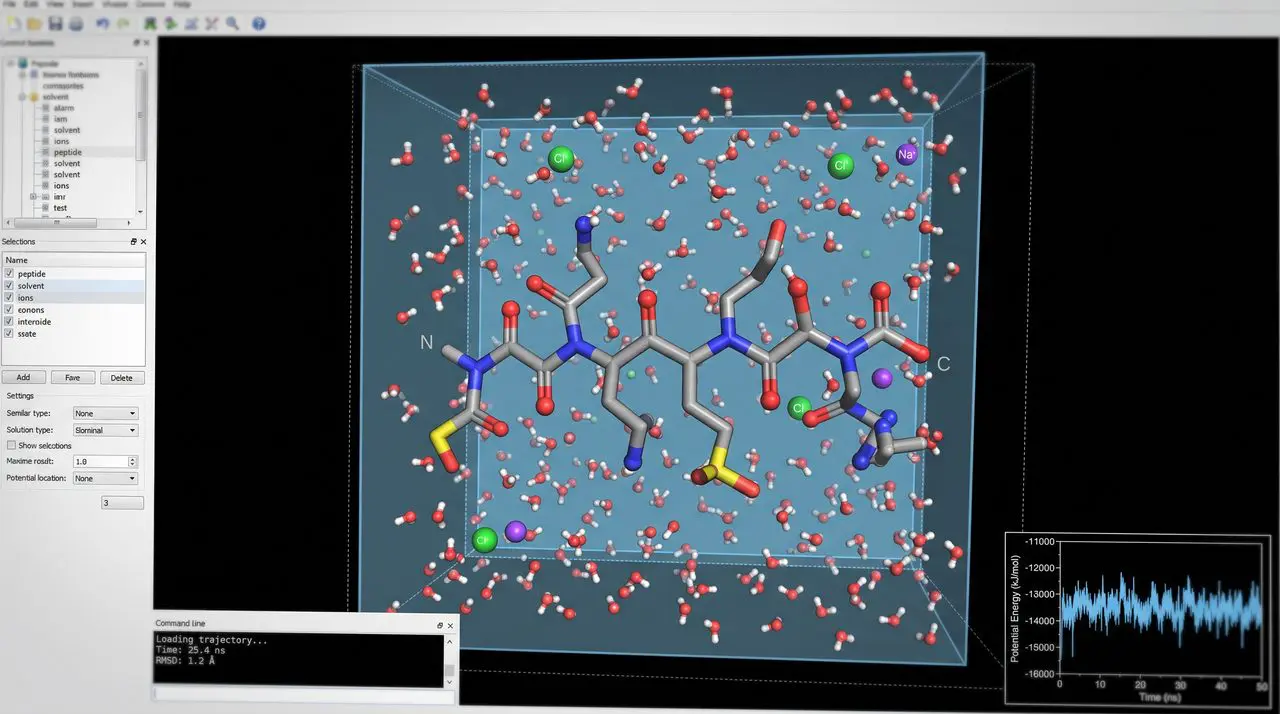
Computations can be prohibitive on classical hardware. Quantum computers offer a promising alternative due to their linear scaling in space requirements with system size. A new hybrid quantum-classical algorithm for *ab initio* molecular dynamics introduces active incorporation of nuclear quantum effects via the nuclear-electronic orbital method. The algorithm evaluates ground state energies and forces on the quantum computer using a variational quantum eigensolver, while molecular geometries update classically. Validation occurs through simulations of H 2, H 2 O and the Zundel ion H 5 O 2 +, comparing simulated vibrational spectra with experimental data.
Quantum computation refines accuracy in simulating vital Zundel ion vibrational spectra
Vibrational spectra error reductions reached up to 45cm−1 for the Zundel ion when compared against previous methodologies lacking nuclear quantum effects, a threshold previously unattainable due to computational cost. Accurate modelling of proton transfer phenomena is now possible, offering important insights into chemical reactions such as those occurring during photosynthesis and respiration. Conventional simulations struggle because representing atomic nuclei accurately demands exponentially increasing computing power.
However, by employing a hybrid quantum-classical algorithm utilising the nuclear-electronic orbital method, energies and forces evaluated on a quantum computer while geometries underwent classical updates demonstrated through simulations involving hydrogen, water, and the Zundel ion H5O2+. Incorporating these crucial nuclear quantum effects resulted in effectively barrierless movement for protons within this key molecule.
Calculations performed on hydrogen and water molecules alongside the Zundel ion H5O2+ validated this advancement with sharp improvements observed in frequency error modelling compared to earlier methods that lacked such quantum considerations. Streamlined computational circuits also allowed performance comparable to more complex algorithms like UCCSD, suggesting potential execution on currently available near-term quantum devices. Molecular simulation has made strong progress towards accuracy; however practical application still requires scaling up beyond small test cases presented here. Further research is needed to expand system size capabilities.
Accurate modelling of proton transfer advances understanding of photosynthesis mechanisms
Researchers at the German Aerospace Centre and Helmholtz Institute Ulm have developed a method for simulating molecular behaviour with greater accuracy, addressing long-standing challenges in modelling both proton transfer and hydrogen bonding, processes vital for comprehending biological processes such as photosynthesis. The work reveals that qubit requirements scale linearly, rather than exponentially, offering promising avenues for successful simulations involving larger systems despite achievements already made with water, hydrogen, and the Zundel ion. Despite current limitations preventing scaling to substantially larger molecular systems, this represents a step forward within computational chemistry.
The research demonstrated that simulating molecules including proton transfer can be achieved with linear scaling of required qubits, offering an alternative to computationally intensive traditional methods. This means more complex systems may become accessible for simulation than previously possible, as nuclear quantum effects were incorporated into calculations for hydrogen, water and the Zundel ion H5O2+. Inclusion of these effects removed barriers to proton movement in the Zundel ion and improved accuracy when modelling vibrational spectra against experimental data. The authors suggest further work is needed to expand this method’s capabilities to larger molecular simulations.
👉 More information
🗞 Molecular Dynamics with Nuclear Effects on Quantum Computers
✍️ Lukas Haßfurth, Juliane Heitkämper, Elias Walter and Birger Horstmann (Affiliation: German Aerospace Center)
🧠 ArXiv: https://arxiv.org/abs/2610.01549



See today’s quantum computing news on Quantum Zeitgeist for the latest breakthroughs in qubits, hardware, algorithms, and industry deals.