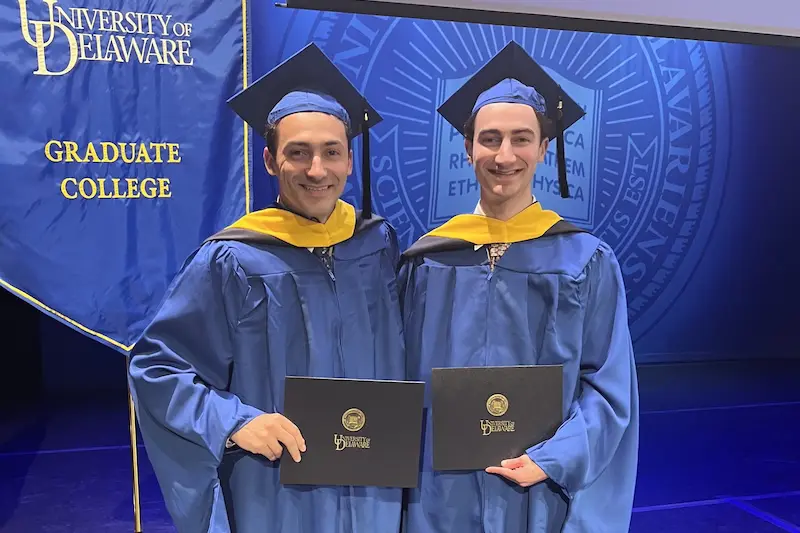
Ocean County College saw an unusual return when Michael Manfre, having previously left to build a business in California, reenrolled alongside his younger brother Tyler. The pair then became the first to utilize a new accelerated pathway into quantum information science: a 3+2 program established by Brandon Mitchell of West Chester University and Matthew Doty of the University of Delaware. Doty said, allowing Tyler and Michael Manfre to earn bachelor’s and master’s degrees and gain valuable hands-on experience in a rapidly developing field.
3+2 Program Accelerates Quantum Science Path for Manfre Brothers
The University of Delaware’s new 3+2 program enabled Michael and Tyler Manfre to transition directly from undergraduate research into advanced quantum studies, a pathway previously unavailable to students. This accelerated route, combining three years at West Chester University with two at UD, was specifically designed to address a critical skills gap in the emerging field of quantum information science.
Matthew Doty, professor of materials science and engineering at UD, explained the program’s origins: “Brandon Mitchell [professor of physics and engineering at WCU] and I established the 3+2 program as a faster and more cost-effective path to a master’s degree that provides both core technical knowledge and hands-on experience in the emerging discipline of quantum information science.” The Manfre brothers were the first to utilize this approach, establishing a streamlined educational experience.
A key component of the program’s success lies in its experiential learning requirement: a six-credit capstone project or industry internship designed to cultivate practical skills. Doty highlighted a specific industry need the program addresses, noting that quantum companies consistently seek technicians proficient in nanofabrication, manufacturing devices at the nanometer scale.
Michael Manfre’s experience during this phase proved particularly formative. “At one point, I managed a full manual cooldown largely on my own, monitoring valve sequences and chamber pressure and catching a pressure excursion before it caused damage,” he said, emphasizing the value of translating coursework into tangible, hands-on responsibility.
Tyler Manfre’s learning style differed, focusing on immediate application. “Tyler learns through implementation,” explained Michael, “He’ll start working with the equipment or the code and learn by doing. I tend to map out the full problem and understand why each step matters before I start.” The brothers’ collaborative approach extended beyond coursework, fostering a reciprocal learning environment. “Mike is a quick learner, and he was great at helping me visualize concepts that I was struggling with,” Tyler stated.
“Explaining those ideas helped reinforce his own understanding, and the same thing happened in reverse when I grasped something before he did. We really pushed each other to learn more deeply and came out stronger because of it.” This mutual support, combined with the program’s focused curriculum, allowed them to not only complete their degrees efficiently but also to develop a strong foundation for future careers.
Even after graduation, the brothers intend to maintain this collaborative spirit. “Even when we’re not literally working together, I want us to keep doing what we did in the program — comparing notes, sharing leads and calling each other out when one of us is settling for less,” said Michael.
I want us to keep doing what we did in the program – comparing notes, sharing leads and calling each other out when one of us is settling for less.
Michael, who discovered he wanted a career in quantum hardware through the internship
Nanofabrication Research Improves Photonic Device Precision
The University of Delaware’s accelerated program directly addresses a critical industry bottleneck: a shortage of skilled technicians proficient in nanofabrication, the manufacture of devices with components measured in nanometers. Matthew Doty, who co-established the 3+2 program, noted this need stemmed from consultations with quantum companies seeking personnel capable of hands-on work with nanoscale materials and tools.
Tyler Manfre joined Doty’s photonics lab to investigate a common nanofabrication challenge: discrepancies between designed and fabricated device dimensions. He developed an automated image analysis tool at the UD Nanofabrication Facility, comparing intended nanoscale designs to the actual devices produced.
This tool generated a correction table, proactively accounting for fabrication fluctuations and aiming to improve the precision of photonic device manufacturing, a process vital for reliable quantum systems. “Being able to take what I learned in class and apply it to real research using nanofabrication tools and electron microscopy made everything feel tangible,” said Tyler, highlighting the value of directly applying theoretical knowledge to practical experimentation.
The program’s impact extends beyond technical skill development; it also fostered a clear career focus for its first participants. Tyler, now a photonic assembly and test technician at CACI International Inc., expressed a desire to translate research into real-world applications, contributing to the development of dependable photonic and quantum systems.
Similarly, Michael Manfre began a position as a field service engineer at Oxford Instruments, aiming to improve the reliability of quantum hardware outside of research settings. “I hope my work helps bridge the gap between research and real-world technology,” Tyler stated, reflecting a shared ambition among the program’s graduates to advance the practical implementation of quantum technologies. Doty affirmed the success of this initial cohort, noting that “Tyler and Michael were the first two to take advantage of the program, so they were blazing a trail coming from West Chester to UD.”
Brandon Mitchell [professor of physics and engineering at WCU] and I established the 3+2 program as a faster and more cost-effective path to a master’s degree that provides both core technical knowledge and hands-on experience in the emerging discipline of quantum information science.
Matthew Doty, professor of materials science and engineering and director of the quantum science and engineering program at UD
Quantum Hardware Internship Validates Career Focus
The University of Delaware’s accelerated 3+2 program demonstrably translated academic study into career momentum for its initial cohort, with both Michael and Tyler Manfre securing positions focused on practical quantum hardware implementation immediately following graduation. Michael Manfre’s internship at Northrop Grumman provided the hands-on experience that solidified his career direction. “Seeing coursework concepts translate into something I was physically responsible for is what made it click that this was the right field for me,” Michael said, highlighting the value of applying theoretical knowledge to real-world challenges.
I hope my work helps bridge the gap between research and real-world technology. I’d like to contribute to developing reliable photonic and quantum systems that eventually make their way into practical applications.
Tyler, who started that goal when he was hired as a photonic assembly and test technician at CAC



See today’s quantum computing news on Quantum Zeitgeist for the latest breakthroughs in qubits, hardware, algorithms, and industry deals.