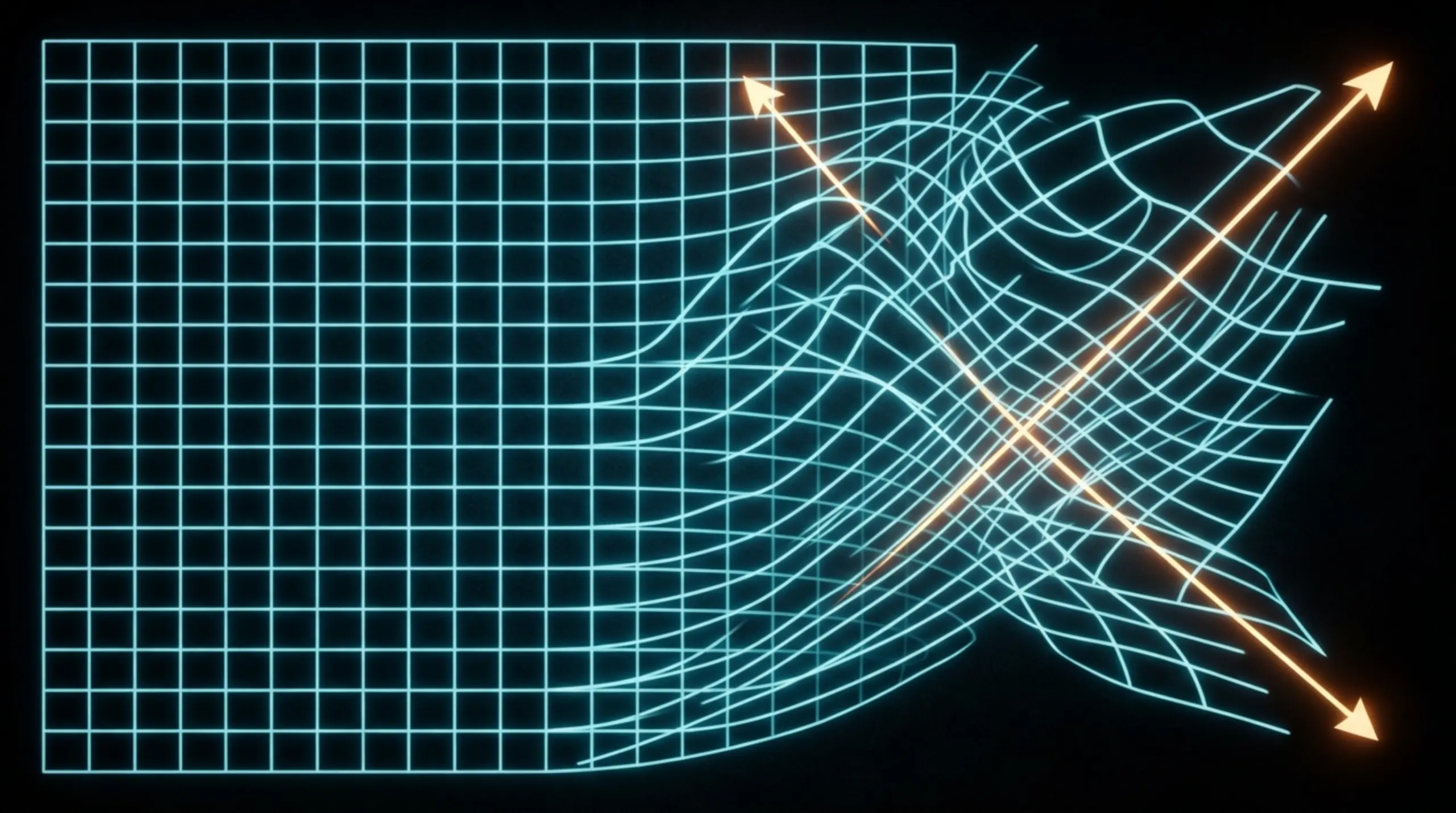
The team from Aix-Marseille University, Tsinghua University, and Nagoya University found that if retrodiction respects established principles of channel composition and unitary inversion, it must align with the Petz transpose map for finite-dimensional systems. Predicting past states from quantum measurements remains a complex challenge; retrodiction follows unique rules when certain logical conditions are met, specifically, it must align with something called the Petz transpose map.
This finding clarifies fundamental principles governing this “reverse prediction” by demonstrating these constraints uniquely determine how to calculate such reversals. Work from Aix-Marseille University, Tsinghua University, and Nagoya University proves that reversing quantum processes follows unique rules under specific conditions; it’s akin to looking backwards from an outcome to infer what likely caused it, like figuring out which key opened a lock after seeing it unlocked.
The team demonstrated this reversal must align with something called the Petz transpose map if certain logical principles are met regarding how these reversals combine sequentially or in parallel, return to the original process when applied twice, and behave predictably for simple reversible changes. A ‘quantum channel’, essentially a process transforming information during transmission (think of sending a message through static), is central to understanding this concept. This finding clarifies fundamental principles governing “reverse prediction” by demonstrating that these constraints uniquely determine its calculation.
Defining Retrodiction Through Fundamental Consistency Principles
A new approach to retrodiction, reversing quantum processes to infer past states, began not by assuming properties, but by defining fundamental consistency criteria it must satisfy; this technique was developed by Eleanor Rieffel. These principles stipulated how assignments should behave when combining multiple transformations sequentially or in parallel, ensuring reversibility (applying reversal twice returns the original process), and aligning with known behaviour for simple reversible changes like unitary evolution. This framed the problem as proving whether the Petz transpose map adhered uniquely to these rules.
The work focused on channels, maps transforming quantum states between systems, and their reversal to infer prior states given current ones. Instead of directly assuming properties, researchers defined fundamental consistency criteria: reversibility (reversing twice yields the initial state), correct behaviour under sequential and parallel composition, and agreement with established physics governing simple reversible processes such as unitary evolution. Beyond simply identifying a retrodictive method, this provides insight into how different transformations interact when reconstructing past events from present observations.
Petz Map Uniqueness Derives From Fundamental Retrodiction Principles
Establishing a unique method for ‘retrodiction’, inferring past quantum states from measurements, previously proved elusive; now any consistent retrodictive assignment must align with the Petz transpose map when applied to finite-dimensional systems under four specific conditions: involutivity (reversing twice returns the original state), respect for sequential and parallel composition of transformations, agreement with unitary inversion (predicting backwards through simple reversible changes) and application across all prior probabilities and channels. This proof establishes the inevitability of the Petz map by deriving it from these fundamental principles rather than assuming its properties directly, characteristics like affinity under probabilistic mixtures follow as a consequence.
Unique Retrodiction Hinges on Reversibility and Consistent Probabilistic Handling
Pinpointing how to infer past quantum states from present measurements remains challenging, but conditions have now been identified under which a unique solution emerges: alignment with the Petz transpose map. However, this theorem relies heavily upon specific criteria, reversibility when applying transformations twice, predictable behaviour for simple changes, and consistent handling of probabilistic mixtures, raising questions about whether alternative retrodictive assignments might exist if these constraints are relaxed. Despite acknowledging doubts regarding potential alternatives emerging with loosened constraints, establishing such conditions remains valuable; it clarifies when established methods employing this approach are demonstrably justified.
Quantum retrodiction, inferring past states from present measurements, is definitively linked to fundamental principles rather than assumed properties. This work doesn’t necessarily close off all avenues of investigation into past quantum states but provides a firm foundation upon which future research can build by outlining precisely what characteristics any viable solution *must* possess.
This research demonstrates that the Petz transpose map is uniquely determined as the analogue of Bayes’ rule within quantum theory, given specific consistency requirements. Importantly, properties such as predictable behaviour under probabilistic mixtures are shown to be consequences of these principles rather than assumptions. This clarifies why the Petz transpose map appears in various areas of quantum theory and establishes a foundation for evaluating alternative approaches if those constraints were altered.
👉 More information
🗞 Inevitability of the Petz transpose map
✍️ Jacopo Surace (Affiliation: Aix-Marseille University); Chenxu Li (Tsinghua University); Francesco Buscemi (Nagoya University)
🧠 ArXiv: https://arxiv.org/abs/2610.40158




See today’s quantum computing news on Quantum Zeitgeist for the latest breakthroughs in qubits, hardware, algorithms, and industry deals.