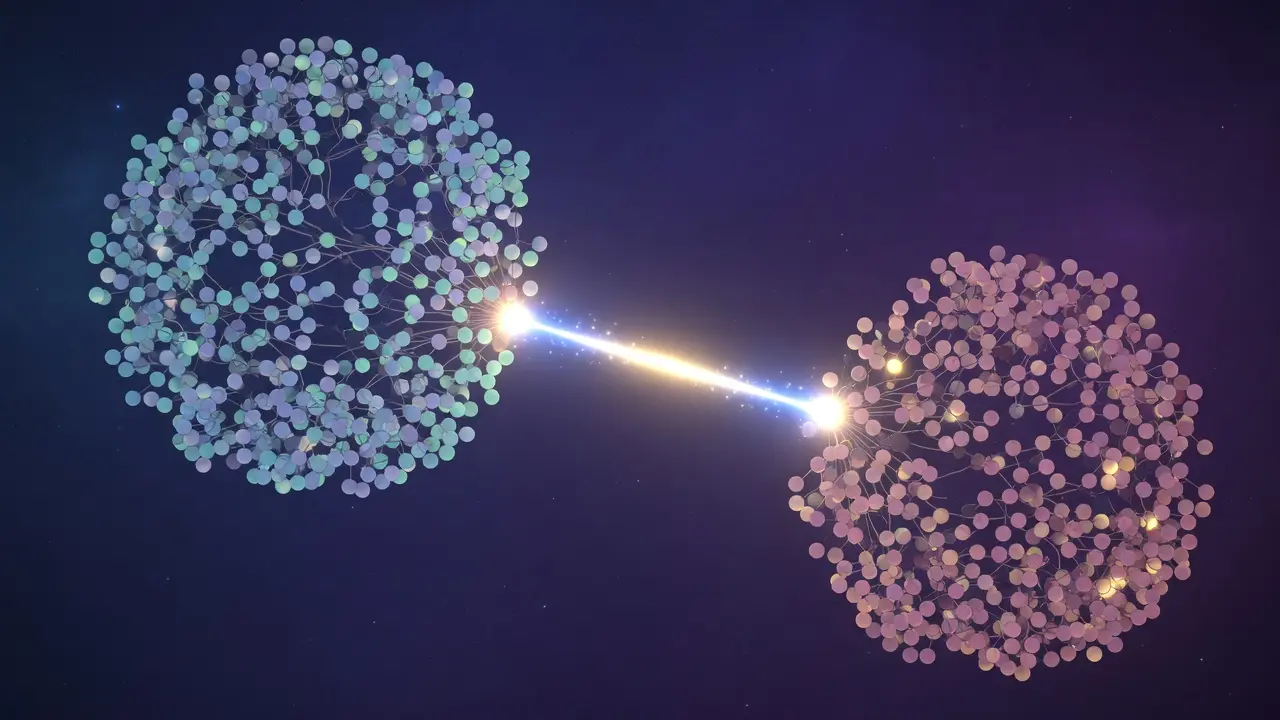
Long-range, genuine multipartite entanglement (GME) between distant parties forms a key resource for distributed quantum information processing. Controlling short-range GME states within a network using stochastic local operations aided by classical communication (SLOCC) establishes long-range GME between chosen target nodes when needed.
Optimising these multipartite entanglement distribution protocols while considering network structure, target node selection, and limited resources presents a vital challenge to effective resource management. A recent study involving researchers from Indian Institute of Technology Bombay, Okinawa Institute of Science and Technology Graduate University, and Delft University of Technology demonstrates a new set of tools that enable this optimisation.
Multipartite Entanglement Surpasses Previous Limits with Optimised Quantum Repeaters
Genuine multipartite concurrence (GMC), measuring complex quantum correlations among multiple parties, has increased from one to values exceeding three within networks utilising Dür, Cirac, Tarrach states. This breakthrough surpasses previous limitations that restricted GME distribution to specific network designs and simple resource states. The advancement unlocks access to previously unattainable classes of entanglement while enabling stronger long-range communication protocols for distributed quantum information processing. This was achieved by classifying networking operations into inflation, connecting existing entangled units; deflation; and purification primitives.
A hypergraph models the network as a structure connecting qubits via ‘hyperedges’ representing short-range entangled units, defining operations like inflation which connects adjacent entangled states through stochastic local operations aided by classical communication (SLOCC). Inflating these short-range entangled units cannot create more entanglement than was present in the weakest original unit; for example, even after all inflations are performed on starting states with GMC equal to one, no resulting state can exceed that value. Deflation and purification work alongside inflation allowing systematic construction of multipartite quantum repeater protocols, reducing complexity and enhancing quality respectively.
Optimising multipartite entanglement unlocks advanced secure communication possibilities
This new framework offers systematic optimisation for distributing multipartite entanglement across quantum networks, revealing previously inaccessible classes within Dür, Cirac, Tarrach states but relies upon “a simple example.” This raises an important question: how well does this methodology scale to more complex network architectures or alternative resource states. Despite focusing presently on only one scenario, the demonstration establishes vital groundwork for future exploration; it allows optimisation of these systems and identification of configurations with enhanced long-distance connections between multiple parties, potentially unlocking such capabilities within the decade. They categorized network actions into three core operations: inflation, deflation reducing complexity, and purification enhancing quality. This builds upon an initial classification detailed above by providing practical application to complex systems through systematically building optimised ‘repeater protocols’ that allow distribution of long-distance entanglement under real-world constraints like limited resources or imperfect connections.
Researchers developed an operational framework for managing genuine multipartite entanglement (GME) within quantum networks by categorizing networking operations as either inflating, deflating, or purifying entanglement. The study demonstrates how combining these operations enables the systematic construction of optimized “quantum repeater protocols” for distributing GME across a network, even with resource limitations.
Applying this approach to Dür-Cirac-Tarrach states revealed achievable levels and types of end-to-end GME not previously understood; it provides a method for building scalable systems that connect multiple parties through long-distance entangled links. This work establishes a foundation for further exploration into optimizing complex quantum networks.
👉 More information
🗞 Optimising multipartite entanglement manipulation in quantum networks
✍️ Shashank Shekhar and Siddhartha Santra (Indian Institute of Technology Bombay); David Elkouss (Okinawa Institute of Science and Technology Graduate University)
🧠 ArXiv: https://arxiv.org/abs/2610.21420


See today’s quantum computing news on Quantum Zeitgeist for the latest breakthroughs in qubits, hardware, algorithms, and industry deals.