

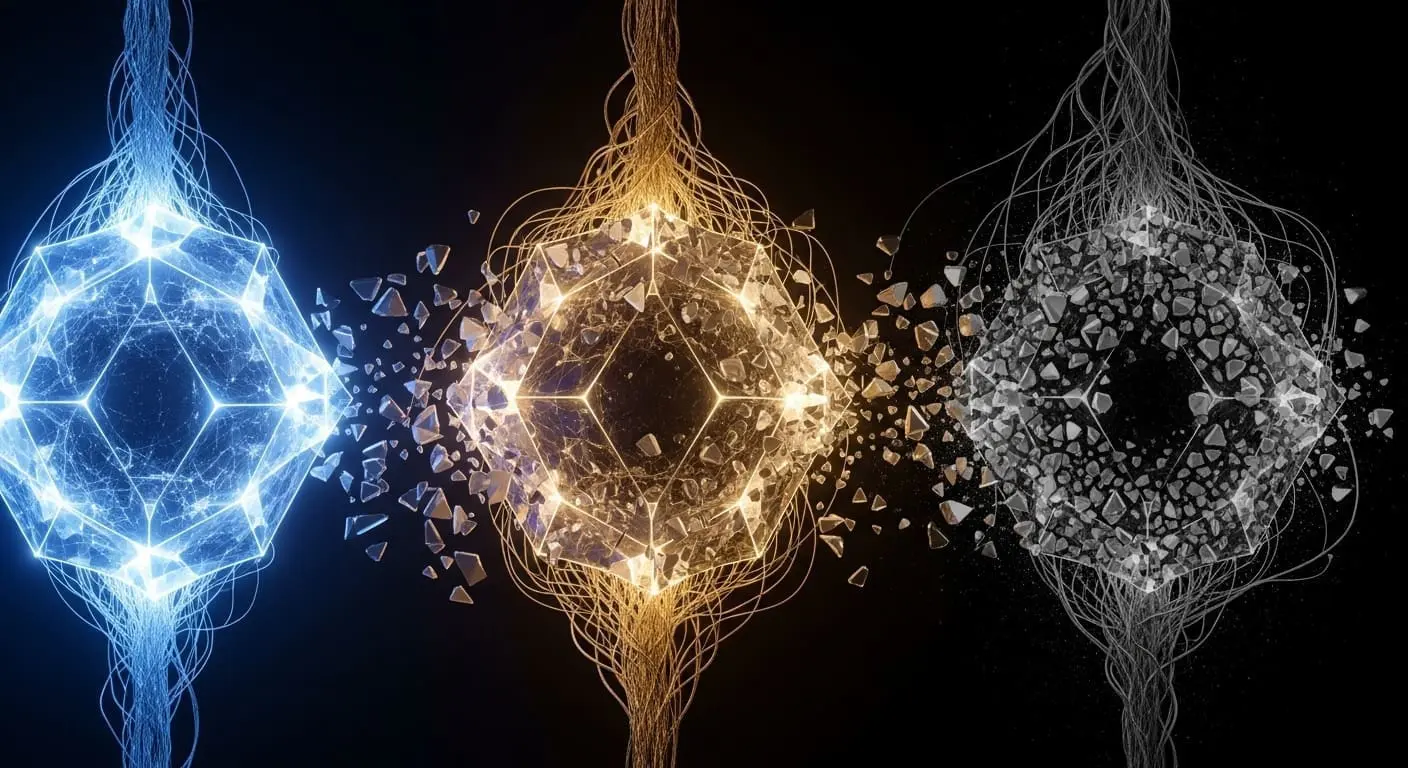
On a lithium niobate chip, genuine quantum interference among four photons has been created for the first time. Previously, establishing these faithful correlations limited itself to two photons; this extends that to three and four, generating coherent multiphoton states. This achievement uses loss and decoherence, typically detrimental to quantum systems, as resources for quantum information processing. A new method for creating complex states involving multiple photons demonstrates extending previous work limited to pairs.
This achieved using loss and decoherence, traditionally considered problematic in quantum physics, as tools to generate these states, a departure from standard techniques. Establishing correlations between four photons is a key technical advance for developing more sophisticated quantum technologies and may lead to improvements in both quantum computing and communication systems. Yifan Du of the Stevens Institute of Technology and colleagues have achieved a breakthrough in manipulating light by creating genuine quantum interference with four photons simultaneously.
This builds on previous work limited to pairs and triplets of photons, opening new avenues for advanced quantum technologies. The team harnessed typically unwanted effects, loss and decoherence, and repurposed them as tools to generate these complex, multi-photon states, a significant departure from conventional approaches. Imagine a special crystal, like a prism splitting white light into a rainbow, but instead splitting a single photon into two lower-energy photons through a process called spontaneous parametric down-conversion. These multiple photons then act as a coordinated group, analogous to a marching band performing in perfect synchronisation, a state known as coherent multiphoton states. The experiment conducted on a lithium niobate chip, and the results raise a vital question: can we routinely engineer loss and decoherence to build more powerful and resilient quantum systems.
Harnessing photon loss to generate strong four-photon entanglement
Faithful correlations among four photons have been established for the first time, exceeding the previous limit of two and representing a key advance in multi-photon quantum systems. This breakthrough crosses a critical threshold, enabling the creation of complex, coherent multi-photon states previously unattainable due to the challenges of maintaining quantum interference with increasing particle numbers. By deliberately introducing loss and ‘decoherence’, typically detrimental effects, into a lithium niobate chip, these phenomena used as resources for generating these states, fundamentally altering conventional approaches to quantum information processing.
The experiment incoherently links two spontaneous parametric down-converters, utilising a highly-lossy channel to create a shared reservoir for photon interaction and demonstrating a new pathway for strong quantum state generation. A lithium niobate chip successfully generated correlations not only between two photons, but also demonstrably among three and four photons simultaneously, actively tuned by altering the phase of the laser pumps driving the down-converters. This level of manipulation extends beyond simple entanglement, offering control over the generated states. While a pathway to strong quantum state generation is now apparent, the current system does not yet indicate scalability beyond four photons, nor does it address the significant engineering challenges required for practical quantum computation. Further investigation will focus on optimising the chip design and exploring methods to increase the number of correlated photons.
Utilising quantum loss to simplify multi-photon generation for scalable quantum technologies
Deliberately utilising quantum effects typically considered detrimental represents a major shift in building future technologies. Conventional quantum research prioritises isolating systems to minimise disruptive decoherence, but this work introduces loss as a tool for generating complex multi-photon states. Creating correlated photons is fundamental to advances in quantum computing and secure communication, and existing methods demand painstaking isolation of quantum systems, adding cost and complexity.
This research offers a radically different approach, actively using loss to generate vital multi-photon states, potentially simplifying future device fabrication and operation. Researchers now embrace this approach to forge connections between multiple photons, utilising a lithium niobate chip to link converters and generate correlated states. Multi-photon interference has been demonstrated, establishing a new method for generating coherent quantum states and creating correlations between photons via a shared reservoir of energy, differing from techniques that attempt to isolate and protect quantum information. However, demonstrating scalability beyond just four correlated photons remains a significant hurdle, as extending this technique to substantially larger numbers of entangled photons presents a considerable challenge.
The researchers successfully created correlated states involving two, three, and four photons by utilising loss and decoherence, typically seen as obstacles in quantum technologies. This demonstrates a new method for generating multi-photon interference, where photons are linked through a shared energy reservoir on a lithium niobate chip. This approach offers a potentially simpler pathway to creating the multi-photon states essential for quantum computing and communication, as it actively uses loss instead of attempting to eliminate it. Further work will focus on optimising the chip design and increasing the number of correlated photons that can be generated.
👉 More information
🗞 Decoherence-induced Multiphoton Interference
🧠 ArXiv: https://arxiv.org/abs/2604.05422



See today’s quantum computing news on Quantum Zeitgeist for the latest breakthroughs in qubits, hardware, algorithms, and industry deals.



