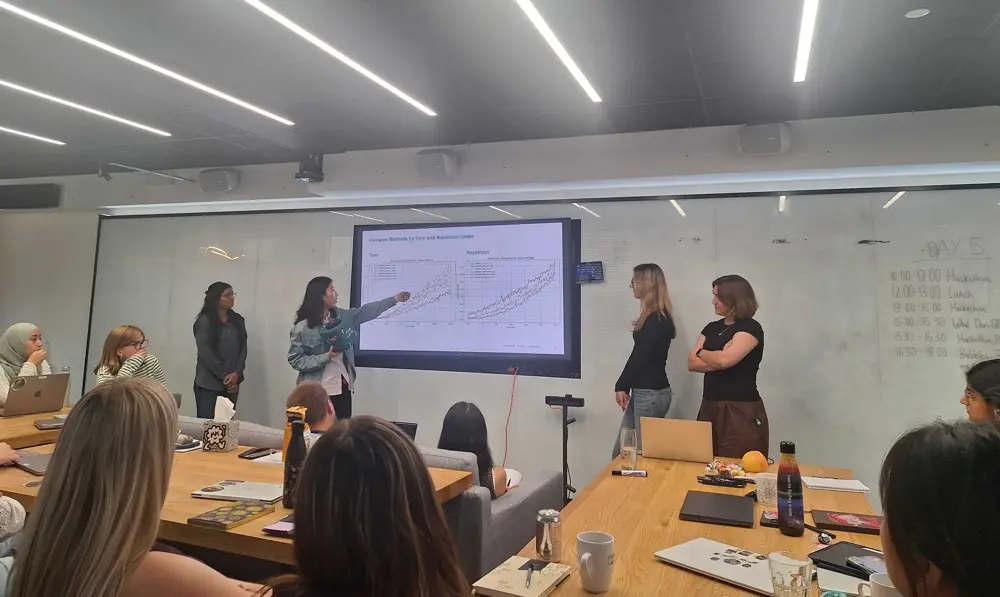
With just one in 54 applicants for quantum roles identifying as women, the emerging field faces a significant gender disparity as it rapidly expands. The UK Quantum Skills Taskforce projects 840,000 new quantum computing roles globally by 2035, intensifying the need to broaden the talent pool. Riverlane’s Bertha Swirles QEC Workshop offers one pathway to inclusion, recently leading Tamsin Sandhu from attendee to Associate Research Engineer at the company; “The hackathon is probably the thing that stayed with me most,” she says, “It was the first taste of what you would actually work on.”
Bertha Swirles QEC Workshop Addresses Quantum Skills Gap
Riverlane’s Bertha Swirles QEC Workshop actively addresses the gender imbalance within quantum computing, with over a quarter of workshop alumni transitioning into quantum-related roles in industry, academia, or postgraduate study. The workshop’s structure intentionally moves beyond theoretical instruction, offering participants direct exposure to the realities of working at Riverlane through shared meals, informal talks and collaborative problem-solving sessions. The programme’s design prioritises inclusivity, explicitly targeting women undergraduates, recent graduates, and postgraduates with backgrounds in mathematics, physics, computer science, and engineering.
“Everyone here has a different degree and a different background, but there’s a way all of you could contribute to a company like Riverlane,” explains a Riverlane representative, highlighting the workshop’s focus on transferable skills and diverse perspectives. This approach is further reinforced by the mentorship component, pairing each participant with a Riverlane employee for one-to-one career guidance and practical CV advice.
The workshop’s aim, according to Riverlane, is to empower potential candidates by stating, “Don’t be worried that you don’t have the qualifications or the insight yet.” A key element of the workshop is a two-day hackathon, designed to immerse participants in a real-world technical challenge.
Riverlane emphasizes that the workshop is a pathway for individuals to explore their potential, stating, “The aim of the workshop is to say: you are capable, and there are ways you can use the skills you already have.” The company believes this approach is essential to meet the growing demand for talent, as they “need you to progress the vision that we have.”
The hackathon is probably the thing that stayed with me most.
Tamsin Sandhu, Associate Research Engineer at Riverlane
Workshop Curriculum: From Quantum Basics to Decoder Hackathon
The workshop curriculum deliberately progresses beyond introductory theory, culminating in a hands-on experience with a functioning quantum device. Participants spend the final two days of the five-day program building and refining a decoder using Riverlane-provided code, then presenting their findings in a team hackathon format. This intensive approach is intentional; Riverlane scientists and engineers actively engage with the teams, posing questions and collaboratively troubleshooting problems.
The hackathon’s design aims to simulate a realistic work environment, providing a preview of the challenges and collaborative spirit found within the company. The program’s structure begins with foundational quantum concepts, moving through repetition codes, quantum error correction circuits and the classical algorithms that interpret error data. Sessions are led by Riverlane personnel from diverse departments, including high-performance computing, quantum hardware, research, engineering and even legal counsel.
The aim of the workshop is to say: you are capable, and there are ways you can use the skills you already have.
Tamsin Sandhu, Associate Research Engineer at Riverlane
Riverlane Workshop Fosters Career Pathways for Women
The workshop’s design prioritises practical skill-building, with participants tackling a realistic technical problem during a two-day hackathon simulating a professional work environment. This cross-departmental exposure illustrates that contributions to quantum computing extend beyond traditional physics and engineering roles, encouraging a more inclusive view of the field’s talent needs. The collaborative atmosphere within Riverlane proved particularly appealing to Sandhu, who noted the positive impact of the team dynamic. Riverlane intends the workshop to convey a clear message. Individuals possess the capability to contribute to quantum computing, and the programme provides the necessary foundation to do so.
I very quickly felt that this was an environment I’d like to work in.
Post-Workshop Outcomes: Alumni Transition to Quantum Roles
The demand for a skilled quantum workforce is intensifying, with the UK Quantum Skills Taskforce projecting 250,000 new roles globally by 2030 and a further 840,000 by 2035. Riverlane’s Bertha Swirles QEC Workshop actively seeks to broaden participation, not simply by raising awareness, but by equipping participants with foundational skills and a pathway to employment, the company says. The programme’s curriculum moves rapidly from introductory quantum computing concepts to the intricacies of repetition codes, circuits and quantum error correction decoders.
The workshop’s impact extends beyond theoretical knowledge, offering a preview of the practical challenges within a quantum computing company. Tamsin, who completed a Master’s in applied maths and quantum physics, found the experience particularly valuable despite prior internship work in photonics.
This exposure, combined with the programme’s emphasis on foundational concepts, proved instrumental in building confidence among participants lacking extensive prior experience. “That is what the workshop is there to give you.” Riverlane frames the workshop as a means to help people realize their potential, believing a diverse workforce is essential to realizing the full scope of quantum computing’s progress. The company views attracting a wider range of talent not merely as a matter of equity, but as a necessity for driving innovation and achieving ambitious goals in quantum error correction.
Don’t be worried that you don’t have the qualifications or the insight yet.



See today’s quantum computing news on Quantum Zeitgeist for the latest breakthroughs in qubits, hardware, algorithms, and industry deals.