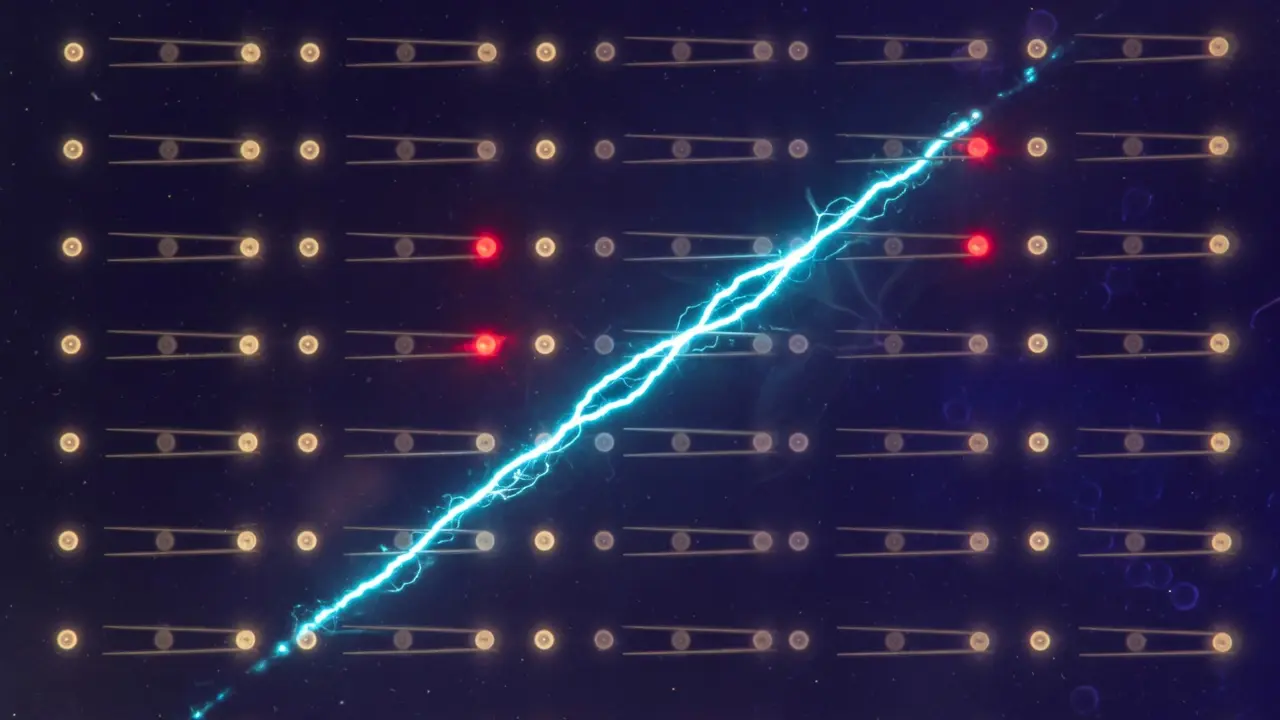
Quantinuum reports achieving 99.9995% logical fidelity on its Helios computer, a new world record representing just five errors in a million operations. This result, ten times lower than the company’s September 2026 record and one hundred times lower than Google Quantum AI’s best published result, validates Quantinuum’s approach to building a universal fault-tolerant quantum computer, the company says. “With this result, we’ve proven that we have the error-correction architecture and trapped-ion technology required to achieve universal fault-tolerance,” says Dr. Rajeeb Hazra, CEO of Quantinuum, as the company remains on track for its 2029 Apollo target.
Helios Achieves 99.9995% Logical Fidelity with Error Correction
99.9995% logical fidelity, translating to just five errors per million operations, a new world record in quantum error correction. This result surpasses the company’s previous record set in September 2026 and significantly outperforms the best published results from other hardware platforms, including a superconducting system demonstrated by Google Quantum AI, according to Quantinuum. The achievement hinges on Quantinuum’s error-correction architecture and trapped-ion technology, which are rapidly improving the accuracy of quantum computations.
The latest study employed a “color code” within that architecture, yielding a logical qubit nearly 100 times better than its component physical qubits. This advancement is particularly notable because Quantinuum demonstrated these gains using the same Helios hardware as its September record, showing the adaptability of its system. The company’s ability to rapidly prototype different error-correction codes, Helix and now color code, allows optimization for specific strengths in accuracy, efficiency and speed, a key factor in scaling quantum computing.
This improved fidelity brings Quantinuum closer to its 2029 goal of realizing Apollo, a universal fault-tolerant quantum computer. A scaled-up version of the current system could achieve the reliability needed for useful computation with fewer than a million physical qubits, a threshold previously considered challenging.
“We have reduced error rates tenfold in rapid succession using a different code on the same commercial hardware, demonstrating the flexibility of our error-correction architecture,” the company reports. This flexibility, combined with the demonstrated accuracy, reinforces the viability of Quantinuum’s path toward commercial quantum computing and the potential to unlock value at scale, according to the company.
With this result, we’ve proven that we have the error-correction architecture and trapped-ion technology required to achieve universal fault-tolerance.
Dr. Rajeeb Hazra, CEO of Quantinuum
Quantinuum’s Architecture Scales Error Suppression via Code Distance
Demonstrating a direct relationship between the distance of its error-correction code and the suppression of errors in quantum computations, a finding important for scaling the technology, Quantinuum’s latest experiments achieve this result. This achievement builds on prior work using the Helix code, demonstrating the adaptability of Quantinuum’s approach to error mitigation, the firm reports. The significance of this result extends beyond a new record; it validates the underlying architecture and trapped-ion technology as a viable path toward fault-tolerant quantum computing.
This means that as the system grows, the ability to maintain accuracy improves at an accelerating rate. The company’s findings suggest that different applications may benefit from different codes as systems progress toward full fault-tolerance.
The paper demonstrates real, serious performance gains from quantum error correction, a logical qubit nearly 100x better than its component physical qubits.



See today’s quantum computing news on Quantum Zeitgeist for the latest breakthroughs in qubits, hardware, algorithms, and industry deals.