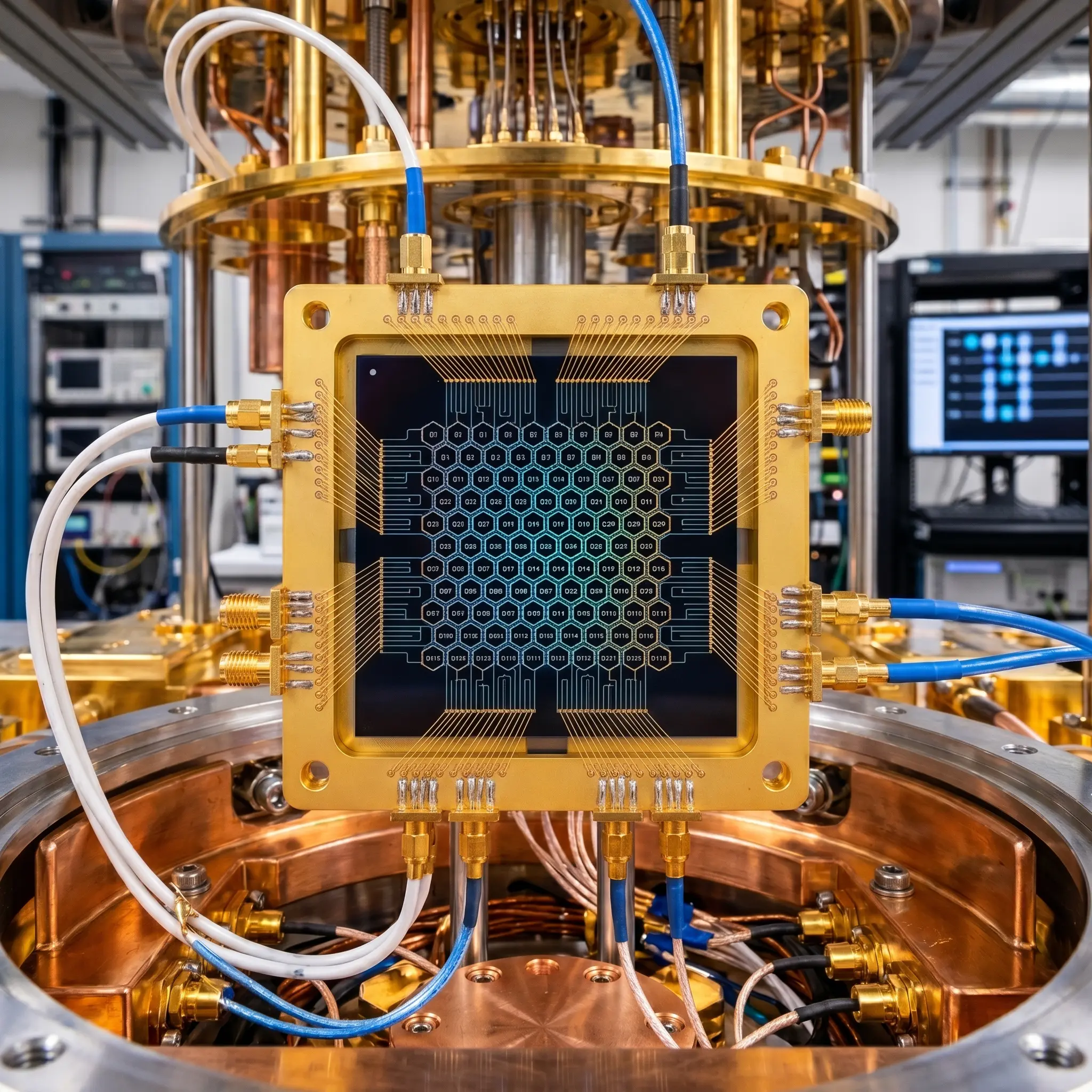
A new Quantum Monte Carlo algorithm developed by Quantum Elements and USC compresses simulations of noisy quantum circuits, offering a solution to a critical bottleneck in the pursuit of fault-tolerant quantum computing. Researchers currently rely on direct density-matrix simulation, a method that becomes impractical as the number of qubits increases; this new approach preserves essential dynamics while dramatically lowering computational resource demands. Tong Shen, quantum research scientist at Quantum Elements and a postdoctoral researcher at USC, co-authored the peer-reviewed paper detailing the algorithm, published in Physical Review Letters. “Fault tolerance will require a much tighter feedback loop between hardware, control, simulation and decoding,” says Izhar Medalsy, co-founder and CEO of Quantum Elements, explaining how the technology supports the creation of accurate digital twins for quantum systems.
Quantum Monte Carlo Algorithm Simulates Noisy Quantum Circuits
Published in Physical Review Letters, the Quantum Monte Carlo algorithm offers a significant improvement over existing methods like direct density-matrix simulation, which becomes increasingly unwieldy as the number of qubits grows. Researchers currently face a scaling issue with qubit counts that this approach aims to resolve. The team demonstrated the algorithm’s efficacy by simulating a 97-qubit, distance-7 surface-code syndrome-extraction round, a complex operation essential for quantum error correction. The core benefit of the algorithm lies in its ability to compress simulations without sacrificing the fidelity needed to accurately model quantum dynamics. According to the researchers, a brute-force simulation of the same 97-qubit system would require tracking 497 density-matrix entries, a computationally intensive task; however, the Quantum Monte Carlo-based method completed the simulation in approximately one hour on a single compute node.
This speedup was achieved through a collaboration with Amazon Web Services (AWS), who helped translate the methodology into an architecture leveraging AWS ParallelCluster, enabling horizontal scaling across multiple instances. Michael Brett, Worldwide Go-To-Market Strategy Lead for Quantum Technologies at AWS, said, “This is peer-reviewed evidence of what we demonstrated earlier this year in collaboration with Quantum Elements, and we look forward to leveraging AWS’ classical and quantum compute resources in conjunction with their digital twin technology to accelerate the path towards fault tolerance via quantum error correction.” The development of this algorithm is particularly timely given the increasing focus on quantum error correction as the pathway to building useful quantum systems. Understanding how real-world noise impacts logical performance, and how software and control mechanisms can mitigate these effects, is a major engineering challenge.
This gives us a rigorous algorithmic foundation for building digital twins that capture the noise behavior hardware teams need.
Izhar Medalsy, co-founder and CEO of Quantum Elements



See today’s quantum computing news on Quantum Zeitgeist for the latest breakthroughs in qubits, hardware, algorithms, and industry deals.