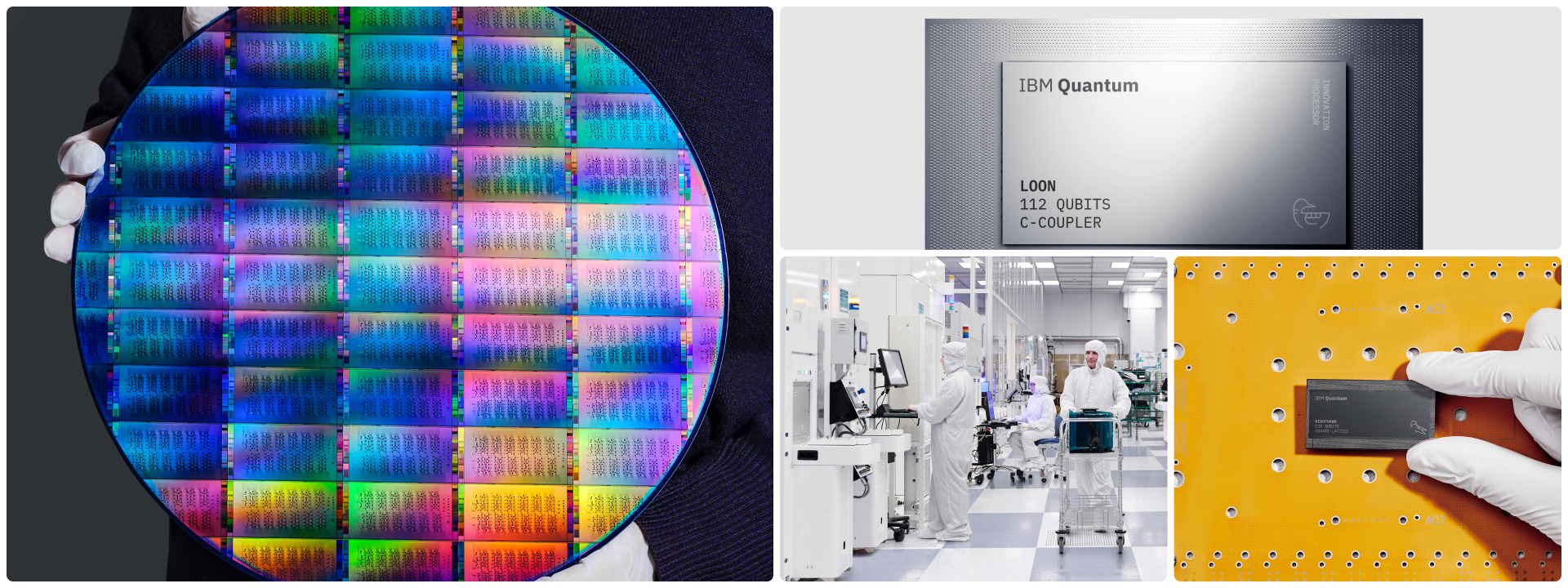
Cameron Cogburn of Rensselaer Polytechnic Institute and colleagues have demonstrated the potential of current quantum hardware by mapping a simplified model of particle physics and tackling a cybersecurity challenge on the IBM Nighthawk processor. In the first demonstrations on this system, researchers successfully mapped (1+1)-dimensional quantum chromodynamics, a version of the theory describing the strong force, allowing them to measure the attractive interaction between particles and probe non-perturbative particle dynamics. A separate effort explored quantum defenses against cyberattacks, using the Quantum Approximate Optimization Algorithm to analyze datasets of up to 110 nodes. These results, stemming from collaboration across the IBM Quantum Network, show that.
QCD₂ Simulation Probes Non-Perturbative Particle Dynamics on Nighthawk
This achievement, detailed in a recent publication, allowed the team to measure the attractive force between excitations resembling baryons, as the researchers report. The experiment, conducted with scientists from Stony Brook University, University of Washington, and Brookhaven National Laboratory, demonstrates a pathway to explore particle interactions that are difficult to model with traditional computational methods. By translating QCD₂ into a spin model, the team leveraged Nighthawk’s quantum processing capabilities to investigate fundamental forces at a subatomic level. This work, alongside a parallel cybersecurity application, highlights the potential of the IBM Quantum Network to foster innovation independent of direct IBM involvement, showcasing scalable frameworks utilizing IBM hardware and opening new avenues for quantum simulation.
QAOA with Honeypot Data Demonstrates Cybersecurity Workloads on IBM QPUs
Converting traffic analysis into a graph optimization problem, the team successfully executed workloads involving datasets of up to 110 nodes on IBM’s ibm_miami (Nighthawk) processor, showing current quantum systems can handle realistic, albeit small-scale, cybersecurity tasks, according to the researchers. These dual demonstrations signify a broadening scope for near-term quantum processors, extending beyond theoretical simulations to address practical challenges in both fundamental science and applied security, and represent an example of how collaboration across the IBM Quantum Network can produce new, scalable frameworks using IBM hardware.
Source: https://arxiv.org/abs/2606.02574




See today’s quantum computing news on Quantum Zeitgeist for the latest breakthroughs in qubits, hardware, algorithms, and industry deals.