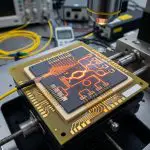
Cryogenic systems are increasingly vital for practical quantum photonic technologies. Alex H. Rubin and colleagues at University of California, in collaboration with University of Cambridge, present a thorough review of the cooling hardware essential for achieving the performance levels demanded by solid-state quantum devices such as colour centres and quantum dots. The review details the evolution of low-temperature engineering, from liquid cryogens to automated closed-cycle systems including flow cryostats, mechanical cryocoolers and dilution refrigerators, offering key technical insights for researchers navigating this rapidly developing field and assessing the future scalability of quantum technology.
Helium isotope separation enables millikelvin temperature attainment
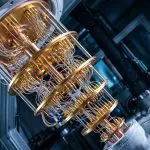
Dilution refrigerators represent a cornerstone of modern cryogenic cooling, developed to overcome the 4.2 K base temperature limit of liquid helium. These specialised cryostats exploit the unique properties of helium-3 and helium-4 mixtures; at extremely low temperatures, these isotopes separate into distinct phases, behaving similarly to oil and water. Continuous energy input maintains this phase separation, creating a cooling effect analogous to evaporative cooling on skin.
A new approach has allowed scientists and the University of Cambridge to surpass the limitations of simple liquid cryogen cooling, achieving temperatures in the millikelvin range. This advancement enables more precise control over sensitive solid-state quantum devices, such as colour centres and quantum dots. Millikelvin temperatures are now routinely achieved using dilution refrigerators, avoiding the practical drawbacks of manually handling liquid cryogens and the limitations of early mechanical coolers. Closed-loop systems, including Gifford-McMahon and pulse tube cryocoolers, also deliver cooling power below 4 K, though dilution refrigerators remain essential for the coldest temperatures required by solid-state quantum devices.
Cryogenic cooling unlocks high-brightness single photon emission from quantum dots
Utilising cryogenic cooling has resulted in a tenfold increase in zero-phonon line brightness, rising from a few percent to over 90 percent in quantum dots. Previously, this improvement was impossible due to the dominant influence of phonon interactions, which broadened emission spectra and reduced coherence; suppressing these interactions demands extremely low temperatures. Modern low-temperature engineering routinely reaches temperatures below 3 K, a necessity for maintaining coherence in solid-state quantum devices.
These advances are key to realising bright, identical single photon sources and enabling scalable quantum technologies; system performance is directly linked to the ability to suppress thermal fluctuations. Quantum dots now typically emit 90 percent of their light within the zero-phonon line, a key indicator of emission quality, demonstrating a strong advantage over colour centres which achieve only a few percent. Reduced electron-phonon coupling within the quantum dot structure directly links to this heightened brightness; these nanoscale semiconductors confine charge carriers, creating discrete energy levels and enabling high-quality single photon emission. Furthermore, these quantum dots exhibit transition dipole moments considerably larger than those found in atomic-like colour centres, enabling stronger coupling to optical cavities and waveguides, allowing for more efficient light manipulation. Maintaining cryogenic temperatures, typically around 4 K or below, remains vital for suppressing thermal fluctuations that cause spin dephasing within the quantum dot system.
Addressing helium-3 scarcity and the need for advanced cryogenic techniques
The relentless pursuit of stable qubits demands increasingly sophisticated cryogenic control, essential for harnessing the potential of solid-state quantum devices. While automated cooling systems routinely reach the millikelvin range, enabling brighter single photon sources and improved coherence, the field appears to lack exploration of radically different approaches. Utilising alternative refrigerants to address the looming helium-3 shortage represents a significant, yet largely unaddressed, challenge, extending beyond incremental improvements to existing dilution refrigerators and pulse tube cryocoolers.
Dilution refrigerators, cooling materials to near absolute zero using liquid helium and helium-3, are currently essential for operating many quantum devices; however, reliance on a diminishing resource presents a clear risk. Addressing the dwindling supply of helium-3 is now vital, and exploration of alternative refrigerants will begin to define the next generation of cryogenic systems. The evolution of cooling systems now supports increasingly complex solid-state quantum devices, moving beyond the limitations of manual liquid cryogen handling.
Automated, closed-cycle cryostats have become standard, enabling sustained millikelvin temperatures essential for maintaining qubit coherence and improving the performance of single photon sources. This transition enables more reliable operation and allows for scaling up quantum systems, a critical step towards practical quantum technologies. However, this progress raises questions about long-term sustainability; dependence on helium-3, a finite resource, presents a significant challenge for widespread deployment.
This research detailed the cooling technologies currently used with solid-state quantum devices, noting a reliance on temperatures around 4 K or below to maintain performance. Maintaining these cryogenic temperatures is vital for suppressing thermal fluctuations that impact qubit stability and single photon sources. The review highlights a growing concern regarding the limited supply of helium-3, a key component in dilution refrigerators, and suggests that exploring alternative refrigerants is essential for the future of quantum technology. Automated cooling systems now enable more reliable operation and scaling of these complex devices.
👉 More information
🗞 Cryogenic Systems for Quantum Photonic Technologies: A Practical Review
🧠 ArXiv: https://arxiv.org/abs/2605.12285


See today’s quantum computing news on Quantum Zeitgeist for the latest breakthroughs in qubits, hardware, algorithms, and industry deals.