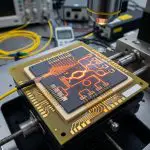
Researchers at CNRS, in collaboration with University of Oslo and Félix-Bloch Institute, led by Félix Cache, have undertaken a detailed investigation of the spin properties of G centres within silicon, providing crucial insights into their behaviour when subjected to optical excitation. Their work elucidates the photo-dynamics underlying the optical detected magnetic resonance (ODMR) response of these centres, identifies optimal parameters for measurement, and demonstrates both coherent spin control and level-anticrossing of the G centre electron spin states. Unveiling this spin degree of freedom represents a vital step towards developing silicon-based quantum memories and registers.
Extended spin coherence and level anticrossing in silicon-based G centres
Spin-coherence times for G centres in silicon have now been extended from previously reported values in the picosecond range to over 300 nanoseconds. Careful optimisation of measurement parameters achieved this substantial improvement, effectively overcoming the limitations encountered in earlier research focused on single G centres and the associated spin-tumbling effects. Spin-tumbling refers to the rapid dephasing of the electron spin due to local magnetic field fluctuations, hindering the maintenance of quantum information. Identifying an optimal pulsed sequence for optical detected magnetic resonance (ODMR) spectroscopy was pivotal, enabling coherent spin control and maximising the readout contrast of the G centre’s electron spin. This is essential for realising robust quantum registers, as a high signal-to-noise ratio is required for accurate state determination. The ODMR technique relies on the principle that microwave radiation enhances the absorption by the electron spin when the sample is illuminated with light of a specific wavelength, allowing for sensitive detection of spin transitions.
Magneto-optical measurements revealed a level-anticrossing of the G centre electron spin states, providing important insights into their energy level structure and enabling more refined manipulation of their spin properties. Level-anticrossing occurs when two energy levels would normally cross as a parameter varies, but instead avoid crossing due to a perturbation. This phenomenon is sensitive to the local environment of the G centre and can be exploited to control its spin. Differential time-resolved photoluminescence experiments further characterised the G centre’s spin dynamics, revealing a laser-assisted deshelving mechanism impacting the population of the metastable spin triplet level. The triplet state is a key component for quantum information storage, and understanding its dynamics is crucial for optimising performance. G centres were created using ensembles formed by co-implantation with carbon ions and protons in silicon-on-insulator wafers. Silicon-on-insulator technology provides a high-quality material with reduced defect density, enhancing the coherence properties of the G centres. While these extended coherence times represent a significant advance, current operation necessitates low temperatures between 4 and 8 Kelvin, and achieving operation at room temperature remains a substantial hurdle. This limitation is due to the increased thermal noise at higher temperatures, which accelerates spin dephasing. Further investigation focused on the influence of this deshelving process on spin readout efficiency, and the impact of ensemble creation methods on the observed coherence, aiming to improve the overall performance and scalability of these quantum systems.
Ensemble coherence informs strategies for single-defect control in silicon quantum computing
Building scalable quantum computers demands precise control at the single-defect level, yet inherent variability between G centres within an ensemble presents a significant challenge. Each G centre is not identical, exhibiting slight variations in its energy levels and response to external stimuli. Despite current limitations in addressing individual defects, coherent spin control within these silicon G centres provides a foundational understanding of their spin dynamics for optimising readout contrast and identifying suitable conditions for quantum information storage. These G centres offer bright light emission in the telecom O-band, around 1300 nanometers, and addressable electron spins, qualities particularly important for potential quantum technologies due to the compatibility with existing fibre optic infrastructure. Maximising readout contrast was achieved by optimising the parameters for optical detected magnetic resonance (ODMR) spectroscopy, a technique utilising light and microwave radiation to ‘listen’ to electron spins. The ODMR signal is directly proportional to the population of the spin states, and maximising this signal is crucial for accurate and efficient readout. Detecting a level-anticrossing of the G centre electron spin states further clarifies their complex energy structure, opening avenues for tailored spin control and offering a deeper understanding of the energy level structure revealed by magneto-optical measurements. This detailed understanding allows for the development of more sophisticated control schemes, enabling precise manipulation of the spin states. The ability to control and manipulate these spin states is fundamental to the operation of a quantum computer, allowing for the encoding and processing of quantum information. The research highlights the potential of G centres as building blocks for future quantum devices, paving the way for advancements in quantum computing and communication technologies.
The research successfully demonstrated coherent spin control and characterised the spin-coherence properties of ensembles of G centres in silicon. Understanding the spin dynamics of these defects is important because it addresses a key challenge in building scalable quantum computers, namely variability between individual G centres. Researchers identified an optimal pulsed sequence for measuring the optical detected magnetic resonance (ODMR) spectrum, and detected a level-anticrossing of the electron spin states. These findings unveil the spin degree of freedom of the G centre, opening new possibilities for developing quantum memories and registers based on silicon colour centres.
👉 More information
🗞 Optical detection of the electron spin resonances of G centers in silicon
🧠 ArXiv: https://arxiv.org/abs/2605.12473


See today’s quantum computing news on Quantum Zeitgeist for the latest breakthroughs in qubits, hardware, algorithms, and industry deals.