Researchers at Tsinghua University have created AIGP, a new artificial intelligence framework capable of generating high-fidelity metasurface designs in seconds. Unlike traditional methods that rely on computationally intensive simulations like finite-difference time-domain methods, AIGP directly translates desired optical properties into fabricable subwavelength structures. The system utilizes transmission, phase, and polarization as prompts to map specifications to designs, overcoming limitations inherent in modeling these structures, whose scale prevents analysis with conventional optics. According to the scientists, “First, it achieves high-precision mapping, converting full-band transmission spectra, phase profiles, and polarization responses into corresponding sixty-four structural-color meta-atoms within seconds, all ready for immediate fabrication,” potentially enabling large-scale, AI-driven generative optical devices.
Diffusion Model Enables Direct Mapping of Optics to Metasurfaces
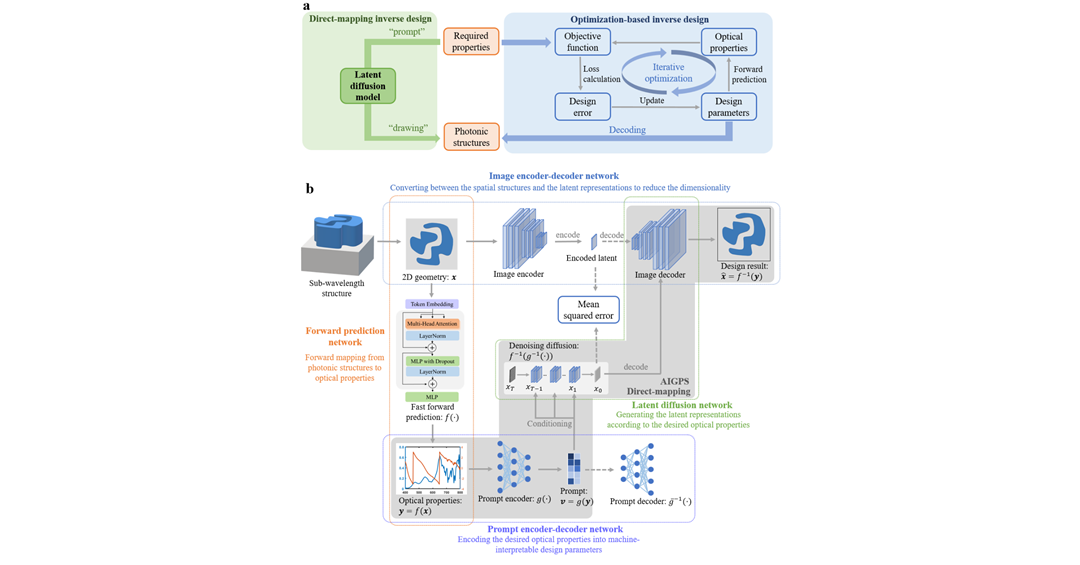
A new artificial intelligence framework is capable of designing functional metasurfaces in a matter of seconds, a speed previously unattainable with conventional methods reliant on intensive computational simulations. Researchers at Tsinghua University have unveiled AIGP, a diffusion-based generative framework that bypasses iterative optimization processes by directly translating desired optical properties into fabricable designs. Unlike traditional approaches limited by predefined structure libraries, AIGP interprets specifications like transmission, phase, and polarization as prompts, effectively allowing the AI to create photonic structures with remarkable precision. This innovation addresses a long-standing challenge in the field of subwavelength optics; structures such as photonic crystals and metasurfaces, due to their nanoscale dimensions, cannot be accurately modeled using standard analytical techniques. Previous inverse design methods, while capable of generating high-performing structures, depended on computationally expensive algorithms like finite-difference time-domain methods, hindering large-scale development. The team developed a novel encoding scheme for optical properties and a dedicated prompt encoder network to provide a flexible interface for on-demand design. Experimental validation on a silicon-on-sapphire platform demonstrated AIGP’s capabilities, successfully fabricating sixty-four structural-color meta-atoms.
AIGP Framework Resolves Non-Uniqueness & Design Constraints
Existing methods for designing subwavelength photonic structures, like photonic crystals and metasurfaces, have long been hampered by computational limitations and inherent design challenges. Traditional approaches relying on simulations such as finite-difference time-domain methods are extraordinarily time-consuming, while iterative optimization algorithms struggle with convergence and identifying the best possible designs. These structures, scaled below the wavelength of light, defy modeling with conventional optics, necessitating entirely new design strategies. Researchers at Tsinghua University addressed these issues with the development of AIGP, an artificial intelligence-generated photonic framework that bypasses iterative design. This allows for flexible, on-demand photonic design, generating high-fidelity results within seconds, all ready for immediate fabrication. Crucially, the framework incorporates a comprehensive training dataset of freeform shapes, proactively filtering out designs that would be impossible to manufacture. The scientists highlight three core advantages: beyond speed, AIGP supports flexible design constraints, enabling polarization-insensitive device generation via C4 symmetry and allowing band-specific masking to adapt to diverse design goals. The system exhibits approximating ideal performance even with incomplete or abstract requirements, demonstrating a significant leap forward in AI-driven photonic innovation.
Silicon-on-Sapphire Validation: Generating & Fabricating Meta-Atoms
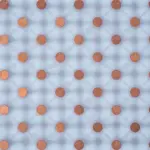
Researchers are increasingly turning to artificial intelligence to overcome limitations in designing nanoscale optical components, and recent work at Tsinghua University demonstrates a significant leap forward in this area. Rather than relying on traditional, computationally expensive methods like finite-difference time-domain simulations, the team has validated a new approach using a silicon-on-sapphire platform to directly generate and fabricate meta-atoms with unprecedented speed. The core of this innovation is AIGP, a diffusion-based generative framework that interprets desired optical characteristics, specifically transmission, phase, and polarization, as prompts for creating physical structures. This direct mapping circumvents the need for iterative optimization, a common bottleneck in photonic inverse design. Experimental results published in Light: Advanced Manufacturing showcase AIGP’s capabilities; sixty-four structural-color meta-atoms were directly generated and fabricated on a 230 nanometer silicon layer, successfully encoding a sunflower image.
The speed and accuracy of AIGP are particularly notable given the difficulty of modeling subwavelength structures, where conventional geometric and wave optics break down. Beyond the sunflower image, the method’s versatility was confirmed through successful fabrication of bandpass filters, polarization beam splitters, and multi-wavelength phase modulators, suggesting a new paradigm for photonic innovation and a move toward large-scale, AI-driven device creation. References DOI /lam. Original Source URL https://doi.org/ /lam.




See today’s quantum computing news on Quantum Zeitgeist for the latest breakthroughs in qubits, hardware, algorithms, and industry deals.